





A Virginia legislative commission on marijuana has unveiled a much-anticipated proposal to legalize recreational marijuana sales that it is recommending lawmakers pass during the 2026 session. And with an incoming governor supportive of the cannabis reform, advocates are optimistic that the plan could come fruition.
After months of hearings and debate, the legislature’s Joint Commission to Oversee the Transition of the Commonwealth into a Cannabis Retail Market released a framework for an adult-use marijuana program at its final meeting on Tuesday.
Since legalizing cannabis possession and home cultivation in 2021, Virginia lawmakers have worked to establish a commercial marijuana market—only to have those efforts consistently stalled under outgoing Gov. Glenn Youngkin (R), who twice vetoed measures to enact it that were sent to his desk by the legislature.
Once the next legislative session begins in January, the new proposal is expected to be sponsored by Del. Paul Krizek (D), who has served as chair of the commission, as well as Sens. Louise Lucas (D) and Aaron Rouse (D).
Notably, the latest version of the recommended legislation omits language from previous measures that would’ve allowed local jurisdictions to opt out of allowing marijuana businesses within their borders, while also increasing the authority of local governments to levy taxes and promoting a licensing structure that prioritizes small businesses.
“Our commission has worked very diligently to review existing law and develop a bill that will not only establish a much needed adult-use retail market here in Virginia, but also reflect what Virginians wanted to be. And we’ve listened to you,” Krizek said in opening remarks on Tuesday.
The panel didn’t release the text of a finalized bill it wants the legislature to pass—as staff are still making tweaks based on members’ input—and instead posted a seven-page document outlining changes from a bill that advanced last session.
“Our goal has been to listen, and I think we have. And so this bill hopefully has a little for everybody,” Krizek said. “It builds a new market that supports hundreds of small businesses and strengthens Virginia agriculture, reduces the racial disparities created by the prohibition on marijuana and, most importantly, protects public safety and health.”
Sen. Lashrecse Aird (D), the vice chair of the panel, echoed those points, stating that the commission “has taken the feedback that has been shared through various stakeholders. You will hear support for some of those recommendations, and you will hear continued opposition to some of those recommendations, but this is what they are.”
“They are simply recommendations that will continue to be a fluid—continue to be assessed and further work all the way through this process, as well as the legislative process,” she said. “But I hope that what this matrix reveals today is a responsive attempt to try to take all of the feedback that has been received and structure it into a process and a framework that we can work from in a more collective way.”
Krizek and Aird—alongside fellow commission member Rep. Will Morefield (R)—also laid out their thinking on the cannabis rgulatory framework in an op-ed published by Cardinal News on Monday.
The lawmakers wrote that they “want retailers to reflect the character and essence of the communities they locate in.”
“That’s why any legislation that removes the opt-out option will also allow local governments to maintain full zoning authority, set operational guidelines, review local business licensing and set buffer distances from schools and houses of worship,” they said.
“We get one chance to get this right. Virginia has gone on too long in a state of confusion created by an unfinished cannabis law,” the legislators said. “No matter where a person lives, whether it’s in rural, urban or suburban Virginia, they deserve access to cannabis should they choose to use it, and without fear of contaminated products that put their health, safety and well-being at risk.”
“There is only one way to do that, and it’s with a law that establishes a retail marketplace for adults that protects consumers and children, allows equitable and fair participation and access in that marketplace, supports law enforcement and fulfills the promise of true legalization,” they said.
Here’s what Virginia’s marijuana sales legislation as passed last year would have done:
- Retail sales could begin as of May 1, 2026.
- Adults would be able to purchase up to 2.5 ounces of marijuana in a single transaction, or up to an equivalent amount of other cannabis products as determined by regulators.
- A tax of up to 11.625 percent would apply to the retail sale of any cannabis product. That would include a state retail and use tax of 1.125 percent on top of a new marijuana-specific tax of 8 percent. Local governments could levy an additional 2.5 percent.
- The Virginia Cannabis Control Authority would oversee licensing and regulation of the new industry. Its board of directors would have the authority to control possession, sale, transportation, distribution, delivery and testing of marijuana.
- Local governments could ban marijuana establishments, but only if voters approve an opt-out referendum.
- Locations of retail outlets could not be within 1,000 feet of another marijuana retailer.
- Cultivators would be regulated by space devoted to marijuana cultivation, known as canopy size. Both indoor and outdoor marijuana cultivation would be allowed, though only growers in lower tiers—with lower limits on canopy size—could grow plants outside. Larger growers would need to cultivate plants indoors. Secure greenhouses would qualify as indoor cultivation.
- Only direct, face-to-face transactions would be permitted. The legislation would prohibit the use of other avenues, such as vending machines, drive-through windows, internet-based sales platforms and delivery services.
- Existing medical marijuana providers that enter the adult-use market could apply to open up to five additional retail establishments, which would need to be colocated at their existing licensed facilities.
- Serving sizes would be capped at 10 milligrams THC, with no more than 100 mg THC per package.
- No person could be granted or hold an interest in more than five total licenses, not including transporter licenses.
- People with convictions for felonies or crimes involving moral turpitude within the past seven years would be ineligible to apply for licensing, as would employees of police or sheriff’s departments if they’re responsible for enforcement of the penal, traffic or motor vehicle laws of the commonwealth.
- An equity-focused microbusiness program would grant licenses to entities at least two-thirds owned and directly controlled by eligible applicants, which include people with past cannabis misdemeanors, family members of people with past convictions, military veterans, individuals who’ve lived at least three of the past five years in a “historically economically disadvantaged community,” people who’ve attended schools in those areas and individuals who received a federal Pell grant or attended a college or university where at least 30 percent of students are eligible for Pell grants.
- A “historically economically disadvantaged community” is defined as an area that has recorded marijuana possession offenses at or above 150 percent of the statewide average between 2009 and 2019.
- Tax revenue from the program would first cover the costs of administering and enforcing the state’s cannabis system. After that, 60 percent of remaining funds would go toward supporting the state’s Cannabis Equity Reinvestment Fund, 25 percent would fund substance use disorder treatment and prevention, 10 percent would go to pre-K programs for at-risk children and 5 percent would fund a public health and awareness campaign.
- Adults could also share up to 2.5 ounces with other adults without financial remuneration, though gray-market “gifting” of marijuana as part of another transaction would be punishable as a Class 2 misdemeanor and a Class 1 misdemeanor on second and subsequent offenses.
- A number of other new criminal penalties would be created. Knowingly selling or giving marijuana or marijuana paraphernalia to someone under 21, for example, would be a Class 1 misdemeanor, punishable by up to a year in jail and a maximum $2,500 fine, as would knowingly selling cannabis to someone reasonably believed to be intoxicated. It would also be a Class 1 misdemeanor to advertise the sale of marijuana paraphernalia to people under 21.
- Knowingly obtaining marijuana on behalf of someone under 21 would be a Class 1 misdemeanor.
- People under 21 who possess or use marijuana, or attempt to obtain it, would be subject to a civil penalty of no more than $25 and ordered to enter a substance use disorder treatment and/or education program.
- Illegal cultivation or manufacture of marijuana, not including legal homegrow, would be a Class 6 felony, punishable by up to five years imprisonment and a $2,500 fine.
- People could process homegrown marijuana into products such as edibles, but butane extraction or the use of other volatile solvents would be punishable as a Class 1 misdemeanor.
As recommended by the joint commission, here’s how the bill would change for 2026:
- Retail sales would begin as of November 1, 2026.
- Local government could not opt out of allowing marijuana businesses to operate in their area.
- Localities wold have greater tax authority, however. They could impose up to a 3.5 percent local tax on marijuana sales, compared to a 2.5 percent cap in prior bills.
- Cannabis retailers could not operate within one mile of each other, rather than 1,000 feet as the original bill stipulated.
- The bill would create a “direct-to-consumer” license allowing micro-businesses to deliver their products to adult-use customers’ homes.
- Existing medical cannabis operators could have up to nine dispensaries for adult sales, if they pay a $10 million licensing conversion fee.
- Top-tier marijuana cultivator licensees could have a maximum canopy size of 35,000 square feet—half the size of what the original bill proposed.
- All cannabis businesses would have to establish a labor peace agreement with workers.
- Officials would need to explore allowing on-site consumption licenses and permits for cannabis events such as farmers markets.
- Up to 50 percent of initial cannabis licenses would go to micro-businesses. And all types of licensees would be limited to a maximum of five total retail and/or cultivation authorization.
- No sales or transfers of marijuana business licenses could be made without regulators’ approval. Doing so without approval would result in an automatic license suspension.
- Marijuana dispensaries that are operated by pharmaceutical processors would need to keep certain amounts of cannabis for sales that’s produced by micro-businesses or manufacturers owned by people disproportionately impacted by prohibition.
“We’re trying to really make sure that there’s no monopolies and no Big Tobacco, right?” Krizek, the chair of the commission, said at Tuesday’s meeting, referring to ownership limits on licenses. “And so it’s better, in some ways, to be a little tougher with this iteration than not.”
“If it comes back a year from now or two years from now, and it’s problematic, then we revisit the code. We make changes. But it seems to me, it’s more prudent to be the tough parent, if you will,” he said. “And then we can always walk it back a little bit because there’ll definitely be changes that we’ll need to make in the future.”
JM Pedini, development director for the advocacy group NORML and executive director for Virginia NORML, told Marijuana Moment that the group will be “keeping a close eye on those inflated licensing fees and proposed tax rates—ultimately costs which are passed on to and paid for by cannabis consumers, not corporations.”
“NORML will remain steadfast in our advocacy for consumers’ access to cannabis products that are safe, convenient, and affordable,” Pedini said. “Without cannabis consumers, there is no cannabis industry.”
Chelsea Higgs Wise, co-founder and executive director of Marijuana Justice, testified before the commission on Tuesday, expressing concern that the timeline to start sales on November 1 of next year may disproportionately favor existing medical cannabis dispensaries that are able to convert sooner than new applicants could get licensed.
“It would only be the medical folks that are there and able to sell,” she said.
Rouse, one of the sponsors of the newly recommended 2026 proposal, said last month that he’s “very optimistic” about the prospect of advancing legislation to create an adult-use marijuana market in the coming session. That optimism is heightened by the fact that state Democrats widened their House majority, and voters elected a pro-legalization governor, in November.
“Any measure that we can take to find revenue, I’m very optimistic about that approach,” the senator, who has been the lead sponsor of legislation to legalize and regulate adult-use sales that was vetoed by the outgoing GOP governor, said.
“We, in Virginia, have to take every step we can to make sure we can find revenues that strengthen our communities, that strengthens the education process, that puts food on the table, that gets people back to work,” Rouse said.
—
Marijuana Moment is tracking hundreds of cannabis, psychedelics and drug policy bills in state legislatures and Congress this year. Patreon supporters pledging at least $25/month get access to our interactive maps, charts and hearing calendar so they don’t miss any developments.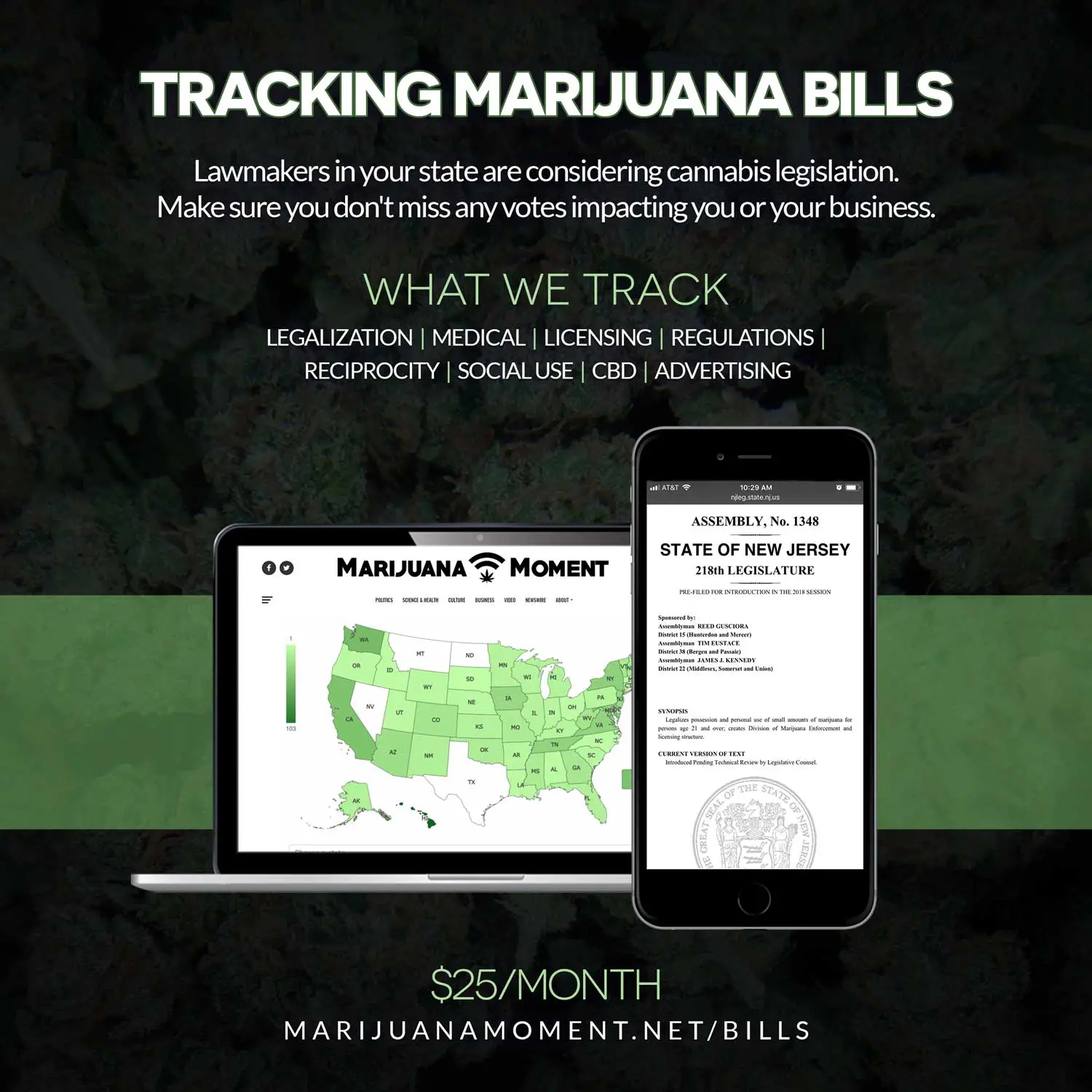
Learn more about our marijuana bill tracker and become a supporter on Patreon to get access.
—
This next session is shaping up to deliver different results. In addition to growing their majority in the Assembly, Democrats now have Abigail Spanberger as the state’s next governor, and the party also secured wins in the Commonwealth’s lieutenant governor and attorney general races.
Spanberger, a former congresswoman, told Marijuana Moment ahead of the election that “as Virginia takes steps toward creating a legalized retail market for cannabis,” the commonwealth “needs a clear strategy to set up a market that is safe for consumers, transparent for businesses, and fair to entrepreneurs.”
She added that “revenue from commercial cannabis products must return to Virginia communities and be reinvested for purposes like strengthening our public schools.”
The governor-elect said she will “work with leaders in the General Assembly to find a path forward that both prioritizes public safety and grows Virginia’s economy”—and that part of that is establishing “a formalized, legal, emerging cannabis market.”
During her time in Congress, Spanberger voted twice on the House floor in support of bills to federally legalize marijuana. She also consistently backed legislation to free up banking services for the industry, protect all state cannabis program from federal interference and expand marijuana research. The former congresswoman additionally opposed a proposal to remove protections for universities that study cannabis.
She voted against certain reform proposals, however, including on measures to lift certain research barriers for Schedule I drugs and to revise federal policy to prevent past marijuana use from being used as a factor to determine eligibility for a security clearance.
Spanberger cosponsored bills to provide medical cannabis access for military veterans on two occasions, and she cosponsored the Secure and Fair Enforcement (SAFE) Banking Act during the 116th Congress.
At the legislative commission’s first meeting in July, members discussing broad regulatory considerations and other issues related to THC potency, the hemp market and more. In August, the panel focused on cannabis taxes and revenue.
Meanwhile, a top Democratic Virginia senator recently said the state should move forward with legalizing recreational marijuana sales—in part to offset the Trump administration’s cuts to federal spending in support of states.
Marijuana Moment is made possible with support from readers. If you rely on our cannabis advocacy journalism to stay informed, please consider a monthly Patreon pledge.