





As President Donald Trump affirms that his administration is “very strongly” considering a proposal to reschedule marijuana, bipartisan senators raised the issue during a hearing with a former state cannabis regulator who testified about the unique challenges federal prohibition imposes on state regulators.
While attention within the cannabis community is largely focused on a potentially historic rescheduling decision by Trump, the Senate Banking Subcommittee on Financial Institutions and Consumer Protection on Tuesday discussed the adjacent issue for the marijuana industry: The lack of banking access for cannabis companies under federal prohibition.
Tyler Klimas—who served as executive director of the Nevada Cannabis Compliance Board (CCB) and was a founding member of the Cannabis Regulators Association (CANNRA) before becoming the founder of Leaf Street Strategies—testified before the panel as the Democratic minority’s witness.
Sen. Catherine Cortez Masto (D-NV), the Democratic ranking member of the panel, said that “we want to make sure that all Americans have a fair access to banking,” and that includes state-regulated marijuana businesses such as those in her state.
“There are so many Nevada business owners who have opened legal cannabis businesses and created jobs across our state,” the senator said, adding that she also hopes Congress will pass a bipartisan bill titled the Secure and Fair Enforcement Regulation (SAFER) Banking Act
“Even if the president reschedules marijuana, that will not address the limits on banking services that are harmful for our Nevada cannabis growers and retailers, as well as others in the cannabis industry across the nation,” she said. “In 2026 I hope we hold more discussions on addressing banking by cannabis businesses and strengthening consumer protection.”
Chairman Thom Tillis (R-NC)—who has stood out among his Republican colleagues as someone who’s backed regulating cannabis to some extent at the federal level—said he “absolutely” agreed with the ranking member that the marijuana banking issue should be addressed.
“I mean, we’ve got to realize that two-thirds of the states have legal cannabis operations—either medicinal or recreational. I’m a free market capitalist,” he said. “Whether or not I agree with a given market activity, if it exists, the federal government should exist to regulate it and also [prevent] bad actions.”
The chairman said, however, that he’s “not quite there on the SAFER Banking Act,” because he feels it serves as a “forcing mechanism for a more comprehensive framework.” And he remains concerned about how to strike the right regulatory balance to permit licensed marijuana businesses to bank while preventing certain industry marketing tactics—such as advertising products that look like Oreos—that might make their products appealing to youth.”
“All of this stuff is Wild Wild West right now,” Tillis said, “and we’ve got to get it under control.”
Klimas, for his part, said in testimony submitted to the subcommittee that “no discussion of this issue is complete without addressing the challenges facing the cannabis industry and the role policy solutions like the SAFER Banking Act can play in addressing them.”
“Today, 40 states and territories have developed regulated cannabis markets, supporting hundreds of thousands of jobs and generating billions in state tax revenue. Yet many of these state-legal businesses continue to struggle to access basic financial services,” he said. “As a result, they remain cash-intensive, creating a significant public safety risk and an economic burden on small and medium-sized businesses that already operate on thin margins.”
He added that the enactment of the SAFER Banking Act would “provide the certainty financial institutions need to serve this growing industry, while also making communities safer and improving transparency and accountability in the marketplace.”
Klimas emphasized that, beyond the financial consequences for state-licensed cannabis businesses, current policy complicates the job for state regulators.
“In Nevada, our regulation of cannabis risked disrupting the state’s entire relationship with its banking partner, forcing us to spend countless hours to find creative workarounds and issue guidance to the industry on what language to avoid putting on payment notices,” he said. “Instances like these are common in other states.”
Noting recent developments at the federal level—with Trump confirming active consideration of rescheduling marijuana from Schedule I to Schedule III of the Controlled Substances Act (CSA)—the former state regulator said the reform would represent a “monumental recognition of the medical benefits of cannabis and an opening of pathways to more research and better public health policy.”
However, “rescheduling alone does not alleviate the current banking challenges nor does it have any impact on safe harbor for financial institutions,” Klimas said. “Congressional action is still needed, perhaps now more than ever.”
(Disclosure: Klimas supports Marijuana Moment’s work via a Patreon pledge.)
He added that without “greater engagement by financial institutions, we are also left with a growing lack of insight and transparency into licensed operators in state markets.”
“This, too, directly impacts public safety. In Nevada, we drew from our world-renowned gaming regulatory model, to implement one of the nation’s most comprehensive cannabis investigations divisions. We understood the importance not only of compliance, but of understanding exactly who was operating in our state industry and ultimately who was profiting from it. While states enjoy incredible insight into supply chains through mandatory tracking systems, reconciling that information with the financials of companies that have difficulty maintaining banking relationships, or deal mainly in cash, makes that job extremely difficult.”
Consequently, “this creates opportunity for bad actors to exploit the lack of transparency and challenges in oversight, simply because we have yet to fill this policy gap,” he said.
Many banks continue to resist accepting even state-licensed cannabis businesses as clients because of the potential risk of federal enforcement action given that marijuana remains a Schedule I drug under the CSA. However, some banks and credit unions have taken that gamble, while following Obama-era reporting guidance to mitigate the risk.
“I understand the desire to put effort behind a more comprehensive federal regulatory framework for cannabis. That is a goal shared with most in this industry,” Klimas said. “But each day we wait on commonsense measures like the SAFER Banking Act, we’re hurting businesses, creating obstacles for employees trying to earn a living, and providing cover for bad actors to persist.”
Notably, the former Nevada official said that the recent enactment of a spending bill containing provisions to recriminalize much of the hemp market means there’s “even greater pressure and urgency on the need for legislation like the SAFER Banking Act,” a bill that prevents federal regulators from penalizing banks simply for servicing licensed cannabis businesses.
“There are thousands of hemp companies that will be thrown into the same turmoil next November when the change in definition goes into effect,” Klimas said.
“Even when financial institutions do enter the space, they take on risk due to that uncertainty, risk that results in high administrative and compliance costs. These costs are then passed on to cannabis businesses in the form of high fees. And for the cannabis businesses that do find banking partners, many must look outside of their state to do so. In many cases, the full suite of banking services a normal business would expect, like lending and credit products, are unavailable to cannabis banking customers, despite the high cost of fees.”
“Businesses that support or engage with the cannabis industry, like industrial suppliers, agriculture vendors, commercial and industrial real estate firms, and even automotive dealers, fall victim to many of the same banking challenges because of their association with cannabis,” he said, concluding that “allowing clear and certain access to the financial system for state-legal cannabis businesses does not amount to the federal legalization of cannabis.”
“Legislation like the SAFER Banking Act enhances and strengthens regulatory oversight and allows financial institutions to rightfully serve businesses in their communities without unnecessary fear or uncertainty,” he said.
The hearing took place about two weeks after a GOP member of the House Financial Services Committee, Rep. Warren Davidson (R-OH), raised the cannabis banking issue with Comptroller Jonathan Gould at a meeting of that panel.
Despite the increased attention to the issue, the prospects of advancing something like the SAFER Banking Act in the near future seem doubtful. Multiple key House and Senate lawmakers told Marijuana Moment last month that the issue has taken a back seat to other legislative priorities.
Sen. Bernie Moreno (R-OH), who is expected the carry the marijuana banking measure in his chamber this Congress, previously said that he imagined the bill would come up over the fall. Those comments came before a historically long government shutdown, however, and the bill has not yet been filed in either chamber for the current session.
Sen. Jeff Merkley (D-OR), who has sponsored the legislation in prior sessions, told Marijuana Moment that the banking issue is among those Congress has put “on the back burner,” with Democrats focused on other priorities such as preserving health care subsidies under the Affordable Care Act.
On the House side, Rep. Lou Correa (D-CA) said “it feels like I’ve heard nothing” about the path forward for SAFE Banking, and he feels “by now we should’ve had some buzz on it.”
The House has passed versions of the legislation seven times over recent sessions. It advanced out of committee in the Senate last Congress, but it was not taken up on the floor.
One of the most proactive anti-cannabis lawmakers on Capitol Hill, Rep. Andy Harris (R-MD), told Marijuana Moment that he’s not sure about the status of the banking bill but he remains of the mind that, “if it’s illegal at the federal level, it should be kept out of the banking system.”
“But it’s the will of the chamber. My position hasn’t changed,” he said. “I don’t hear that [the bill is moving], but it’s been tried before. It may succeed this year. I don’t know.”
The comments from the bipartisan and bicameral lawmakers came about a month after bipartisan senators said they remain eager to advance the marijuana banking measure—though there was disagreement about whether a possible decision from Trump to reschedule cannabis would open the door to passing additional reforms in Congress.
Sen. Steve Daines (R-MT), who’s been the lead GOP sponsor of that banking measure in past sessions, said he’s “not sure absolutely” whether moving marijuana from Schedule I to Schedule III of the Controlled Substances Act (CSA) would meaningfully affect how his colleagues approach the financial services legislation. He said “many senators hold strong opinions,” and “they keep those opinions separate from SAFE Banking.”
Unlike Daines, Sen. Ron Wyden (D-OR) said rescheduling would send a “huge message” to his colleagues about the need to “finally come up with a modern approach” to marijuana laws.
Moreno, for his part, said he did feel that Trump advancing rescheduling would be an “important domino” to advance the bipartisan cannabis banking legislation.
The upcoming House committee hearing comes months after senators on both sides of the aisle addressed the lack of banking access for the marijuana industry at a separate hearing in February, with one GOP member suggesting that the issue warrants a broader examination of federal cannabis policies.
—
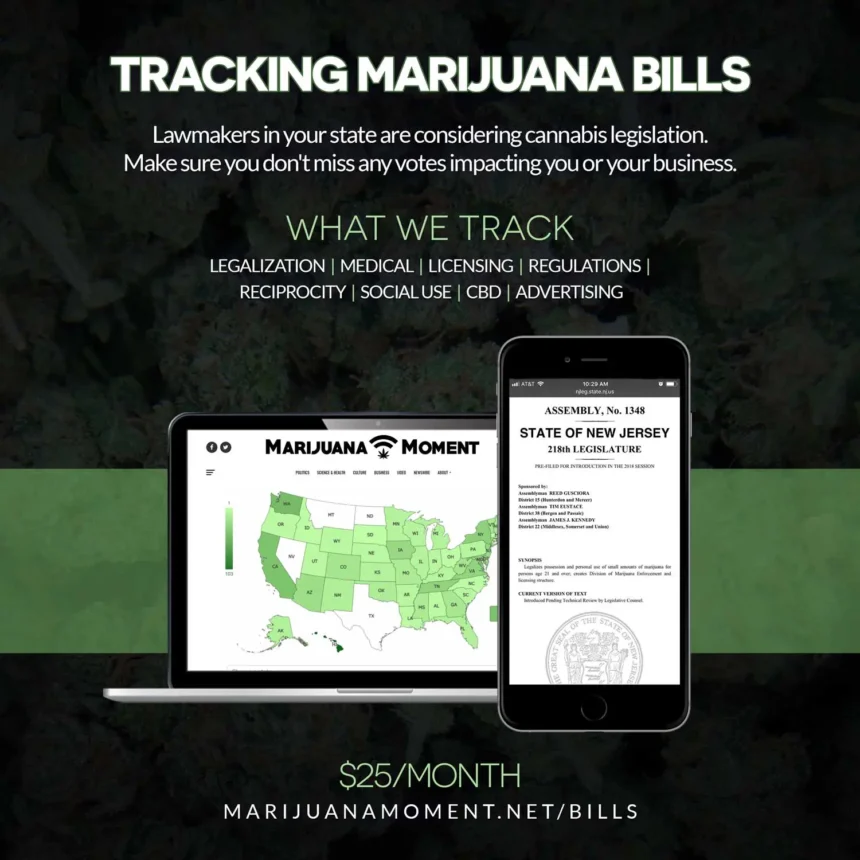
Marijuana Moment is tracking hundreds of cannabis, psychedelics and drug policy bills in state legislatures and Congress this year. Patreon supporters pledging at least $25/month get access to our interactive maps, charts and hearing calendar so they don’t miss any developments.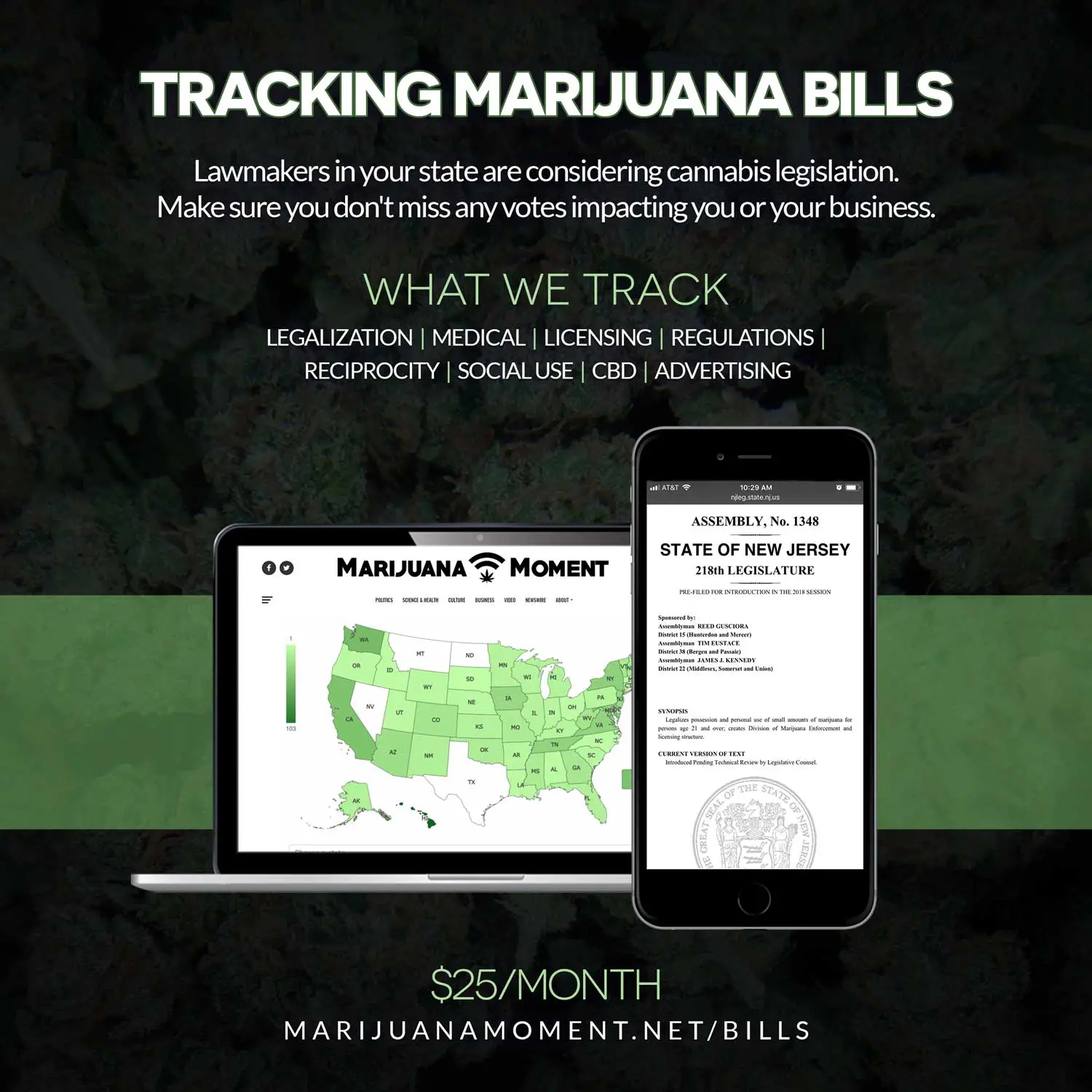
Learn more about our marijuana bill tracker and become a supporter on Patreon to get access.
—
Meanwhile, during a House Appropriations Committee markup in September, Rep. Betty McCollum (D-MN) criticized the exclusion of provisions to protect banks that work with state-licensed marijuana and hemp businesses from a key spending bill.
Relatedly, a bipartisan coalition of 32 state and territory attorneys general from across the U.S. recently called on Congress to pass a marijuana banking bill to free up financial services access for licensed cannabis businesses.
In January, the office of Rep. Dave Joyce (R-OH), who is again leading the effort on the House, told Marijuana Moment that he would be filing the cannabis banking legislation this session but that its introduction was “not imminent” as some earlier reports had suggested.
Marijuana Moment is made possible with support from readers. If you rely on our cannabis advocacy journalism to stay informed, please consider a monthly Patreon pledge.