





Hawaii officials have released a report on the potential economic impact of recreational marijuana legalization in the state, including revenue implications related to domestic and international tourism.
The report from Cannabis Public Policy Consulting—which was commissioned by the Hawaii Department of Health’s (DOH) Office of Medical Cannabis Control and Regulation—looked at a wide range of policy considerations associated with potentially legalizing adult-use marijuana in the state.
All told, researchers said survey data and comparative analyses indicate that Hawaii could see anywhere from $46-$90 million in monthly marijuana sales by year five of implementation, after accounting for a maximum 15 percent tax rate on cannabis products.
The report, which came at the request of regulators last year, also examines how legalization could affect the state’s robust tourism sector, with projections that tourists will contribute upwards of $11.5 million per month “at minimum” if the reform is enacted.
While some lawmakers have previously expressed concern about tourism consequences of legalization, with speculation that Japanese tourists might be less inclined to visit Hawaii, the analysis found that the economic impact would likely be negligible.
“There is anticipated to be minimal loss from Japanese tourists, and gains from Canadian tourists that indicated they would are likely to visit Hawai‘i in the future,” it says. “Perception data from both surveys show that the majority of respondents (57.5 percent in Japan and 64.5 percent in Canada) reported that adult-use legalization would have no influence on their decision to visit Hawai‘i.”
“After balancing the small share who say legalization would make them more likely to visit against those who say it would deter them, the projected net effect is expected to be modest among those anticipating a future visit,” it continues. “In other words, cannabis policy is not a decisive factor in travel decisions for most respondents in either Japan or Canada.”
To meet domestic and international demand for medical and adult-use marijuana, the report suggests the state will need to license at least 65 dispensaries across its various islands.
With respect to Japanese tourists, data from the survey sample signaled “there may be small decrease in visit likelihood from Japanese tourists currently anticipating a visit, although the subset of respondents was small.”
“For most Japanese travelers, cannabis legalization does not appear to be a primary driver of tourism decisions. For those who may be deterred from visiting, the reason for deterrence may be guided by perceived morality of cannabis use, as 16 percent of those who noted it would influence their decision to visit, irrespective of their anticipated travel plans, selected ‘Cannabis use is wrong’ as their reason. Second leading reasons included ‘Cannabis consumption is not legal in Japan and makes me uncomfortable to travel to a location where this activity is legal’ and ‘Legal cannabis makes the destination less safe to travel to.’”
On the other hand, an analysis of Canadian tourism implications for Hawaii if legalization is implemented found “more favorable results” for the state.
“When asked directly whether legalization would influence their decision to visit, the vast majority of respondents (64.5 percent) reported that it would have no influence. Among those who already anticipate visiting Hawai‘i, approximately 52 percent indicated that legalization would not change their plans. Based a small subset of respondents, there may be a positive shift in visit likelihood from Canadian tourists currently anticipating a visit.”
The report also determined that “adult-use cannabis legalization was not significantly associated with a decline nor increase in tourism to Guam for neither Japan nor South Korea.”
Nikos Leverenz, board president of the Drug Policy Forum of Hawaii and member of the Hawaii Alliance for Cannabis Reform (HACR), said in a press release that while the report doesn’t examine potential tax revenue from marijuana sales, “it shows significant demand for cannabis and cannabis products among local and tourist markets.”
“As such, an appropriately regulated adult-use market has the potential to bring tens of millions of additional tax revenue to the state budget each year. This additional funding is even more imperative with ongoing federal budgetary uncertainty,” he said. “An adult use market will kickstart the state’s agricultural sector and augment the state’s tourism sector, which comprises just under one quarter of the state’s GDP.”
“Hawaiʻi is well-positioned to participate in that growing economic sector and the larger national cannabis market once federal law is adjusted to provide for interstate commerce,” Leverenz said. “A regulated adult-use cannabis market is the safer, smarter, and more prosperous policy alternative.”
(Disclosure: Leverenz supports Marijuana Moment’s work via a monthly Patreon pledge.)
In the lead-up to the release of the report, key Hawaii lawmakers this month filed legislation that would put the issue of marijuana legalization on the ballot for voters to decide.
The move comes after repeated efforts to legalize cannabis legislatively in recent sessions have demonstrated momentum but failed before reaching the finish line to be enacted into law.
If the legislature agrees to the new plan, voters would see this on their November ballots:
“Shall the Constitution of the State of Hawaii be amended to:
(1) Authorize individuals aged twenty-one and older to use and possess personal-use amounts of cannabis; and
(2) Require the legislature to enact laws governing the use, manufacture, distribution, sale, possession, regulation, and taxation of cannabis within the State?”
If a majority of voters approved the ballot measure, cannabis legalization would take effect on July 1, 2027.
House Judiciary and Hawaiian Affairs Committee Chairman David Tarnas (D) and Senate Health and Human Services Committee Chair Joy San Buenaventura (D) are the lead sponsors of the new measures. Tarnas’s House proposal has 13 additional cosponsors.
“This is kicking this particular policy decision—very selectively—to the public for a decision,” Tarnas, who has previously sponsored legalization and other marijuana reform bills, said in an interview earlier this month.
While Gov. Josh Green (D) supports legalizing cannabis, and polling has indicated that Hawaiians are ready for the policy change, the new measures signal that the sponsors don’t anticipate that fellow lawmakers will be ready to move forward with a legislative reform this year but may instead be inclined to defer to voters.
Putting the measure on the ballot as a constitutional amendment would require a two-thirds vote in each chamber of the legislature.
That said, Tarnas and San Buenaventura have also filed separate, more traditional statutory cannabis legalization measures for the 2026 session.
House Speaker Nadine Nakamura (D) has acknowledged broad public support for marijuana legalization, but said that some of her chamber’s members from the island of Oahu are not on board with the reform.
Hawaii’s Senate last February narrowly defeated a proposal that would have increased fivefold the amount of cannabis that a person could possess without risk of criminal charges.
Had the measure become law, it would have increased the amount of cannabis decriminalized in Hawaii from the current 3 grams up to 15 grams. Possession of any amount of marijuana up to that 15-gram limit would have been classified as a civil violation, punishable by a fine of $130.
A Senate bill that would have legalized marijuana for adults, meanwhile, ultimately stalled for the session. That measure, SB 1613, failed to make it out of committee by a legislative deadline.
While advocates felt there was sufficient support for the legalization proposal in the Senate, it’s widely believed that House lawmakers would have ultimately scuttled the measure, as they did last February with a legalization companion bill, HB 1246.
In 2024, a Senate-passed legalization bill also fizzled out in the House.
Last year’s House vote to stall the bill came just days after approval from a pair of committees at a joint hearing. Ahead of that hearing, the panels received nearly 300 pages of testimony, including from state agencies, advocacy organizations and members of the public.
Green signed separate legislation last year to allow medical marijuana caregivers to grow marijuana on behalf of up to five patients rather than the current one.
And in July, the governor signed another bill that establishes a number of new rules around hemp products in Hawaii, including a requirement that distributors and retailers obtain a registration from the Department of Health.
Lawmakers also sent a bill to the governor that would help speed the expungement process for people hoping to clear their records of past marijuana-related offenses—a proposal Green signed into law in April.
That measure, HB 132, from Tarnas, is intended to expedite expungements happening through a pilot program signed into law in 2024 by Green. Specifically, it will remove a distinction between marijuana and other Schedule V drugs for the purposes of the expungement program.
The bill’s proponents said the current wording of the law forces state officials to comb through thousands of criminal records manually in order to identify which are eligible for expungement under the pilot program.
Meanwhile, in November, Hawaii officials finalized rules that will allow medical marijuana dispensaries to sell an expanded assortment of products for patients—including dry herb vaporizers, rolling papers and grinders—while revising the state code to clarify that cannabis oils and concentrates can be marketed for inhalation.
The department also affirmed its support for federal marijuana rescheduling—a policy change that President Donald Trump ordered to be completed last month but has yet to come to fruition.
—
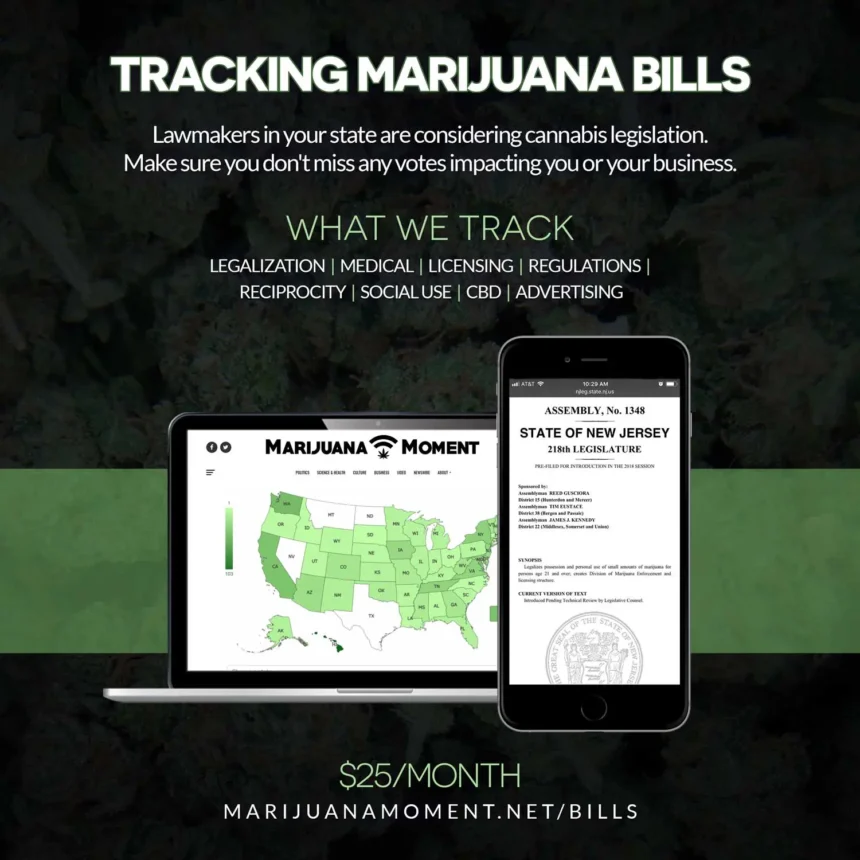
Marijuana Moment is tracking hundreds of cannabis, psychedelics and drug policy bills in state legislatures and Congress this year. Patreon supporters pledging at least $25/month get access to our interactive maps, charts and hearing calendar so they don’t miss any developments.
Learn more about our marijuana bill tracker and become a supporter on Patreon to get access.
—
Regulators are also launching a series of courses designed to educate physicians and other healthcare professionals about medical marijuana as the state’s cannabis program expands.
The underlying medical marijuana expansion bill signed by the governor in late June, in addition to allowing more patients to more easily access cannabis, also contains a provision that advocates find problematic.
Before lawmakers sent the legislation to Green, a conference committee revised the plan, inserting a provision to allow DOH to access medical marijuana patient records held by doctors for any reason whatsoever.
Photo courtesy of Philip Steffan.
Marijuana Moment is made possible with support from readers. If you rely on our cannabis advocacy journalism to stay informed, please consider a monthly Patreon pledge.