






The National Rifle Association (NRA)–arguably the most influential gun rights lobbying group in the U.S.—has joined top drug policy reform organizations and other interests in urging the U.S. Supreme Court to declare the federal ban on gun ownership by marijuana consumers unconstitutional.
In one of the latest amici briefs to be filed ahead of oral arguments in a case before the court, U.S. vs. Hemani, NRA called on justices to uphold a lower court ruling that found the federal statute known as 18 U.S.C. § 922(g)(3) violates the Second Amendment.
The filing came amid other new filings from leading reform groups NORML and the Drug Policy Alliance (DPA).
Central to the arguments from NRA and the drug policy organizations is that, based on separate Supreme Court precedent on gun restrictions, barring marijuana users from buying or possessing firearms lacks historical analogues consistent with the nation’s founding and is inconsistent with the increasing social acceptance of marijuana as states continue to legalize if for medical or recreational purposes.
“To justify firearms prohibition for marijuana users when they are not intoxicated, the government must prove that the ban is consistent with our nation’s historical tradition of firearm regulation,” NRA said. “That tradition supports restrictions on the use of firearms while intoxicated, but it does not support disarming individuals when they are sober merely because they sometimes use intoxicants.”
“Throughout American history, legislatures recognized that intoxication could temporarily increase the danger of firearms misuse. But they did not respond by entirely disarming people based on their status as users,” the brief filed alongside other Second Amendment groups said. “Instead, historical intoxication laws regulated conduct: restricting the carrying, discharge, or purchase of firearms only while a person was intoxicated and only for as long as that condition lasted. The historical record thus reflects a consistent tradition of narrow, situational restrictions rather than categorical disarmament.”
“Bereft of relevant support, the government elides the historical tradition of ‘firearm regulation,’ and instead offers strained analogies to civil-commitment laws for alcoholics who could not manage their affairs and to vagrancy laws that detained people in forced labor for loafing, juggling, or wearing the clothes of the opposite sex,” the brief states. “The government also cites surety laws, but those laws undermine its case because they required an individualized judicial finding of dangerousness.”
“Besides contradicting the specific American historical tradition about regulating firearms and intoxicants, the prosecution of Hemani for marijuana use violates a broader rule: individual disarmament must be based on dangerousness. Yet the government has made no serious effort to establish a connection between marijuana use and dangerousness. Rather than focusing on marijuana, it discusses drugs in the abstract and relies primarily on violent incidents involving methamphetamine, heroin, tranquilizers, quaaludes, and PCP.”
“This Court should hold 18 U.S.C. § 922(g)(3) unconstitutional as applied to Hemani because the government failed to demonstrate that disarming him based on marijuana use is consistent with the nation’s historical tradition of firearm regulation,” NRA concluded. “The judgment below should be affirmed.”
Relatedly, last year NRA’s lobbying arm said that court decisions calling into question the constitutionality of the federal government’s ban on gun ownership by marijuana consumers had “led to a confusing regulatory landscape” that’s impacted Americans’ Second Amendment rights.
NORML, for its part, said in its brief on the current case that the Second Amendment “protects ‘the right of the people to keep and bear Arms,’” and cannabis consumers “are plainly among ‘the people’ to be afforded its protection.”
“They are not aliens, enemy combatants, or some constitutionally excluded caste,” it says. “They are ordinary citizens and residents, many of them veterans, workers, parents, and medical patients, who happen also to consume a plant that Congress still places in Schedule I, but partially protects and promotes in interstate commerce by means of spending appropriations measures.”
Justice determined in an earlier ruling that gun laws must be rooted in historical precedent going back to the founding principles enshrined in the U.S. Constitution. And both NORML and DPA seized on that point in their respective briefs.
“The closest historical analogues concern temporary restrictions on carrying or firing a weapon while actually intoxicated,” NORML said. “Those laws did not impose a continuing disability on persons who drank alcohol or used other intoxicants, and they certainly did not strip those persons of their right to possess arms in their homes.”
The organization went further, noting that cannabis itself “underscores the historical mismatch at the heart of this case.”
“Hemp was a familiar and ubiquitous commodity from the colonial period through Reconstruction: colonial governments affirmatively promoted—and in Virginia required—its cultivation; members of the Founding generation grew it; and by the nineteenth century cannabis preparations were widely used medicinally and recognized in standard pharmaceutical compendia,” it said. “Yet neither the Founding era nor Reconstruction produced any tradition of disarming cannabis users as a class, or treating mere cannabis use as a proxy for dangerousness sufficient to justify categorical deprivation of the right to keep and bear arms.”
Additionally, NORML said modern policy “underscores the irrationality of applying § 922(g)(3) categorically to cannabis users, as a “substantial majority of States now authorize the medical use of cannabis, and many also permit adult-use possession under comprehensive regulatory regimes.”
“These widespread legislative judgments reflect the reality that cannabis use is both common and socially normalized, rather than a marker of dangerousness sufficient to justify the permanent deprivation of a fundamental constitutional right,” it said. “Congress itself has repeatedly reinforced that accommodation by prohibiting the Department of Justice from using appropriated funds to interfere with States’ implementation of medical-cannabis laws.”
“Historically, going back 400 years, cannabis in and of itself has not been viewed a harmful plant or a threat,” it continued. “Only since the 1930s and beyond with its Schedule I designation under the Controlled Substances Act of 1970 has it been so relegated–which has been acknowledged as being for political reasons.”
“Cannabis users are among ‘the people’ whose right to keep and bear arms the Second Amendment protects. For centuries, Americans cultivated, consumed, and prescribed cannabis without any suggestion that doing so warranted the loss of firearms rights. State-authorized medical cannabis patients continue to do so today, under regimes Congress has repeatedly chosen to protect. The historical analogues the government identifies concern temporary restrictions on carrying or discharging weapons while actively intoxicated, or disarmament of persons adjudged dangerous—not blanket bans on all users of a disfavored substance. Section 922(g)(3), as applied here, is a modern, statusbased firearm prohibition of unprecedented breadth. It is not consistent with this Nation’s historical tradition of firearm regulation.”
DPA, for its part, said in a brief that the Constitution’s “prohibition on vague laws protects the separation of powers by ensuring that Congress, rather than police, prosecutors, or judges, defines what conduct is criminal.”
“It also protects ordinary people by requiring a criminal law to be sufficiently definite to provide notice of what the law prohibits,” it said. “The statute at issue here, 18 U.S.C. § 922(g)(3) (the Statute), violates this precept because it prohibits an ‘unlawful user’ of ‘any controlled substance’ from possessing a firearm, without defining the quantity, frequency, or timing of the use that triggers its application.”
“The Government disagrees. It reasons that, if this Court reads certain terms into the Statute, then that modified version of § 922(g)(3) is not unconstitutionally vague, as applied to Mr. Hemani,” it said. “It argues, without relevant authority, that the Statute operates as a “temporary” disarmament that reaches only ‘habitual’ drug users. The Government’s interpretation does not remotely reflect the Statute’s capacious reach.”
“In our constitutional order, a vague law is no law at all. Congress is the only branch that has the power to enact federal criminal laws. Allowing this prosecution to proceed under § 922(g)(3) as applied here would require this Court to supply the limiting principle Congress omitted and to decide when the Statute applies and to whom. That approach only furthers the inequitable, selective criminalization of drug use. It has little, if anything, to do with regulating firearms. This Court should affirm.”
Further, the statute that’s being contested holds “the potential to ensnare tens of millions of Americans. The potential consequences are dire: A gun owner with no prior criminal history who experiments with marijuana can suddenly—without any individualized determination of dangerousness—be stripped of their constitutional right to possess a firearm, be subject to felony penalties and, depending on their domicile, be prohibited from voting in elections due to the collateral consequences of a felony conviction.”
“In a nation where marijuana consumption is as common as alcohol use, it cannot be the law that any American who uses marijuana forfeits their constitutional right to firearm possession,” the brief states, adding that the “Government attempts to defend § 922(g)(3) by implicitly relying on the assumption that drug use meaningfully correlates with dangerousness. Those claims are not supported by sound data.”
“Whatever its policy aims, § 922(g)(3) does not condition criminal liability on any finding of dangerousness, impairment, or misuse of a firearm,” it said. “The Government’s attempt to justify the Statute by reference to generalized correlations asks this Court to supply limiting principles that Congress did not enact. This Court’s vagueness doctrine forbids that exercise.”
“The notion that a person may be vaguely labeled as an ‘unlawful user’ and subsequently deprived of a fundamental liberty is irrational. Nor is it rooted in any equitable historical tradition of the United States,” the brief concludes. “The Statute operates as an unbounded, indiscriminate deprivation of fundamental liberties and should not be tolerated.”
In addition to NORML and DPA, several gun rights groups joined the chorus with their own amici briefs opposing the firearm ban for cannabis consumers this week.
In an amicus brief filed with the Supreme Court on Thursday, the Second Amendment Foundation (SAF), California Rifle and Pistol Association (CRPA), Second Amendment Law Center (2ALC), Citizens Committee for the Right to Keep and Bear Arms and Minnesota Gun Owners Caucus (MGOC) identified a number of legal issues with the underlying federal statute, 18 U.S.C. § 922(g)(3).
Because the court selected U.S. vs. Hemani instead of other more marijuana-specific cases challenging the constitutionality of the federal ban, the amici called it an “exceptionally poor vehicle to decide such an important question.”
More recently, the Firearms Policy Coalition, National Association for Gun Rights and New York State Rifle & Pistol Association submitted briefs in the case. Also, the National Association of Criminal Defense Lawyer (NACDL) and Center for Human Liberty filed briefs urging the court to find the current ban unconstitutional.
All of these amici briefs were filed days after ACLU attorneys representing Hemani made the case that the federal ban on gun ownership by marijuana consumers is nonsensical and unconstitutional—and that it’s made all the more confounding by the fact that Trump directed the expeditious finalization of a rule to move cannabis from Schedule I to Schedule III of the Controlled Substances Act (CSA).
The Supreme Court is scheduled to hear oral arguments in the Hermani proceedings on March 2.
In the background, the Bureau of Alcohol, Tobacco, Firearms, and Explosives (ATF) recently moved to loosen rules that bar people who consume marijuana and other illegal drugs from being able to lawfully purchase and possess guns by making it so fewer people would be affected.
The interim final rule from ATF seeks to update the definition of “unlawful user of or addicted to any controlled substance” under an existing policy that has been interpreted to deny Second Amendment rights to people who have used illegal substances a single time within the past year.
Last month, meanwhile, attorneys general for 19 states and Washington, D.C. filed their own brief siding with the federal government in the Hemani case, insisting that justices should maintain the current § 922(g)(3) statute.
Several other briefs were also submitted last month for the case, which was granted cert in October. Firearm control groups including Everytown for Gun Safety, Second Amendment Law Scholars, Brady Center to Prevent Gun Violence, Giffords Law Center to Prevent Gun Violence and Global Action on Gun Violence have told the Supreme Court to overturn the lower court’s ruling in the matter, for example. A coalition of history and law professors also submitted a brief.
Also last month, Smart Approaches to Marijuana (SAM) and 21 other prohibitionist groups filed a brief, urging justices to uphold the constitutionality of the federal gun ban for people who use cannabis—which they claim is associated with violence and psychosis.
U.S. Solicitor General D. John Sauer, for his part, told the Supreme Court that people who use illegal drugs “pose a greater danger” than those who drink alcohol.
Meanwhile, the Biden administration was evidently concerned about potential legal liability in federal cases for people convicted of violating gun laws simply by being a cannabis consumer who possessed a firearm, documents recently obtained by Marijuana Moment show.
The previously unpublished 2024 guidance from former President Joe Biden’s Justice Department generally cautioned U.S. attorneys to use discretion in prosecuting federal cannabis cases, particularly for offenses that qualified people for pardons during his term. But one section seems especially relevant as the Supreme Court takes on a case challenging the constitutionality of the current federal gun statute.
With respect to Hemani, in a separate August filing for the case, the Justice Department also emphasized that “the question presented is the subject of a multi-sided and growing circuit conflict.” In seeking the court’s grant of cert, the solicitor general also noted that the defendant is a joint American and Pakistani citizen with alleged ties to Iranian entities hostile to the U.S., putting him the FBI’s radar.
If justices declare 922(g)(3) constitutional, such a ruling could could mean government wins in the remaining cases. The high court recently denied a petition for cert in U.S. v. Cooper, while leaving pending decisions on U.S. v. Daniels and U.S. v. Sam.
The court also recently denied a petition for cert in another gun and marijuana case, U.S. v. Baxter, but that wasn’t especially surprising as both DOJ and the defendants advised against further pursing the matter after a lower court reinstated his conviction for being an unlawful user of a controlled substance in possession of a firearm.
Meanwhile, in recent interviews with Marijuana Moment, several Republican senators shared their views on the federal ban on gun possession by people who use marijuana—with one saying that if alcohol drinkers can lawfully buy and use firearms, the same standard should apply to cannabis consumers.
Separately, the U.S. Court of Appeals for the Tenth Circuit last year sided with a federal district court that dismissed an indictment against Jared Michael Harrison, who was charged in Oklahoma in 2022 after police discovered cannabis and a handgun in his vehicle during a traffic stop.
The case has now been remanded to that lower court, which determined that the current statute banning “unlawful” users of marijuana from possessing firearms violates the Second Amendment of the Constitution.
The lower court largely based his initial decision on an interpretation of a Supreme Court ruling in which the justices generally created a higher standard for policies that seek to impose restrictions on gun rights.
In the U.S. Court of Appeals for the Eleventh District, judges recently ruled in favor of medical cannabis patients who want to exercise their Second Amendment rights to possess firearms.
As a recent report from the Congressional Research Service (CRS) explained the current legal landscape, a growing number of federal courts are now “finding constitutional problems in the application of at least some parts” of the firearms prohibition.
In another ruling, a three-judge panel for the U.S. Court of Appeals for the Eighth Circuit vacated a defendant’s conviction and remanded the case back to a district court, noting that a retrial before a jury may be necessary to determine whether cannabis in fact caused the defendant to be dangerous or pose a credible threat to others.
The Third Circuit separately said in a published opinion that district courts must make “individualized judgments” to determine whether 922(g)(3) is constitutional as applied to particular defendants.
A federal court in October agreed to delay proceedings in a years-long Florida-based case challenging the constitutionality of the ban on gun ownership by people who use medical marijuana, with the Justice Department arguing that the Supreme Court’s recent decision to take up Hemani warrants a stay in the lower court.
—
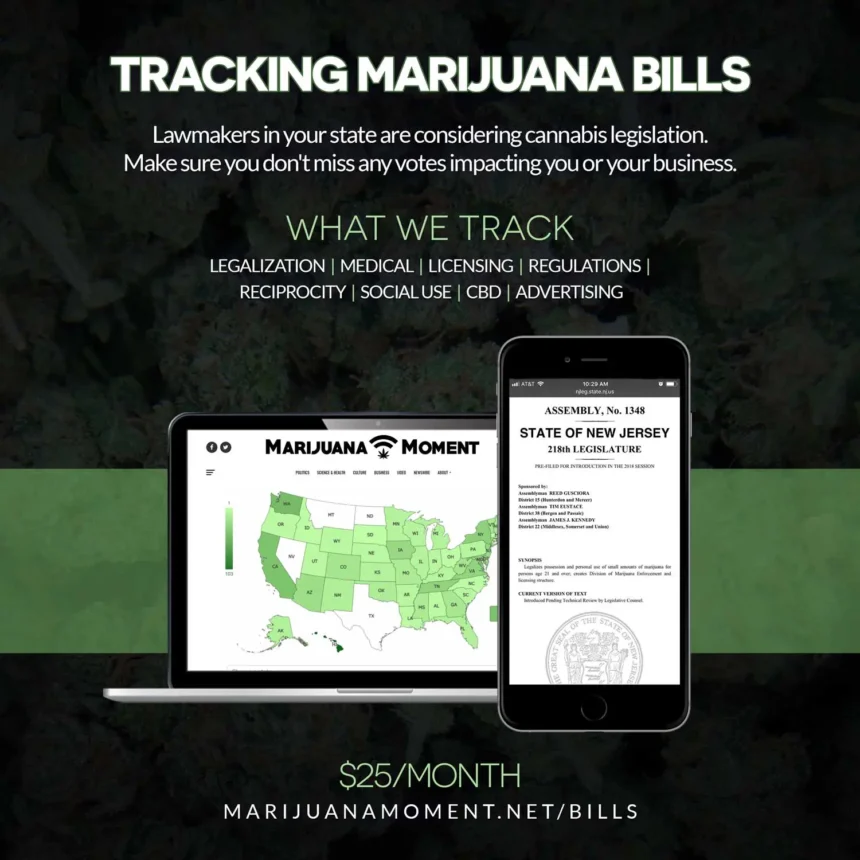
Marijuana Moment is tracking hundreds of cannabis, psychedelics and drug policy bills in state legislatures and Congress this year. Patreon supporters pledging at least $25/month get access to our interactive maps, charts and hearing calendar so they don’t miss any developments.
Learn more about our marijuana bill tracker and become a supporter on Patreon to get access.
—
Last year, a federal judge in Rhode Island ruled that the ban was unconstitutional as applied to two defendants, writing that the government failed to establish that the “sweeping” prohibition against gun ownership by marijuana users was grounded in historical precedent.
A federal judge in El Paso separately ruled in 2024 that the government’s ongoing ban on gun ownership by habitual marijuana users is unconstitutional in the case of a defendant who earlier pleaded guilty to the criminal charge. The court allowed the man to withdraw the plea and ordered that the indictment against him be dismissed.
DOJ has claimed in multiple federal cases over the past several years that the statute banning cannabis consumers from owning or possessing guns is constitutional because it’s consistent with the nation’s history of disarming “dangerous” individuals.
In 2023, for example, the Justice Department told the U.S. Court of Appeals for the Third Circuit that historical precedent “comfortably” supports the restriction. Cannabis consumers with guns pose a unique danger to society, the Biden administration claimed, in part because they’re “unlikely” to store their weapon properly.
Meanwhile, some states have passed their own laws either further restricting or attempting to preserve gun rights as they relate to marijuana.
Recently a Pennsylvania lawmaker introduced a bill meant to remove state barriers to medical marijuana patients carrying firearms.
Colorado activists also attempted to qualify an initiative for November’s ballot that would have protected the Second Amendment rights of marijuana consumers in that state, but the campaign’s signature-gathering drive ultimately fell short.
As 2024 drew to a close, the ATF issued a warning to Kentucky residents that, if they choose to participate in the state’s medical marijuana program that’s set to launch imminently, they will be prohibited from buying or possessing firearms under federal law.
The official said that while people who already own firearms aren’t “expected to” turn them over if they become state-legal cannabis patients, those who “wish to follow federal law and not be in violation of it” must “make the decision to divest themselves of those firearms.”
Since then, bipartisan state lawmakers have introduced legislation that would urge Kentucky’s representatives in Congress to amend federal law to clarify that users of medical marijuana may legally possess firearms, though no action has since been taken on that bill.
Kentucky Gov. Andy Beshear (D) said last year that he supported the legislature’s effort to urge the state’s congressional delegation to call for federal reforms to protect the Second Amendment rights of medical marijuana patients, but the governor added that he’d like to see even more sweeping change on the federal level.
Marijuana Moment is made possible with support from readers. If you rely on our cannabis advocacy journalism to stay informed, please consider a monthly Patreon pledge.