





The Hawaii Senate has passed a bill to allow qualifying patients to access medical marijuana at health facilities.
After receiving a favorable report in committee last week, the legislation from Sen. Joy San Buenaventura (D) advanced through the full chamber in a unanimous 25-0 vote on Tuesday as part of the consent calendar. A House companion version of the proposal has also been moving through the process this session.
The bill states that it’s the “intent of the legislature in enacting this chapter to support the ability of terminally ill patients and qualifying patients over sixty-five years of age with chronic diseases to safely use medical cannabis within specified health care facilities.”
Advocates would have liked to see a mandate for health facilities to allow medical cannabis use, but as drafted it would simply permit such policies, while exempting residential treatment centers from the proposed law.
Other exceptions built into the legislation, SB 2408, include provisions stipulating that medical marijuana couldn’t be used in substance misuse recovery hospitals, state hospitals or emergency departments of general acute hospitals “while the patient is receiving emergency services and care.”
Smoking and vaping cannabis would remain prohibited in health facilities under the proposal, “provided that a home health agency shall only prohibit smoking or vaping immediately before or while home health agency staff are present in the residence.”
General acute care hospitals couldn’t allow patients with a chronic disease to use medical cannabis unless they were terminally ill.
In the event that a federal regulatory agency, Justice Department or Centers for Medicare and Medicaid Services (CMS) takes enforcement action against a health facility related to the medical cannabis policy, or if they explicitly notify the facility that they’re violating federal law, the health care institution could suspend the policy.
Meanwhile, last week, another Hawaii Senate committee approved a bill to allow patients to immediately access medical cannabis once their registrations are submitted, instead of having to wait until their cards are delivered as is the case under current law.
Buenaventura, chair of the Health and Human Services Committee, is also the sponsor of her chamber’s version of the proposal. Her panel more recently passed legislation to legalize low-dose and low-potency marijuana, even as members’ counterparts in the House of Representatives have said that cannabis prohibition will not be ended in the state this year.
The legislation would allow adults 21 and older to legally possess and use certain amounts of low-dose and low-THC cannabis for personal use, with products limited to a maximum of 5 milligrams of THC per serving. In liquid form, they could have up to 5 milligrams of THC per twelve ounces.
The Senate committee action comes after key House lawmakers signaled that cannabis legalization proposals would not be advancing in the 2026 session, citing a lack of sufficient support in their chamber.
Despite renewed hopes that those bills—including one from House Judiciary and Hawaiian Affairs Committee Chairman David Tarnas (D) that would have put the issue of legalization before voters at the ballot—would advance this year, the sponsor and House Speaker Nadine Nakamura (D) said there wasn’t enough support within the legislature to pass them this round.
State officials in January released a report on the potential economic impact of recreational marijuana legalization in the state, including revenue implications related to domestic and international tourism.
All told, researchers said survey data and comparative analyses indicate that Hawaii could see anywhere from $46-$90 million in monthly marijuana sales by year five of implementation, after accounting for a maximum 15 percent tax rate on cannabis products.
Hawaii’s Senate last year narrowly defeated a proposal that would have increased fivefold the amount of cannabis that a person could possess without risk of criminal charges.
Had the measure become law, it would have increased the amount of cannabis decriminalized in Hawaii from the current 3 grams up to 15 grams. Possession of any amount of marijuana up to that 15-gram limit would have been classified as a civil violation, punishable by a fine of $130.
A Senate bill that would have legalized marijuana for adults, meanwhile, ultimately stalled for the session. That measure, SB 1613, failed to make it out of committee by a legislative deadline.
While advocates felt there was sufficient support for the legalization proposal in the Senate, it’s widely believed that House lawmakers would have ultimately scuttled the measure, as they did last February with a legalization companion bill, HB 1246.
In 2024, a Senate-passed legalization bill also fizzled out in the House.
Last year’s House vote to stall the bill came just days after approval from a pair of committees at a joint hearing. Ahead of that hearing, the panels received nearly 300 pages of testimony, including from state agencies, advocacy organizations and members of the public.
Gov. Josh Green (D) signed separate legislation last year to allow medical marijuana caregivers to grow marijuana on behalf of up to five patients rather than the current one.
And in July, the governor signed another bill that establishes a number of new rules around hemp products in Hawaii, including a requirement that distributors and retailers obtain a registration from the Department of Health.
Lawmakers also sent a bill to the governor that would help speed the expungement process for people hoping to clear their records of past marijuana-related offenses—a proposal Green signed into law last April.
That measure, HB 132, from Tarnas, is intended to expedite expungements happening through a pilot program signed into law in 2024 by Green. Specifically, it will remove a distinction between marijuana and other Schedule V drugs for the purposes of the expungement program.
The bill’s proponents said the current wording of the law forces state officials to comb through thousands of criminal records manually in order to identify which are eligible for expungement under the pilot program.
Meanwhile, in November, Hawaii officials finalized rules that will allow medical marijuana dispensaries to sell an expanded assortment of products for patients—including dry herb vaporizers, rolling papers and grinders—while revising the state code to clarify that cannabis oils and concentrates can be marketed for inhalation.
The department also affirmed its support for federal marijuana rescheduling—a policy change that President Donald Trump ordered to be completed expeditiously but has yet to come to fruition.
—
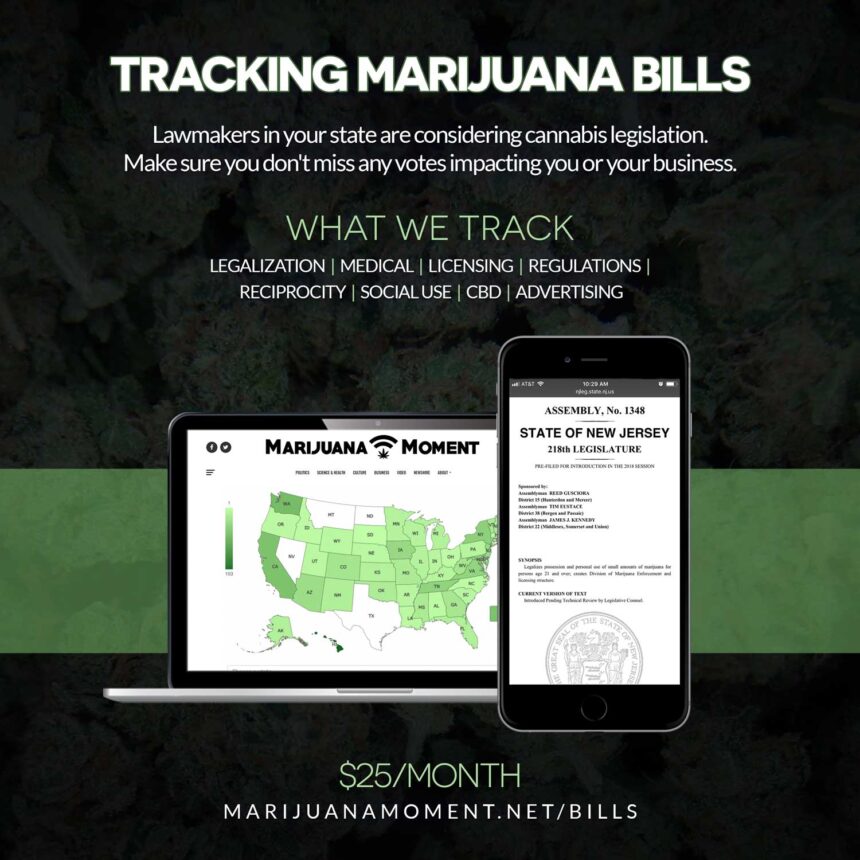
Marijuana Moment is tracking hundreds of cannabis, psychedelics and drug policy bills in state legislatures and Congress this year. Patreon supporters pledging at least $25/month get access to our interactive maps, charts and hearing calendar so they don’t miss any developments.
Learn more about our marijuana bill tracker and become a supporter on Patreon to get access.
—
Regulators are also launching a series of courses designed to educate physicians and other healthcare professionals about medical marijuana as the state’s cannabis program expands.
The underlying medical marijuana expansion bill signed by the governor in late June, in addition to allowing more patients to more easily access cannabis, also contains a provision that advocates find problematic.
Before lawmakers sent the legislation to Green, a conference committee revised the plan, inserting a provision to allow DOH to access medical marijuana patient records held by doctors for any reason whatsoever.
Photo courtesy of Brian Shamblen.
Marijuana Moment is made possible with support from readers. If you rely on our cannabis advocacy journalism to stay informed, please consider a monthly Patreon pledge.