




If you’ve ever wondered how drug tests detect cannabis use, the answer is a little more complicated than most people expect.

Photo by: Gina Coleman/Weedmaps
Image lightbox

Most drug tests don’t actually look for THC or THCA in the same way a cannabis label lists cannabinoids. Instead, they look for metabolites — chemical byproducts the body produces after it processes THC.
This is why drug testing results can seem confusing. A person may not have active THC in their system, but the body can still contain metabolites created after THC was broken down.
In workplace and clinical settings, cannabis testing usually follows a two-step process designed to balance speed and accuracy:
- Immunoassay screening, a fast test that checks whether a sample reacts to antibodies associated with THC metabolite patterns
- Confirmation testing, typically using gas chromatography–mass spectrometry (GC-MS), which identifies specific compounds such as THC-COOH
Understanding how these tests work — and where THCA fits into the metabolism of THC — makes drug testing reports much easier to interpret. Once you know what labs are actually measuring, terms like cutoff levels, metabolite detection, and confirmation testing become much less confusing.
How drug tests detect cannabis
Image lightbox
Most cannabis drug testing programs use a two-stage analysis process designed to quickly screen large numbers of samples and then confirm any potential positives with highly specific laboratory methods.
These steps work together to ensure results are both efficient and scientifically defensible.
Immunoassay screening
The first step in most drug testing programs is an immunoassay screen.
Immunoassays are laboratory tests that use antibodies designed to bind to specific chemical structures. In cannabis testing, those antibodies are typically tuned to recognize metabolites associated with THC use.
Because immunoassays are fast and inexpensive, they’re ideal for large testing programs like workplace screening. However, these tests prioritize speed over precision. That means an immunoassay result is considered presumptive, not definitive.
A positive result simply means the sample produced a signal that exceeded the test’s threshold for cannabinoid-related compounds. It does not confirm the exact substance present.
This is why confirmatory testing exists.
What a “positive” immunoassay result actually means
Seeing the word positive on a drug test can feel alarming, but on an immunoassay screen it has a very specific meaning.
A positive screen indicates:
- The sample triggered the test’s antibody response
- The signal exceeded the established cutoff level
- Further confirmation testing is required
It does not prove THC consumption on its own.
Because immunoassays rely on antibody reactions, compounds with similar molecular structures can sometimes trigger a signal. This phenomenon is known as cross-reactivity.
That’s why screening tests are always followed by confirmatory methods before final results are reported.
Cross-reactivity: why screening tests can be misleading
One of the biggest misconceptions about drug testing is that a positive screen automatically proves cannabis use.
In reality, immunoassays can sometimes react with substances that resemble the target metabolite. This is known as cross-reactivity.
How cross-reactivity works
The antibodies used in immunoassay tests are designed to recognize specific molecular shapes.
If another compound shares enough structural similarity with the target metabolite, the antibody may bind to it as well. When that happens, the test may register a positive signal even if the exact target compound isn’t present.
This is why immunoassays are considered screening tools rather than definitive tests. Only confirmatory testing can determine the precise compound responsible for the signal.
GC-MS confirmation testing: the gold standard
When a screening test returns a positive result, laboratories typically move to confirmatory testing.
The most widely used confirmation method is gas chromatography–mass spectrometry (GC-MS).
Unlike immunoassays, GC-MS doesn’t rely on antibody reactions. Instead, it separates compounds in a sample and analyzes their molecular structure.
How GC-MS works
Gas chromatography–mass spectrometry (GC-MS) is the method labs typically use to confirm positive drug test results. It combines two analytical techniques that work together to identify Gas chromatography–mass spectrometry (GC-MS) is the method labs typically use to confirm positive drug test results. It combines two analytical techniques that work together to identify specific compounds with high precision.
Gas chromatography (GC) separates the compounds in a sample as they travel through a heated column. Different substances move through the column at different speeds, allowing them to be isolated from one another.
Mass spectrometry (MS) then analyzes each compound by measuring its molecular mass and fragmentation pattern. This creates a chemical “fingerprint” that helps the lab identify the substance with high accuracy.
In cannabis drug testing, GC-MS is commonly used to confirm the presence of THC-COOH, the primary metabolite produced after the body processes THC.
Where THCA fits into drug testing
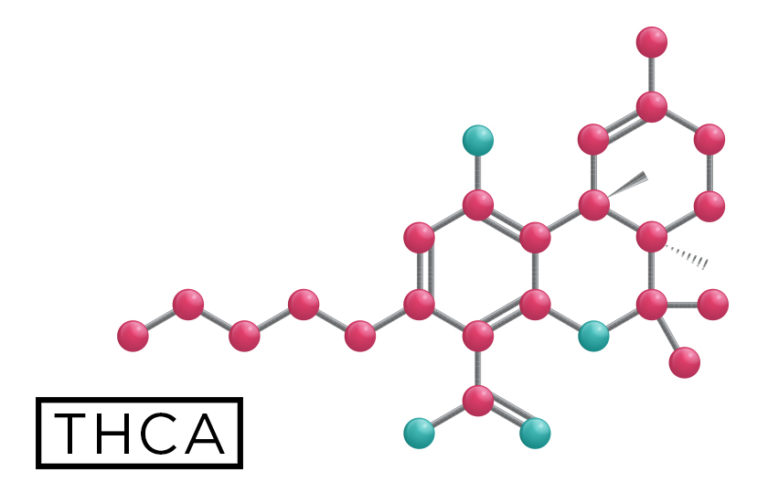
Image lightbox
Drug tests focus on THC metabolites rather than THC itself.
THCA (tetrahydrocannabinolic acid) is the raw, non-intoxicating precursor to THC found in fresh cannabis flower. When cannabis is heated, through smoking, vaping, or cooking, THCA undergoes decarboxylation, converting into delta-9 THC.
Once THC enters the body, it follows the same metabolic pathway described earlier, eventually producing THC-COOH. Because most drug tests look for THC metabolites, not THCA itself, the key factor is whether THC was produced and metabolized.
In other words, drug tests generally detect the body’s metabolic evidence of THC exposure, rather than the original cannabinoid present in the product.
Drug test sample types: urine, blood, and hair
Different drug testing programs use different biological samples, each with its own strengths and limitations.
Urine testing
The most common method used in workplace drug testing.
Urine tests typically detect THC-COOH, making them effective for identifying past cannabis exposure.
Blood testing
Blood tests can detect active THC and metabolites, which may provide a more recent exposure window.
These tests are often used in law enforcement or medical contexts.
Hair testing
Hair analysis can potentially detect drug metabolites over longer periods because compounds become embedded in the hair shaft as it grows.
However, hair testing is less common for cannabis compared with urine screening programs.
Why cutoff levels matter
Drug testing programs don’t simply detect whether a compound is present, they evaluate whether its concentration exceeds a defined cutoff level.
Cutoffs are designed to reduce false positives and ensure results reflect meaningful exposure.
For example, many workplace testing programs use:
These thresholds help distinguish between trace exposure and concentrations associated with cannabis use.
Understanding drug test reports

Drug testing can feel confusing, especially when lab terminology gets thrown around without explanation.
But the core process is straightforward:
- Immunoassay screening flags potential positives quickly
- GC-MS confirmation identifies specific metabolites with high precision
- Laboratories report results based on metabolite concentration and cutoff thresholds
Most importantly, modern cannabis testing is metabolite-driven.
That means laboratories are usually detecting THC-COOH, not THCA or THC directly.
Understanding that distinction helps clarify what drug tests actually measure, and why reading the fine print of a lab report matters.
Order cannabis products for pickup or delivery from a dispensary near you on Weedmaps.