




A Pennsylvania Senate committee has amended a cannabis regulation bill that members previously approved to add new provisions banning the sale of most hemp THC products to align state law with a pending federal policy change that’s set to take effect in November.
As efforts to legalize adult-use marijuana continue to stall in the Keystone State, Sen. Dan Laughlin (R) announced on Monday that the Senate Law and Justice Committee he chairs voted to revise a bill he’s sponsoring to create a Cannabis Control Board (CCB) to oversee the state’s medical cannabis program and intoxicating hemp products.
“As the federal government updates its definition of hemp, Pennsylvania needs to make sure our laws remain consistent and enforceable,” Laughlin said in a press release. “Amending Senate Bill 49 to mirror these federal changes helps close the same loopholes that allowed intoxicating hemp products to flood the marketplace with little oversight.”
“The current system is fragmented and has struggled to keep pace with how quickly the hemp market has evolved,” he said. “A cannabis control board would provide clear oversight, ensure products are properly regulated and give law enforcement the tools they need to get illegal and potentially harmful products off store shelves.”
The revised version, which cleared the panel last year in its original form, still contains the core provisions of the bill, and it has now advanced again with a 10-1 vote.
The CCB established by Senate Bill 49 would regulate medical cannabis and hemp, while preparing to eventually handle the adult-use marijuana market as well if that reform is ultimately enacted.
The senator previewed the measure last May, writing that Pennsylvania should take initial steps to make sure the state is “ready to act when legalization becomes law” by establishing a CCB now. He also voiced concerns about the public health and safety implications of the loosely regulated hemp market that emerged after the crop and its derivatives were federally legalized under the 2018 Farm Bill.
Now that the definition of hemp under federal law is set to change in a way that stakeholders say would effectively eradicate the industry, Laughlin said a revision to SB 49 represents a timely solution.
“Right now, there are too many gray areas in the law,” Laughlin, who is also sponsoring bipartisan legislation to legalize adult-use marijuana, said. “By aligning our statutes with federal standards and establishing a single regulatory body, we can protect consumers, support responsible businesses and help law enforcement crack down on bad actors in the marketplace.”
In a cosponsorship memo circulated last year, Laughlin said his bill would “transfer regulatory control of the Medical Marijuana Program to the CCB, ensuring continuity, efficiency, and improved oversight of medical cannabis businesses and patient access.” It would further “establish uniform safety standards to protect consumers from untested and potentially harmful products.”
The original bill text itself also doesn’t contain an explicit references to adult-use, or recreational, marijuana, and it would not enact legalization on its own. But the description indicates that the sponsors feel the current regulatory regime under the Pennsylvania Department of Health should be replaced with a more targeted agency that would ostensibly be suited to oversee an adult-use market if lawmakers move to end prohibition.
“By consolidating oversight under a single regulatory board, we can eliminate inconsistencies, enhance transparency, and provide the structure needed to responsibly manage this industry,” the memo says.
With respect to the new hemp language, that’s responsive to a major pivot in federal law that’s being enacted under a bill President Donald Trump signed last year.
Since 2018, cannabis products have been considered legal hemp if they contain less than 0.3 percent delta-9 THC on a dry weight basis.
The provisions set to take effect later this year specify that, within one year of enactment, the weight will apply to total THC—including delta-8 and other isomers. It will also include “any other cannabinoids that have similar effects (or are marketed to have similar effects) on humans or animals as a tetrahydrocannabinol (as determined by the Secretary of Health and Human Services).”
The new definition of legal hemp will additionally ban “any intermediate hemp-derived cannabinoid products which are marketed or sold as a final product or directly to an end consumer for personal or household use” as well as products containing cannabinoids that are synthesized or manufactured outside of the cannabis plant or not capable of being naturally produced by it.
Legal hemp products will be limited to a total of 0.4 milligrams per container of total THC or any other cannabinoids with similar effects.
Within 90 days of the bill’s enactment, the Food and Drug Administration (FDA) and other agencies were supposed to publish list of “all cannabinoids known to FDA to be capable of being naturally produced by a Cannabis sativa L. plant, as reflected in peer reviewed literature,” “all tetrahydrocannabinol class cannabinoids known to the agency to be naturally occurring in the plant” and “all other known cannabinoids with similar effects to, or marketed to have similar effects to, tetrahyrocannabinol class cannabinoids.”
However, FDA appears to have missed that deadline. A spokesperson told Marijuana Moment last month that the lists would be posted in the Federal Register when they’re available.
—
Marijuana Moment is tracking hundreds of cannabis, psychedelics and drug policy bills in state legislatures and Congress this year. Patreon supporters pledging at least $25/month get access to our interactive maps, charts and hearing calendar so they don’t miss any developments.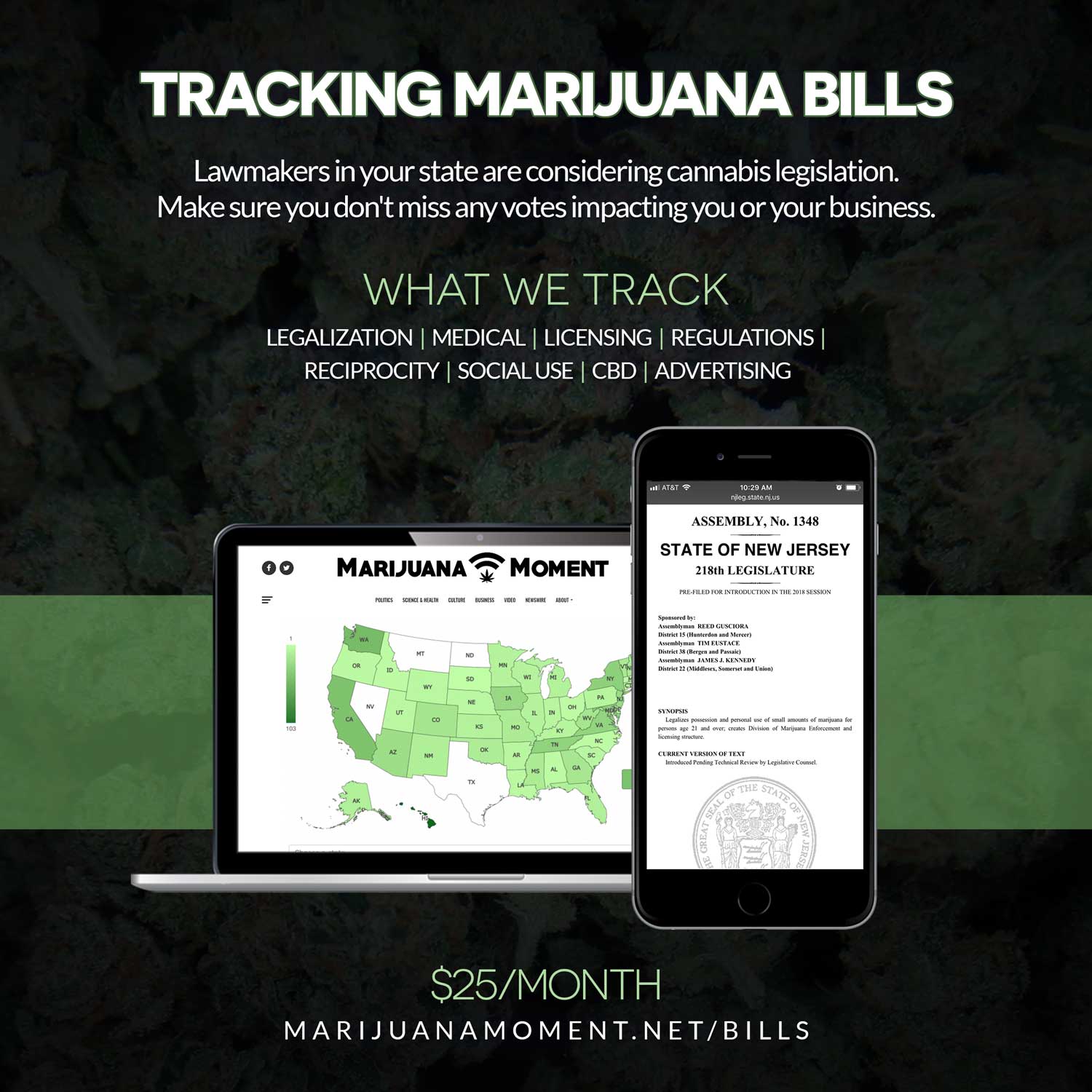
Learn more about our marijuana bill tracker and become a supporter on Patreon to get access.
—
Meanwhile, a Quinnipiac University Poll released last month found that a majority of Pennsylvania voters say they’re ready for the state to legalize adult-use marijuana.
The results of that survey and the committee action on Laughlin’s bill come as state lawmakers once again consider proposals to replace marijuana criminalization with regulation. That includes a plan put forward by Gov. Josh Shapiro (D) as part of his latest budget request.
Legalizing marijuana in Pennsylvania under that plan could bring in nearly half a billion dollars in annual revenue by 2028, according to a recent analysis from the state’s Independent Fiscal Office (IFO) that estimates a significantly larger cash windfall compared to projections from the governor’s own office.
With a proposed 20 percent wholesale cannabis excise tax, 6 percent state sales tax for retail and licensing fees, IFO said Shapiro’s legalization plan that he unveiled earlier this month would generate $140 million in tax revenue in the first year of implementation from 2027-2028 and increase to $432 million by 2030-2031.
That’s a much higher revenue estimate than what the governor’s office put forward in the latest executive budget. According to that analysis, legalization would generate about $36.9 million in tax dollars in its first year from a 20 percent wholesale tax on marijuana—rising gradually to $223.8 million by 2030-2031.
Of course, the projections assume the legislature advances adult-use legalization in line with the governor’s budget request and sales begin on January 1, 2027. It remains to be seen whether lawmakers will follow through on the reform this year, but it wouldn’t be the first time marijuana legalization stalled out in the state if they don’t act this session.
Meanwhile, in January month, a coalition of drug policy and civil liberties organizations urged Shapiro to play a leadership role in convening legislative leaders to get the job done on cannabis legalization this session.
In a letter led by the Marijuana Policy Project (MPP) and sent to the governor, the coalition noted that legalization has consistently made it into Shapiro’s budget requests, “reflecting both sound fiscal policy and the clear will of the people of the Commonwealth.”
Pennsylvania House Democratic lawmakers have separately called on the GOP-controlled Senate to come to the table and pass a bill to legalize marijuana.
At a press conference last month, three Democratic members of the House who have championed adult-use legalization stressed the need to move on reform, laying blame for inaction on the Senate where even supporters of the policy change have so far been unable to deliver on the issue.
Reps. Rick Krajewski (D) and Dan Frankel (D), who sponsored a bill to legalize with state-run shops that advanced through the House last year, said they understand that the novel regulatory approach they envisioned may be “controversial” to some members, but that’s all the more reason for the Senate to bring their own ideas to the conversation to finally enact the reform.
House Speaker Joanna McClinton (D) said in December that legalizing marijuana is one way to create a “very important” revenue source for the state—and that it’s an achievable reform if only legislators could find “the will to do it.”
Bipartisan Pennsylvania lawmakers who’ve been working to enact adult-use legalization over recent sessions without success so far have also recently said that Trump’s federal marijuana rescheduling order could grease the wheels in 2026.
For what it’s worth, another top GOP senator—Sen. Scott Martin (R), chair of the chamber’s Appropriations Committee—said in December that he was skeptical about the prospects of enacting legalization in the 2026 session, in part because of the federal classification of cannabis that’s now expected to change. Of course, marijuana would still be federally illegal under Schedule III, so it’s unclear if a simple loosening of the law would move the needle enough from his perspective.
A top aide to Pennsylvania’s governor said in September that lawmakers should stop introducing new competing legalization bills and instead focus on building consensus on the issue—while emphasizing that any measure that advances needs to contain equity provisions if the governor is going to sign it into law.
Laughlin, for his part, separately said recently that supporters are “picking up votes” to enact the reform this session.
Meanwhile, bipartisan Pennsylvania senators in October introduced a bill that would allow terminally ill patients to use of medical marijuana in hospitals.
Read the text of the hemp amendment to Laughlin’s cannabis bill below:
Marijuana Moment is made possible with support from readers. If you rely on our cannabis advocacy journalism to stay informed, please consider a monthly Patreon pledge.