





For hemp farmers, few guests are less welcome than the corn earworm.
Named after its main source of food, the corn earworm is also a big fan of the hemp plant – particularly when their favorite meal is out of season – feasting on the flowers and destroying up to 60% of the plant’s yield.
“They are known to eat the flower portion, which is the marketable part of the plant most of the time,” says Freweyni Abrha, a Ph.D. student at the University of Maryland, Eastern Shores.
Abrha has a Bachelor of Science in plant science, a master’s degree in plant pathology and this past year was one of the top winners of the first DaySavers Higher Potential Scholarship, a first-of-its-kind initiative designed to help build the next generation of cannabis leaders.
Today, she is two-and-a-half years into a four-year research program analyzing how the plant reacts to the insect with the goal of developing hemp plants that can resist the bugs on their own. In cannabis, the tiny predator’s presence triggers the plant’s defense mechanisms, boosting production of CBD, THC and various terpenes that it uses to protect itself.
Read more: Green Leaf CEO Marc Rodriguez on What It Takes to Power Cannabis From the Back Office – Cannabis & Tech Today
How Does Cannabis Protect Itself?
Like most plants, when hemp detects an infestation, its defense system kicks in, much like a human immune system would. First, the plants produce what is called jasmonic acid followed by what Abrha calls “secondary metabolites” like CBD, THC and other terpenes designed to fend off the corn earworm.
“When they are affected by the insect, they have a tendency to produce more of the secondary metabolites,” Abrha says. “We’re trying to see how these secondary metabolites are related with defense of the plant, which leads to managing the insect using the natural production ability of hemp.”
Abrha is working to analyze which of the plant’s genes are affected and how so that scientists can create non-chemical pesticide options, like insect-resistant varietals of hemp.
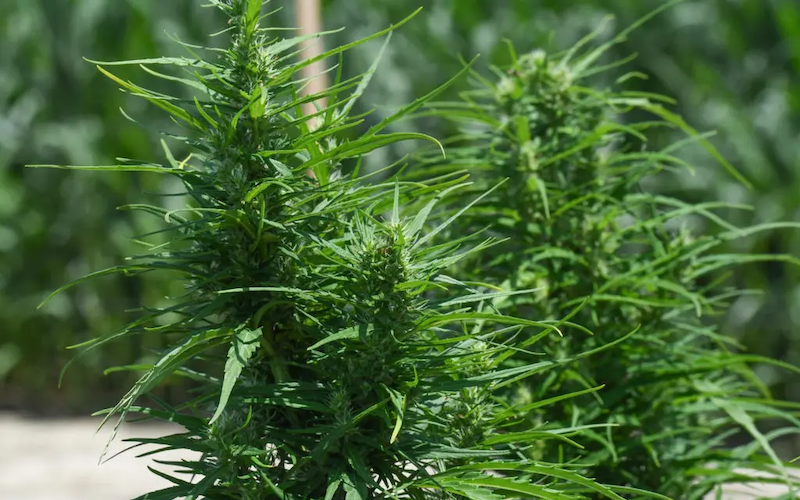
“Through breeding we can increase the concentration of those genes in another way that makes the plant more resistant to the insect,” says Abrha. “Or we can suppress the genes that are attracting the insect, so the plant is no longer attractive to the insect.”
Originally from a small village in Ethiopia, where she says farming was a “day-to-day activity,” Abrha has dedicated her career to studying agriculture and says her passion is in uncovering the molecular and biochemical interactions in hemp when challenged by pests.
Now, her work at the University of Maryland, Eastern Shore may help the hemp farmers of the future protect their crops from infestations of pests, like the corn earworm, for which there is no registered pesticide, though Abrha says some hemp farmers pair their crop with corn so the insect stays on its favorite crop instead of migrating to hemp.
Redefining hemp
Beyond helping develop insect-resistant plants, Abrha’s research may also change our entire definition of what constitutes hemp and what is marijuana. Currently, the federal government defines hemp as cannabis plants containing less than 0.3% THC, the cannabinoid that gives marijuana its psychoactive high.
But what Abrha’s work is proving is that the definition may need to be changed because THC percentage is not “genetically fixed.”
“What I’m finding through my research is THC can be affected by everything including environmental factors,” she says. “So putting this strict 0.3% level on hemp to differentiate it from marijuana may be the wrong decision because this thing is not genetically fixed.”
In real world terms, that means a farmer may plant a known hemp plant with less than 0.3% THC, but because of something like the corn earworm, the plant may produce THC to protect itself taking that plant out of the legal range for “hemp,” meaning a whole crop may have to be destroyed instead of going to market.
However, the fact that hemp and marijuana are the same means her research could in the future apply to the THC industry as well as the hemp industry.
“Currently my specific area is industrial hemp, but it can be applied for marijuana too because, technically, they are the same plant,” she says.