





In the early ’90s, the SoCal trio of Bradley Nowell, Eric Wilson and Bud Gaugh pioneered a mashup of ska, punk, reggae and hip-hop that took the airwaves and stoner culture by storm, before tragedy struck. Now, 30 years later, Brad’s son Jakob Nowell adds closure and a compelling new chapter to the band’s storied legacy.
Everyone has a Sublime story.
Hearing their music for the first time might have accompanied the loss of your virginity, smoking your first joint or some combination of the two.
You might have been high in a friend’s car, drunk at a house party or, if you were lucky enough to catch one, experiencing their fervor at a live show. Whatever your introduction to Sublime, it came to define your relationship with the band and the story you would share.
For many, their Sublime inauguration came in 1996, hearing Bradley Nowell’s voice crescendo across the radio singing “What I Got,” the global smash hit Rolling Stone placed at number 83 on its 2008 list of “100 Greatest Guitar Songs of All Time.”
If future Sublime songs could have also made the cut, we’ll never know: the guitar-strumming fingers and rapturous vocals of Nowell were lost to the physical world a month prior to “What I Got” being released. It seemed Sublime was over before it had begun, catching fire only to be without its driving creative force.
Yet, somehow, the music not only endured. It thrived.
“What I Got” became the summer anthem of 1996, blasting through headphones and speakers across the globe. As the band posthumously grew in popularity, fans from all over the world began to both celebrate and mourn the music: appreciation for its existence, disappointment for never being able to see it performed live again.
Our minds became vehicles for connecting with Sublime. We could picture Nowell lighting up that morning cigarette, stepping into a new day’s sneakers, playing the guitar with calloused hands like a mother fucking riot, the energy of the song’s composition penetrating beyond our sound systems and into our souls, where the Long Beach rebel was still alive.
Now, 30 years later, with over 20 million records sold worldwide, Sublime has been revived with original members Eric Wilson and Bud Gaugh, joined by Bradley’s son, Jakob Nowell, in the role once held by his father.
It’s a synergistic, synchronous, full-circle moment: the baby featured in the “What I Got” music video now stationed as the band’s frontman, carrying the torch and resurrecting our connection to Sublime so we no longer need to imagine “what if.”
With a new tour and new music on the horizon, maybe, just maybe, the greatest Sublime story is the one that hasn’t yet been told.
Forged in the Garages of Long Beach
Visit any university in the United States, and at least one student possesses a poster, shirt or other memorabilia featuring Sublime’s iconic sun symbol, a visual representation of the band akin to The Rolling Stones’ tongue and the Grateful Dead’s skull. The imagery has withstood time in the same way Sublime’s music continues to inspire generations of fans old and new.
Forged in the garages and backyard parties of Long Beach, California, lead singer Bradley Nowell, bassist Eric Wilson and drummer Bud Gaugh emerged as SoCal’s preeminent leader in the Cali-reggae-dub movement, bringing with it a following of friends and fans who also happened to be cannabis enthusiasts.
Since the band’s inception, cannabis culture has played a pivotal role as both relatable subject matter within Sublime’s music and an aid to their creative process.
“I’d been smoking since I was 12 or 13 years old, and when Brad turned me onto reggae music, it was like, ‘Oh, these two things go together hand in hand,’” Gaugh said during a recent interview. “It opens you to your spirituality and puts your mind onto an astral plane where you can be more focused on the divinity you’re encountering. The beats, the rhythm, it all went together trancelike. The rhythm would push your buzz and your buzz would compliment the rhythm. It was all intertwined.”
So intertwined at times, the band would roll up to gigs and find the majority of their audience was already stoned.
“We were smoking outside, we were smoking inside, it was just what we did,” Gaugh said. “There was nothing shameful about it as far as we were concerned.”
Weed was a great unifier between Gaugh and Wilson, who had birthed their creative alchemy in different projects prior to Sublime, but never felt completely in flow until meeting Nowell.
“The writing and creative process in those other bands was slow and painful,” Gaugh said. “It was forced. We really had to struggle to write something we liked, but after meeting Brad and playing in his garage the first week, we had five or six songs. It was effortless. With Brad, we had melodies and rhythms you could dance to.”
Sublime’s first official lineup of Nowell, Wilson and Gaugh debuted at a Fourth of July party on the peninsula, a seemingly innocuous show that, according to Gaugh, turned into a riot.
“The party wasn’t just high school kids and friends, adults were present, citizens from our neighborhood, all bouncing their heads to our music,” Gaugh said. “We received instant approval that our unit had groove, and we knew right away we had something strong there.”
Three friends, each playing their part: Gaugh hammering on the kit, Wilson holding down the bass line, and Nowell commanding both the guitar and the microphone with such intensity the entire crowd was afoot, standing and moving to the rhythm, a byproduct of three musicians tapped into their inner divinities, outwardly transmuting a positive vibration birthed in chaos.
The show proved Nowell, Wilson and Gaugh could not only be an effective band together, but that their music resonated on a deeper level with the audience, something Gaugh and Wilson’s other outfits hadn’t accomplished. Sublime was music you could feel.
“Trying to gig with other friends’ bands, we were always welcomed because those bands knew they were better than us,” Gaugh said. “But when we started playing parties as Sublime, those other bands weren’t too happy to re-invite us.”
Five Bands, Five Kegs, Five Bucks
Building on their growing local momentum, Sublime ventured beyond Long Beach to gig at warehouse and college parties, eventually testing the waters of greater Los Angeles.
“There weren’t a lot of clubs letting punk rock bands play back then, so you would get these ‘five bands/five kegs/five bucks’ deals,” Gaugh said. “Promoters could easily put us with a rock band, hippie band or funk/punk band like Fishbone because we filled all those spaces, one of the driving factors behind people’s enthusiasm to see us. We were playing different types of music beyond just one style.”
Pulling from a multitude of creative influences afforded Sublime a diverse range of audience exposure, creating an influx of fandom from a variety of pockets that were traditionally more siloed.
“We made friends with No Doubt early on because we found their fans were also our fans,” Gaugh said. “They were in Orange County and we were in LA County. When we’d gig in Los Angeles, they would support us, and when they’d gig in Fullerton or Costa Mesa, we’d support them.”
The group then sought out bands who were similar in style to organically grow their reach in other locations.
“We’d be playing a fraternity party at the Colorado River and the other band would be like, ‘Oh, this guy over here from Alpha Beta Kappa G-String is their treasurer,’” Gaugh said. “We’d go talk to that guy and steal the information, which is how we learned to gig for ourselves.”
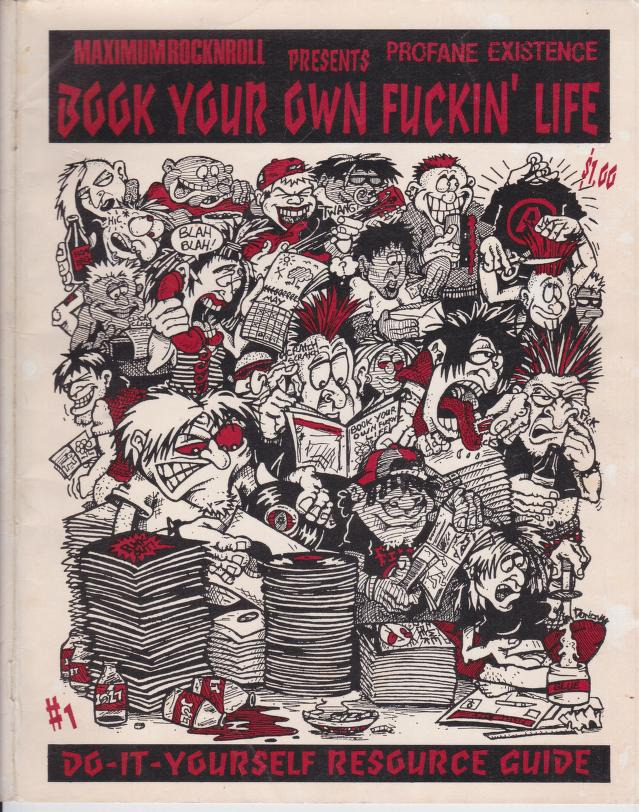
When not immersed in their hard-partying lifestyle, Gaugh and his bandmates flipped through Maximum Rocknroll’s “Book Your Own Fucking Life,” the popular fanzine of the times that listed promoters’ and club owners’ information for bands to book their own shows.
“Miguel [Michael Happoldt, Sublime’s OG mixing engineer and producer] would get on the phone: ‘Hey this is Miguel with Skunk Records, I’ve got Skunk recording artist Sublime coming through your town on these dates and wanted to see if we could hop on a gig there,’” Gaugh said. “We weren’t getting any love until we came up with the Skunk Records imprint. That was the defining factor. It became, ‘Oh Skunk Records? I’ve heard of you guys.’ They had no fucking idea who we were but they didn’t want to sound like assholes.”
The gigs started to roll in for Sublime, and they began to grow their fanbase up and down the West Coast. No longer was it a question if their music resonated with audiences. Now, the mission was to expand their reach and land coveted radio play.
The Sticker on Randy’s BMW
After self-releasing their debut album “40oz to Freedom” in 1992, Sublime embarked on a self-generated tour that began to birth interest from independent labels.
“We were talking with Brett Gurewitz from Bad Religion/Epitaph Records and he gave us some recording time at his studio,” Gaugh said. “We go to Hollywood, we record with Donnell Cameron, but Gurewitz isn’t there. We’re told he flew to New York to sign a contract for Bad Religion with Atlantic but would be back in a week and would call us. Donnell goes to pick up some food for us, and while he’s away, Miguel rewinds the two-inch tape, puts it in the box, and we split.”
Cameron returned to an empty studio with more than enough food for one person, and a small note from the band to have Gurewitz call them when he was back.
But Sublime didn’t see eye to eye creatively nor contractually with Epitaph, and declined to move forward. Having already recorded their material, the band figured they only owed for the studio time and parted ways.
“It was our intellectual property,” Gaugh said. “We were like, ‘This is our music and we’re gonna go,’ which is when we put out ‘Robbin’ the Hood.’ We had half an album finished with eight or nine songs that technically could have been a Hollywood album, but we liked to use all the space on the CD.”
Sublime finished recording “Robbin’ the Hood,” their second studio album, in various living rooms and flop houses across Orange County and Long Beach, but still needed distribution to help maximize its reach.
Fortunately, the band’s previous grassroots touring and independently released records generated enough exposure that they caught the attention of Jon Phillips, a young A&R at Gasoline Alley, an affiliate of Universal MCA.
“I was introduced to Sublime in 1993 through ‘Groovy’ Greg Abramson, an intern at Gasoline Alley,” said Jon Phillips, founder of Silverback Management and Sublime’s former manager. “I’d gotten an entry-level job there right out of school and Greg and I were the same age and had the same cultural identities.”
It was Abramson who handed Phillips the cassette tapes to “Jah Won’t Pay the Bills” and “40oz to Freedom,” instantly igniting his fascination with Sublime.
“Greg invited me to meet the guys and watch them play at Cal State Long Beach,” Phillips said. “I proceeded to identify Sublime as the only band I wanted to sign in the music business. In the two years since I’d received those cassettes, and subsequently ‘Robbin’ The Hood,’ I don’t think there was anything else I wanted to listen to. That’s how infectious Sublime’s songs were, music that fused all these different cultural hues, samples and references.”
In late 1993, Phillips brought the band to the Gasoline Alley offices for what was supposed to be an initial A&R meeting.
“The guys came in hammered with Brad’s dog Lou Dog and cases of beer,” Phillips said. “It scared people. I think Brad thought they were just going to roll in, sign the record deal, and get paid instantly. But the band never really got to meet the brass and sort of got blown off.”
Despite Phillips telling his uncle, Randy Phillips, a partner at Gasoline Alley, that Sublime was the band they needed to sign, he was met with resistance.
“We meet with Randy and he does not think we’re too cute,” Gaugh said. “But we’re Sublime, we’re Bud, Brad, and Eric, and we are who we are. We don’t care if you’re mister fucking Geffen himself, we’re gonna be ourselves. You get the real deal. So we show up stoned, and halfway through the meeting, we step out to smoke a ‘cigarette,’ which Randy did not find professional at all. He basically told us to kick rocks.”
But Phillips was determined to bag Sublime another meeting.
“I came down later that night after the band left and was walking by the executives’ cars with the placards at their parking spaces,” Phillips said. “The cars were all lined up and Randy was driving this new BMW 2-seat convertible European edition.”
“On the way out, we slapped a Sublime sticker on Randy’s brand new BMW that still had its Santa Monica dealer plates,” Gaugh said. “He didn’t think that was too cute either and raged at Jon, almost firing him over it.”
It pissed Randy off so much that it was an immediate, “I’m never signing these guys, they’ll never work in the music business again” type shit, and I was crushed.
Jon Phillips, former Sublime manager
“The label told me they weren’t doing any business with these guys and told the band’s lawyer at the time they weren’t doing any business with these guys. Then the lawyer called me and said he wasn’t doing any business with these guys.”
Phillips called Nowell and broke the news directly, to which Nowell said they were going to write “fuck Gasoline Alley” in the album liner notes. But Phillips was 23 years old and convinced of Sublime’s potential, so he went on a crusade, armed with Sublime’s cassette tapes, CDs, and other underground DIY output.
“I started sending Sublime to every A&R I could contact,” Phillips said. “There was a deal looming at Atlantic Records from another young scout, but they also slept on Sublime. Sublime’s music wasn’t a sure thing for a 50 or 60 year old suit in Beverly Hills and neither were their habits. Years later I asked Brett Gurewitz, ‘You had Sublime in the studio, why didn’t you sign them?’ He was like, ‘They were making music Epitaph didn’t fully identify with, and they had this girl in there doing this ska thing.’”
The girl was Gwen Stefani.
Sublime proceeded to self-release “Robbin’ The Hood” on Skunk Records, but in June 1994, Phillips brokered a reconciliation with Gasoline Alley, netting Sublime their first major record deal.
“When Sublime returned to the office to sign, Brad actually removed a folded Atlantic Records contract from his pocket and joked he was about to sign with another label,” Phillips said. “I’d become close with the guys, dedicated to their mission, and definitely would have been totally defeated if they’d signed elsewhere.”
“We came back to Gasoline Alley with, ‘We thought you’d dig it, just joking, sorry Mr. Randy,’” Gaugh said. “And then we signed a shitty deal.”
According to Phillips, the “shitty deal,” an entry-level Universal Records agreement for which they received $120,000 and was later renegotiated after the band’s success, also included an actual coin flip for their publishing: $100,000 for heads, $75,000 for tails. Nowell flipped heads and planned on using the contract money to buy their own recording equipment and rent a house in North County, San Diego, to make the next Sublime album.
“There are a lot of different layers to that story, but sometimes in the music business, you learn lessons the hard way,” Phillips said. “If you have success, you get some leverage to renegotiate, and if you don’t, labels usually cut their losses and move on. In this case, given all the circumstances, Sublime received an entry-level, boilerplate deal. I actually gave them the advice to lawyer up because I saw what was going on as a young kid. It wasn’t inherent to Sublime, it was any young artist in the music business. They try to own you.”
“Date Rape,” Addiction, and the Edge of Stardom
But as the band laid plans for their future, Nowell spiraled deeper into addiction.
“Brad got slapped with a felony drug charge and wouldn’t be able to travel internationally,” Phillips said. “Gasoline Alley, before Sublime hit any popularity, I’ll give them credit for this, stepped up and threw down $40,000 to $50,000 for lawyers and drug treatment programs to get Brad a drug diversion that allowed him to tour.”
With Nowell on the mend, Phillips focused on maintaining Sublime’s ethos as independent artists, advising the label to allow Sublime to continue marketing the band’s preexisting albums (“40 Oz. To Freedom” and “Robbin’ The Hood”) on independent Skunk Records.
“I wanted the band to build organically and avoid the pitfalls of a major label association,” Phillips said. “By convincing the suits to give us permission to continue marketing the band through Skunk Records, Sublime sold close to a couple hundred-thousand hard copy CDs through independent distribution.”
The vision helped the discovery process, with the popular single from the “40oz” album, “Date Rape,” breaking on KROQ in 1995, roughly six months after Phillips signed Sublime in the summer of 1994.
“When the song ‘Date Rape’ came out, the subject matter was popular in the media,” Gaugh said. “It was national news. People were getting roofied at college parties so it was a common topic on campuses. Brad writes this funny song making light of the situation and how the guy gets it in the end and justice was served. It’s not a ‘pro-date rape’ song.”
In fact, “Date Rape” was first written by Nowell in 1992, three years before it ever received radio attention. According to Phillips, Nowell told him he was jacked on coffee one college morning at UC Santa Cruz and wrote the song without thinking too deeply about it.
But the thought of making a song titled “Date Rape” in 2026 seems unfathomable, regardless if the intent of the song was to shine light on a serious subject through humor. Yet that’s what made Sublime Sublime. Their music reflected the world and times around them, and the band was unafraid to confront the morally reprehensible aspects of society.
Nowell started refusing to play the song live, with Phillips having to sign papers that guaranteed the band would play “Date Rape” at the 3rd Annual KROQ Weenie Roast in June 1995, a now legendary set at Irvine Meadows Amphitheater that saw Stefani join Nowell for their hit “Saw Red” and 40 friends of the band join the stage with fake backstage passes they’d printed in advance.
“Sublime had a penchant, like everyone else, for freedom, and in their case, perhaps anarchy,” Phillips said. “All of that was so much a part of their DNA and the culture around them. It was authentic and they lived it.”
The band wore their association with counterculture on their sleeve, at times failing to show up to their own gigs, further perpetuating their notoriety as purveyors of drugs and mayhem.
But despite their reputation as wild cards, Sublime’s music continued to garner a cult following.
“There was something so unique but also universal about the music,” Phillips reminisced. “The cross section of all the touchpoints Sublime encompassed, hip-hop, reggae, punk rock, pop culture, sampling, even a small ode to the Grateful Dead, they fused together all these music subcultures to create something fresh and new.”
Music You Could Feel
Something fresh and new people could relate to because it was authentic, it was organic, and it resonated.
“We wrote about real things in our lives,” Gaugh said. “Brad had a very charismatic way about writing firsthand. Things that were in our songs like, ‘pissed in someone’s drink and threw a bike in the pool,’ that happened. With all this bullshit going on around us, there was still something lovable about life, and it was about trying to find the ‘good’ even when there were wicked things around.”
It’s why a teenager today can pick up any Sublime record and still have a connection to it, over 30 years later. But perhaps the group’s greatest resonance is the spiritual understanding that they were co-creating music with the universe: Bud, Brad and Eric, a clear channel on the astral plane, a trio communicating truths.
An entity was using these three bodies, these three sacks of bones and blood, to make this music. We were just useful tools it seemed. It was transcendental.
Bud Gaugh
“With Sublime, it was the first time I experienced out-of-body realism,” Gaugh said. “When I was stoned and we were playing, I was floating around the room. A weird, ethereal, metaphysical kind of happening.”
Beyond the shared commonality between Sublime and its audiences around cannabis, weed also provided the basis for creative alchemy between Gaugh, Wilson and Nowell in such a way that their confluence of synergistic output was shared, felt and experienced by the crowd in the same way one might experience Mick and Keith or Flea and Frusciante communicating through their instruments.
“There’s a quote from Brad on one of the promotional CDs, ‘Good music is good music, and that should be enough for anybody,’” Phillips said. “Timeless music is timeless music and that’s the beauty and magic of it. That’s what makes it powerful. One Sublime song could traverse four different styles, not including the full repertoire, which might traverse 10 different forms. They’re so much more intellectual than people give them credit for and there was a lot of wisdom behind where a lot of these things came from that wasn’t by accident.”
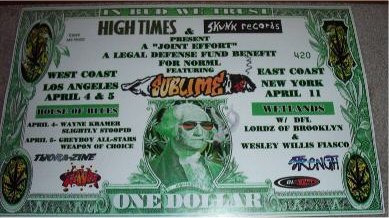
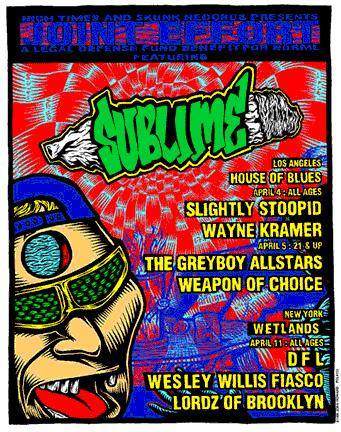
The wisdom came from alignment, including Sublime’s connection to the legalization movement. The band’s last performance in Los Angeles was a 1996 benefit show at House of Blues on the Sunset Strip, cosponsored by NORML and High Times Magazine.
The Baby From the “What I Got” Video Takes the Mic
But now, over 30 years later, cannabis is legal and Sublime has returned to the stage under its original moniker, this time with Brad’s son Jakob Nowell installed as the new lead singer. It’s a role many never saw coming, but one the younger Nowell seemed destined for, with their new album “Until The Sun Explodes” due out June 12th, 2026.
Jakob Nowell only knew his father for 11 months, but as fate would have it, came of age and began carving his own path in the music industry, learning more about Bradley Nowell through the body of work he left behind.
Now, the younger Nowell holds the same guitar frets as his father, singing Bradley Nowell’s words, playing the same chords that became his birthright but delivering a sound and feeling uniquely his own.
If we all come from the same source, Bradley Nowell has certainly returned to that place, and now, while channeling from source, Jakob Nowell is undoubtedly bringing forth the essence and mysticism contained within his father’s energy. Jakob Nowell is not a carbon copy of his father, but if you look under the microscope, you’ll see within the double helixes of his DNA that love is also what he’s got.
“When Eric approached me to do a show for H.R. [Paul Hudson of Bad Brains] with Jakob, I was into it but skeptical,” Gaugh said. “I’d played a couple songs with Jakob maybe seven years prior and he was into a different style of music. I thought, ‘Is this going to work?’ But when we got into the studio together, it was like stepping back in time.”
The same “floating around the room feeling” Gaugh once felt with Wilson and Nowell’s father is the same feeling he’s now experiencing with Wilson and the younger Nowell.
“We’re playing in the studio and came out for a break,” Gaugh said. “Jake’s like, ‘Dude, that was so deep, I was floating around the room! Does that happen for you guys?’ Eric turns and looks at him like, ‘Yeah, man. If you do it right.’”
For a band largely without a lead singer for the past three decades, Sublime has encountered new life, a trippy, fortuitous, full-circle experience cracking open the door to the vista of what the original lineup could have looked like to this day. In many ways, the authenticity of Jakob Nowell as Sublime’s new frontman is emblematic of that panoramic landscape.
“Early on when I was working with Jakob, he was totally focused on wanting to create his own identity and vision and not really touch the Sublime legacy,” Phillips said. “But when you’re blood to that, it’s in your soul that you would one day want to embrace and be a part of it. The fact that he has the talent to do it and carry it the way he does is remarkable to me.”
A new generation of music and fans, built upon older pillars, cut from the same stone.
We were on this ramp shooting off to the moon and all of a sudden, the launch got cancelled. But now, we’re breaking our own records.
Bud Gaugh
“30 years later, we’re still being played on the radio,” Gaugh said. “It’s an incredible feeling. Our fans are the greatest people in the world. Hats off to them because this is truly a testament to their love of the music and why it’s still here. Getting the opportunity to go out and perform this music with Brad’s son is incredibly humbling. I’m just so grateful to be able to do this. It’s a dream come true. We got short changed, we were never able to play some of these songs. ‘Ensenada’ has topped the charts for seven or eight weeks in a row in the US and it’s still on the charts in Canada.”
Sublime’s current airwave success is due in part to the creative input employed by Gaugh, Wilson and the younger Nowell, methodology eerily similar to the way the Sublime elders created songs with Nowell’s father over 30 years before.
“It’s like how we wrote Sublime back in the day,” Gaugh said. “Brad would come with a melody or an idea and he would sit there and play. Then Eric would start playing or I would come up with a rhythm. It was the three of us creating on the spot. Now, Jakob might have a chord progression already done and a hook, but he might not have all the lyrics, which is exactly how we used to do it.”
Gaugh even sees the younger Nowell employ the same formula his father used when crafting songs, writing about what’s happening around him and even writing about the things he’s experiencing while on tour with Sublime, a key component of his dad’s technique.
It’s part of the reason Sublime’s 1990s discography has remained relevant up until today, where the inputs to the songs transcended the moment in time and spoke to the underlying feelings of the times.
And feelings are timeless.
Perhaps there’s a feeling of comfort between Gaugh and Wilson with the younger Nowell in the fold, a trippy recreation of something alchemically familiar and an opportunity to musically expand a previous endpoint into a new beginning.
“The fact there could be a presentation rooted in the actual kin to Bradley, I just love the generational aspect of music,” Phillips said. “I work with Bob Marley’s son Stephen Marley and Aaron Neville’s son Ivan Neville. Whether it’s blood like the Neville Brothers or the Marleys or Sublime, Bradley to Jakob, it only gets the message of the music further out there to affect more people that need to hear it. We didn’t get to see the real Sublime with Brad Nowell enough, and for that reason, it’s a blessing it gets to continue.”
Continue and thrive with both a new generation of fans and those who have been with the band since its inception.
“For the OG fans, Jakob in the band is closure,” Gaugh said. “It’s some kind of relief for them. Everybody has wanted this for years from a fanbase standpoint, so being able to give them that is awesome. But also, for the longevity of the band. I’m a dad now, and the things my kids do and say, I’m an old man. Trying to stay hip is harder as you age, but Jake’s in it and he keeps us relevant.”
A new frontman from the same seed is able to give us something similar but different, weaving an unexpected, unknown tapestry right before our eyes, one we could never have imagined but now get to experience.
“I was talking with a family at Mission Bay Fest and they were like, ‘My dad played your music and I grew up loving Sublime. Now my kids are listening to Sublime,’” Gaugh said. “With our new music coming out, it almost sounds like we started where we left off.”
It’s as if time stood still and now, 30 years later, we’ve resumed a parallel reality where a Nowell is atop the microphone, a Wilson on bass, a Gaugh on drums and the “What I Got” summer anthem of 1996 is morphing into “Ensenada” as the 2026 anthem of the summer.
After a long hibernation, the sky finally opened and Bradley Nowell reached down, placing his guitar into the waiting hands of his son, Jakob, familiar fingers and a familiar voice that now strum fresh perspectives and breathe new life into the Sublime catalogue.
Now it’s Jakob, backed by Bud and Eric, who lights his morning cigarette, slips into his sneakers, and plays his guitar like a mother fucking riot, honoring the legacy of Sublime and inviting the next generation of fans to come along the journey on the road to something new, helping tell a story that hasn’t yet been told.