




It could be so easy to believe that cannabis culture is something that has been fully claimed by the profit-driven forces of capitalism.
The polished packaging that lines the shelves of dispensaries.
The slick branding that populates the websites of many cannabis advocates and cannabis-centered companies.
But somewhere on the streets of Harlem, Logan Grendel—artist, urban gardener, musician, revolutionary community organizer, and “very, very modern version of the village witch”—offers a different vision of what is possible: cannabis as a source of radical hope, connection, and collective liberation.
The Cannabis Connection
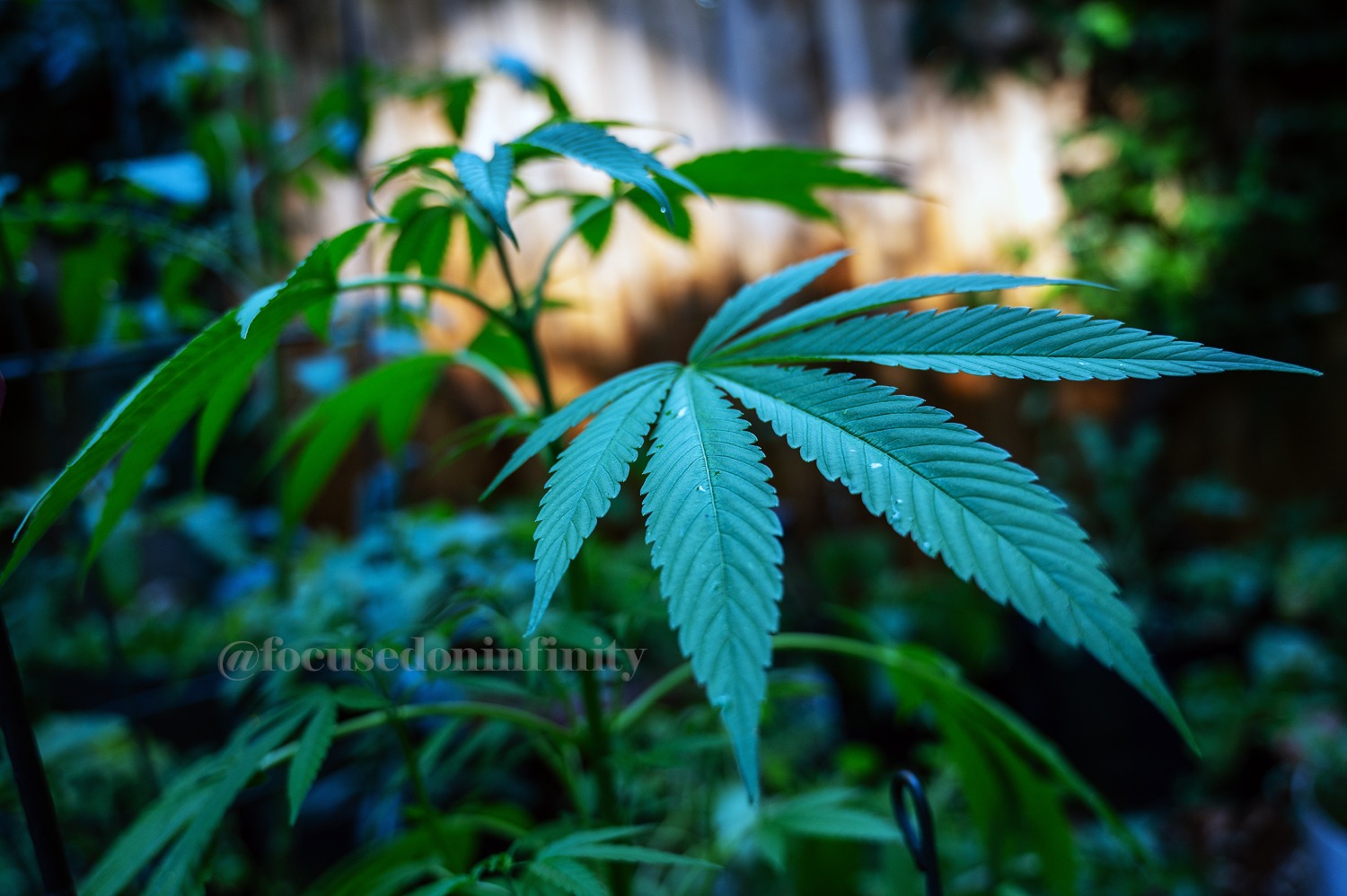
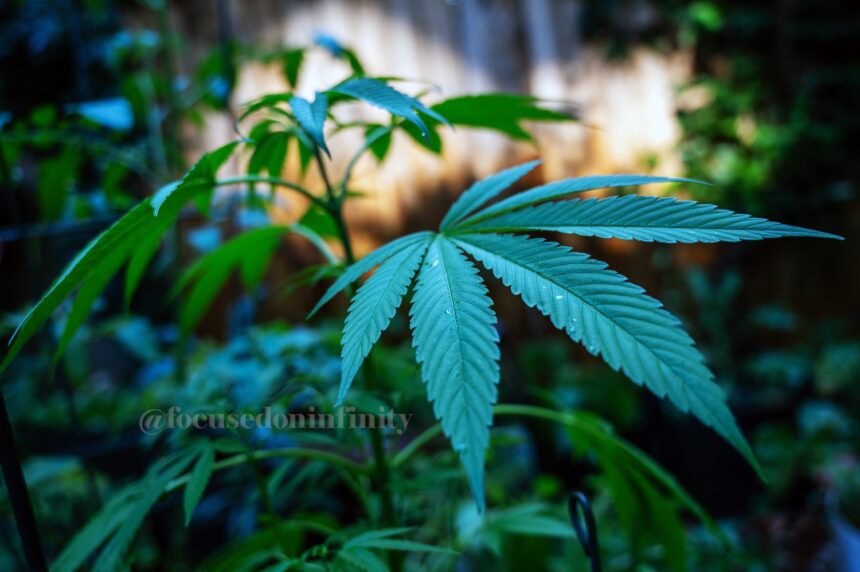
A cannabis plant grown by Logan in a previous season. Photo credit: Logan Grendel. Used with permission.
Logan’s insight into cannabis arises from years of interaction with this mentor plant.
“I have allegedly had a personal relationship with cannabis since I was a young teenager,” they said. “And that relationship, the personal relationship, has been medicinal, it has been healthy, it has been, sometimes, a coping mechanism—because the world is hard when you are multiply marginalized and living through capitalism, et cetera.”
Nowadays, Logan is very intentional about the ways they interact with cannabis. “I don’t partake that much anymore,” they continued. “At this point, it is largely medicinal and spiritual. The spiritual use can depend on the ritual: sometimes I like Big Clarity, but sometimes cannabis will be something I add. Whatever ritual work I am doing, getting out of my own way is part of that, and cannabis can be really helpful there.”
“Sometimes cannabis is just for relaxation, you know? Some people—and I am also some people—would have a glass of wine at the end of the day: sometimes I would prefer a little touch of the water pipe instead, as it were.”
Logan also sings the praises of the medicinal gifts of cannabis. “There is nothing better for settling a stomach that I have found,” they said. “Also, sometimes when the emotions are too loud, it just helps turn down the volume so you can—it may seem paradoxical—have a little bit more clarity during a situation and help you to weather the worst of the storms.”
Despite the fact that they rarely directly imbibe cannabis, their life is nevertheless significantly shaped by this plant and her medicine: their current work with cannabis grows from the soil of a small urban garden, where the flowers they grow and tend become living tendrils of community connections.
You Can Just Grow
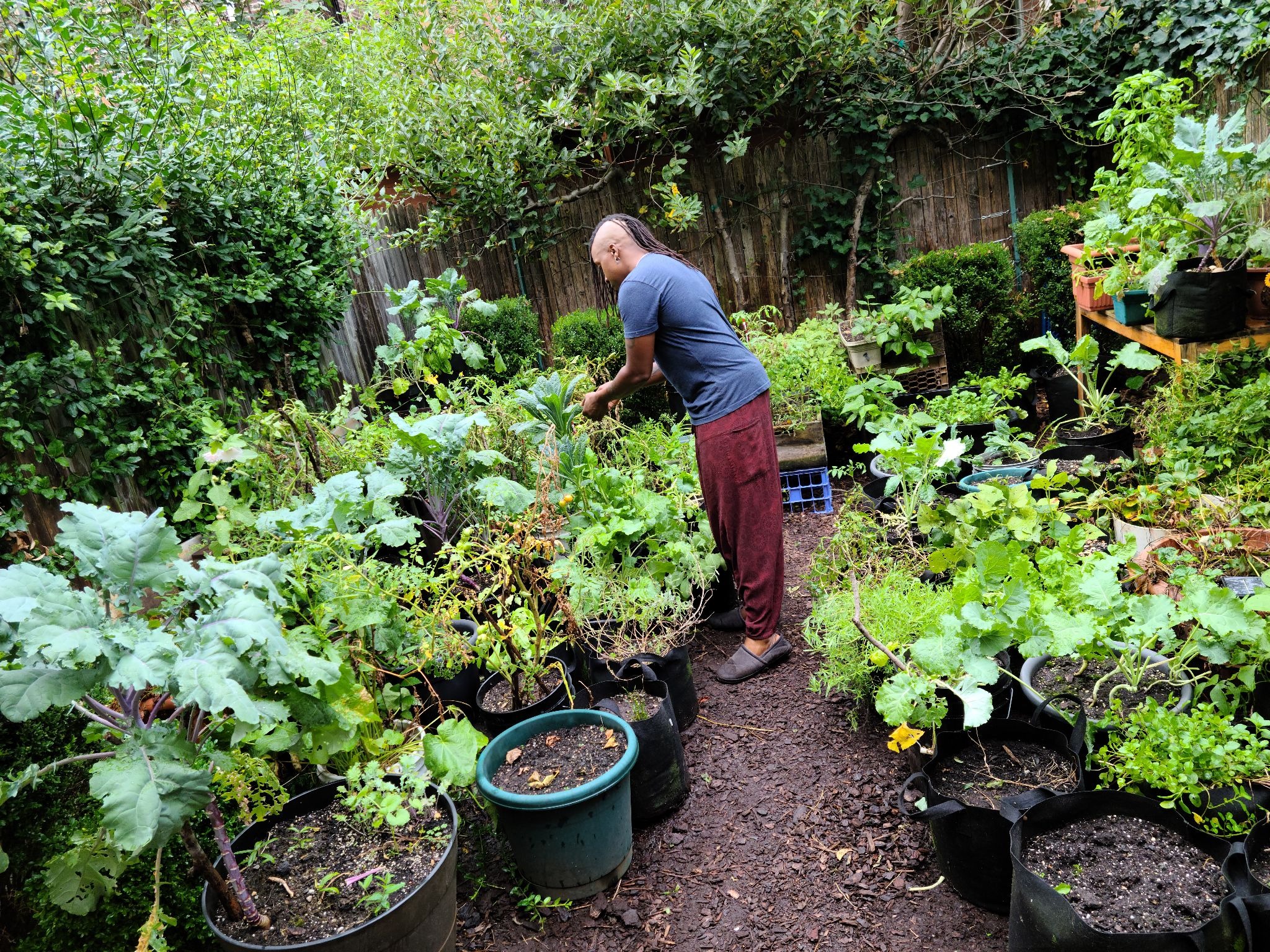
Logan tends to the Infinity Garden. Photo credit: Logan Grendel. Used with permission.
Over the last six years, Logan has frequently posted about the development and growth of their backyard urban garden, known as the Infinity Garden.
“The Infinity Garden—as with basically all things I do—is a syncretic and alchemized crystallization of magick, science, art, political praxis, and just—the practical,” they said. “I like to grow things.”
“So I decided to grow things in a way that made sense for me,” they said. “I mean, I’m a city kid. So, I don’t have acreage. I don’t have fields to plow nor yaks and oxen to plow them. What made sense to me was to take repurposed containers and some fabric pots as well—and 5-gallon buckets that I took out of the garbage outside of restaurants and such in my neighborhood—and turned those into growing vessels.”
They began volunteering at a nearby community garden, and through that experience gained additional layers of knowledge about growing edible and medicinal plants. Now, they are committed to encouraging others to establish gardens of their own…
and then empowering those folks to inspire others to establish gardens of their own,
which will then inspire still others to plant seeds of their own… and so on and on and on.
You see why they named their garden the Infinity Garden?
“Yes, the Infinity Garden is based on the idea of the Victory Gardens from World War II,” they said. “Because I have been seeing the trajectory of what is coming toward us. A lot of people didn’t see it before, but I can bet you they are seeing it now!”
The word-choice pivot from Victory Gardens to Infinity Gardens was a well-considered one.
“It’s not an Infinity Garden until you have convinced someone else to grow one,” they said. “The gardens replicating themselves, the eternal infinite replication, the spreading of green through the gray of cities, through what humanity has put on top of the ‘natural’ spaces—we are putting back the green onto it, even literally atop the gray.”
“And you don’t need anyone’s permission. You can just grow.”
Kindness Spreads
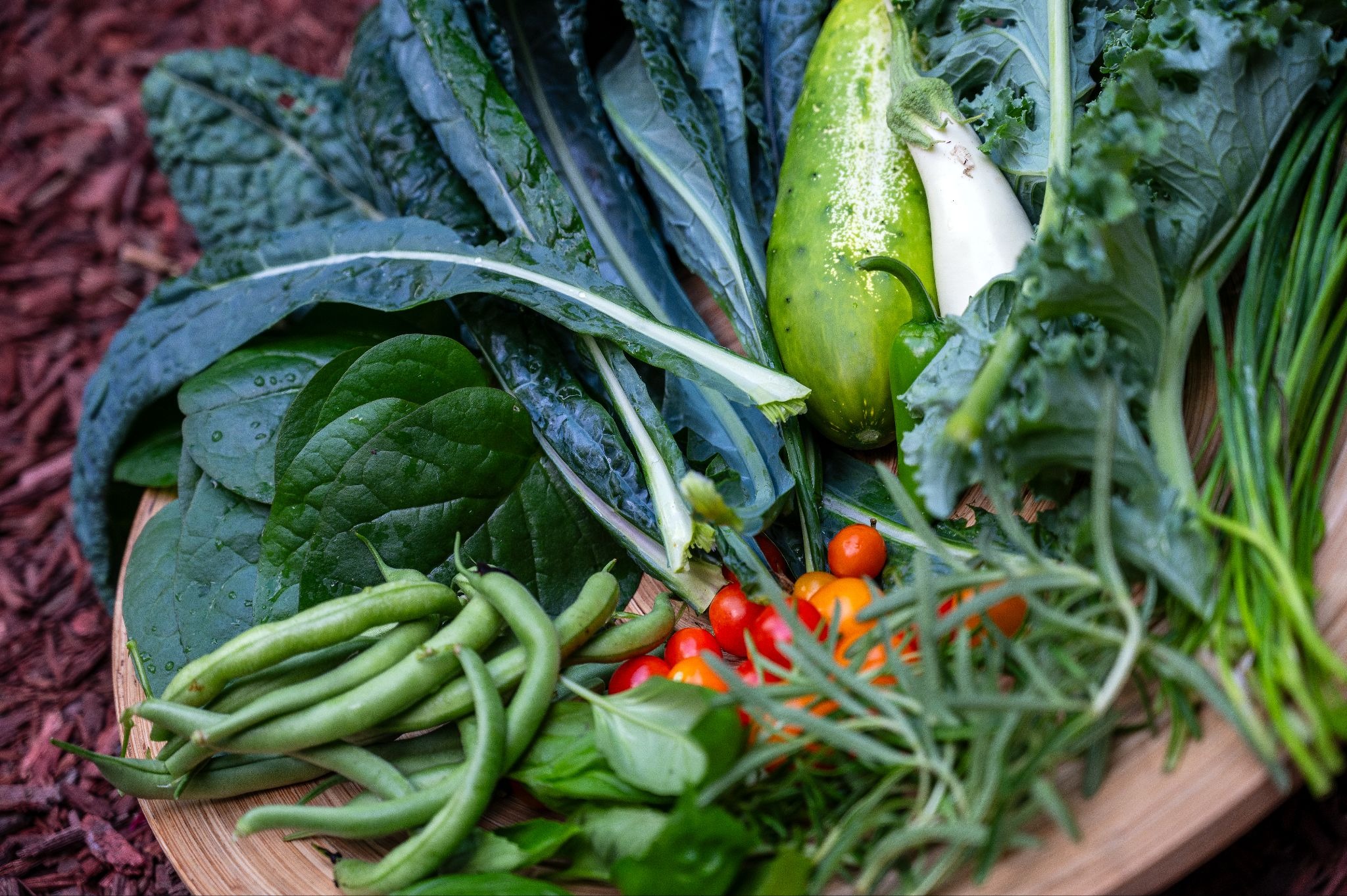
Vegetables harvested from the Infinity Garden. Photo credit: Logan Grendel. Used with permission.
The combination of cannabis’s natural abundance (especially when she is lovingly tended in the way that Logan tends the plants in their garden) with Logan’s infrequent personal indulgence in cannabis means that they have an abundance to share within their community—a practice that they can incorporate into their daily dog-walking rhythms.
“Since I grew last year, I have just been carrying some with me and giving it out,” they said. “I will see someone, maybe someone who is already smoking, maybe someone who I have a nice interaction with, just a random human interaction—Hey, that’s a nice coat you’ve got on or Oh, I like your hat, whatever—and then I will just offer them some.”
“It really has been such a lovely way of passing along literal community connection and good feelings in the area I live in.”

Indeed, several times throughout our interview, Logan needed to pause mid-thought and mid-sentence to greet the many people they knew who crossed their path, their voice full of warmth and genuine interest in every interaction.
“I strongly believe that kindness spreads just as sure as hatred and vitriol spread,” they said. “You do something nice for someone, and they are just in a better mood, and they are more likely to do something nice for the next person—it really is that simple.”
The other side of this coin, of course, is that there is nothing about this practice that exists outside of the overarching context of white supremacy, patriarchy, and extractive ways of living that define the overculture. “I do like to center People of Color and people who are apparently Black cis men,” Logan said. “Of all the people on the planet, these are people who are least often approached with simple acts, just to offer something nice, just to make their lives easier.”
The impact of the overculture makes building these connections harder at times than one might expect. “It is so sad how—a couple of times I have been refused because they were just suspicious that I was going to then launch into a sales pitch or that there was something wrong with it,” they said. “It’s just really sad.”
“But a couple of times, they have just been so beside themselves with joy, and that makes it all worth it, really. It has brought me such happiness to be able to bring a little happiness.”
Community, Care, and Cannabis
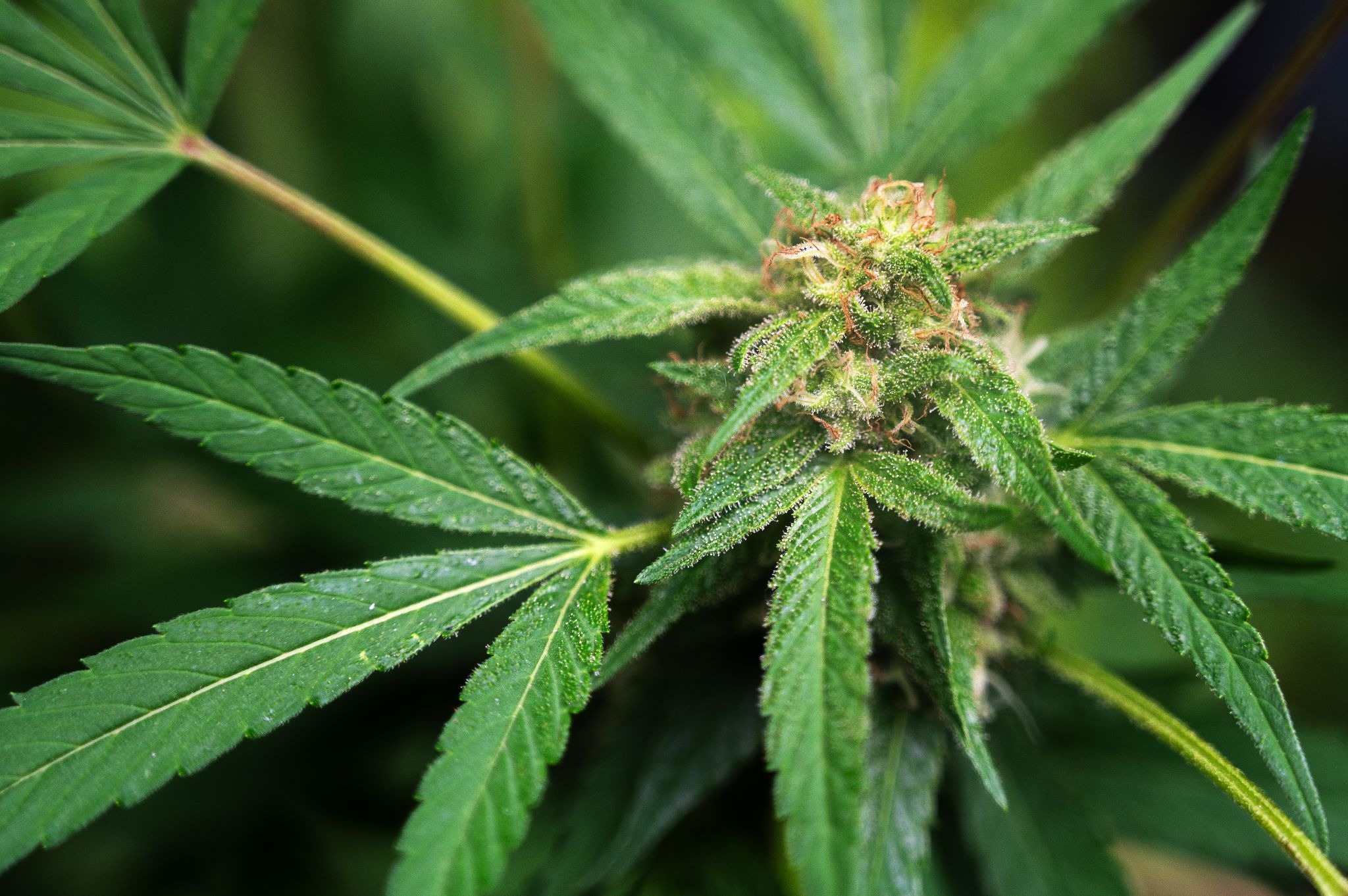
A cannabis plant grown by Logan in a previous season. Photo credit: Logan Grendel. Used with permission.
As it turns out, growing and sharing cannabis, building community, and community organizing are all deeply connected, at least as far as Logan is concerned. “This is the mycelium, too: the community organizing that we do is one way of spreading mycellially (if that’s a word), but also this cannabis connection is another one.”
“And the people I share with aren’t necessarily all people who I would have political discussions or social/political conversations with, who I wouldn’t engage in a conversation about pronouns or such,” they added. “But we meet each other where we are, and through cannabis have an area of simpatico that we can grip onto.”
Building community networks is of vital importance right now, and cannabis is uniquely positioned to help with the problems that we are collectively facing. “The biggest threats to liberation right now are misinformation and disconnection,” Logan stated directly.
“But to get to the next part, to what brings us toward a more liberatory future—what we need is to continue educating each other, and that starts at every level,” they said. “You know, one of the reasons that I have been giving out cannabis and also just other types of plants from my garden, just giving them out—it starts these little relationships. It provides an opportunity to bridge gaps locally.”
“The healing here is not just the literal properties of stomach settling and pain management and emotional regulation that cannabis provides, but it’s also the social connections,” they said. “You can give and receive affection and community and care for no reason other than that you exist and that—honestly, that is some of the biggest healing.”
“And it is just—we spread information like the mycelium, like nature itself spreads seeds, and we have to do that to reeducate ourselves and others because of all the gross miseducation that has been done on every level.”
The Web of Hope
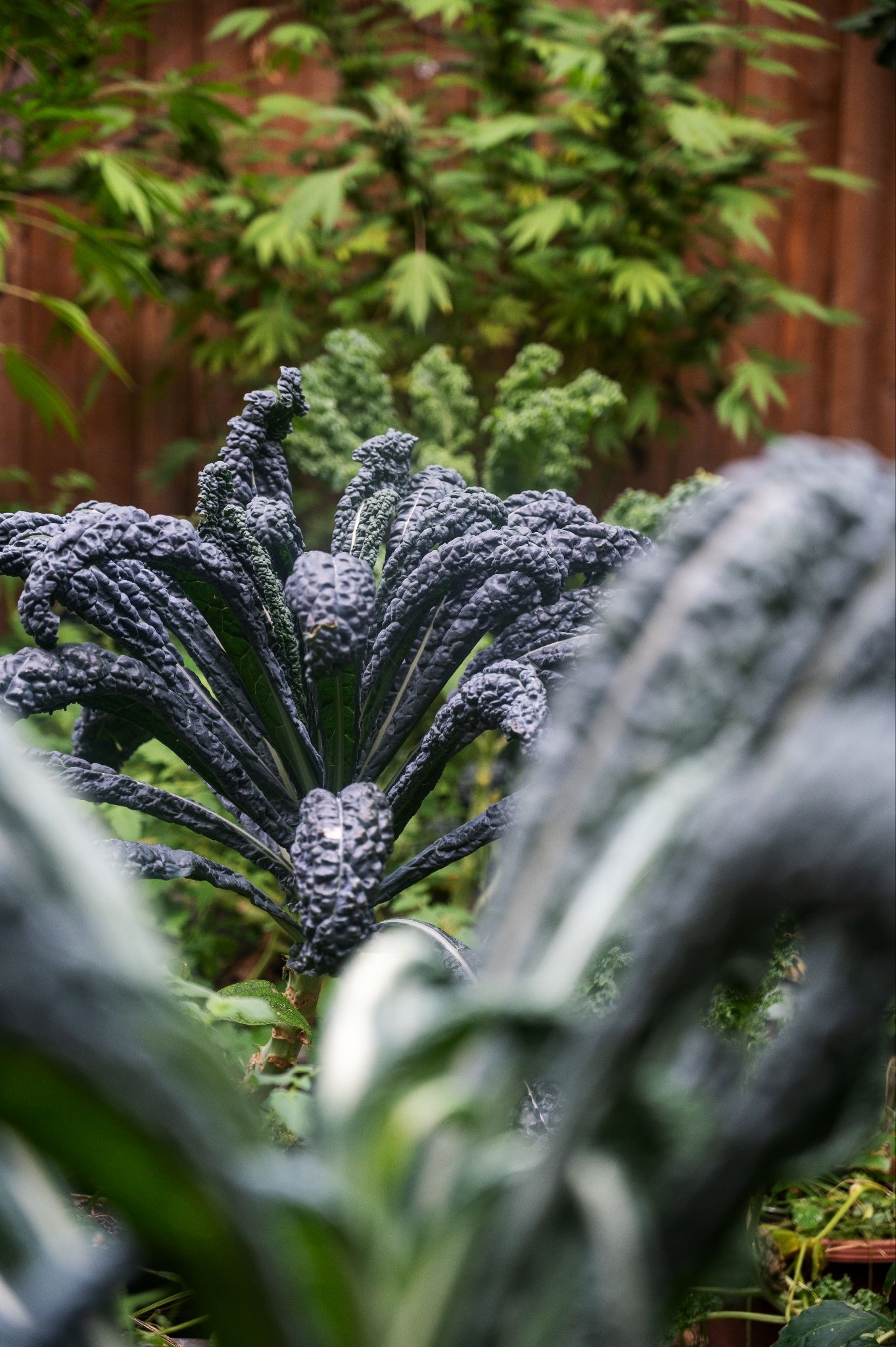
Kale and cannabis grow in the Infinity Garden. Photo credit: Logan Grendel. Used with permission.
The good news is that, according to Logan, healing from misinformation and disconnection is one of the most natural processes we can commit ourselves to.
“I think we want to be part, we want to feel ourselves as part of a living web, as part of the exchange, the interplay between things,” Logan said. “The world is not naturally transactional, and I don’t think that we are so naturally transactional as society makes us believe.”
“There are neighbors who I share plants with, and have for a number of years now,” they continued. “I’ll give them some tomato starters, they’ll give me some sunflower starters, whatever—that right there is so hopeful. We do want to share. We want to give, and that is the hope.”
And it is undeniable that there is something uniquely magical about sharing cannabis. “Cannabis is, like, the best thing for that, because it’s got so many different levels to it!” Logan noted. “It’s got the pure joy, it’s got the potentially medicinal aspects, it makes you feel like you’re kind of sharing in a little skulduggery because of its recent illegality (and still being illegal in some places, ludicrously enough).”
Of course, alongside the joys and gifts of cannabis are the sobering realities of the world at large—a world in which cannabis’s gifts are so direly needed. “With the collapse of all things, dear gods, we are going to need to have ways to get each other everything we need,” Logan observed. “And cannabis is something that—whether it is for medicinal reasons or just for recreational ones, or whatever the reason—I think it is one of the most important plants for us to be cultivating and sharing with each other.”
Resistance Is Fertile
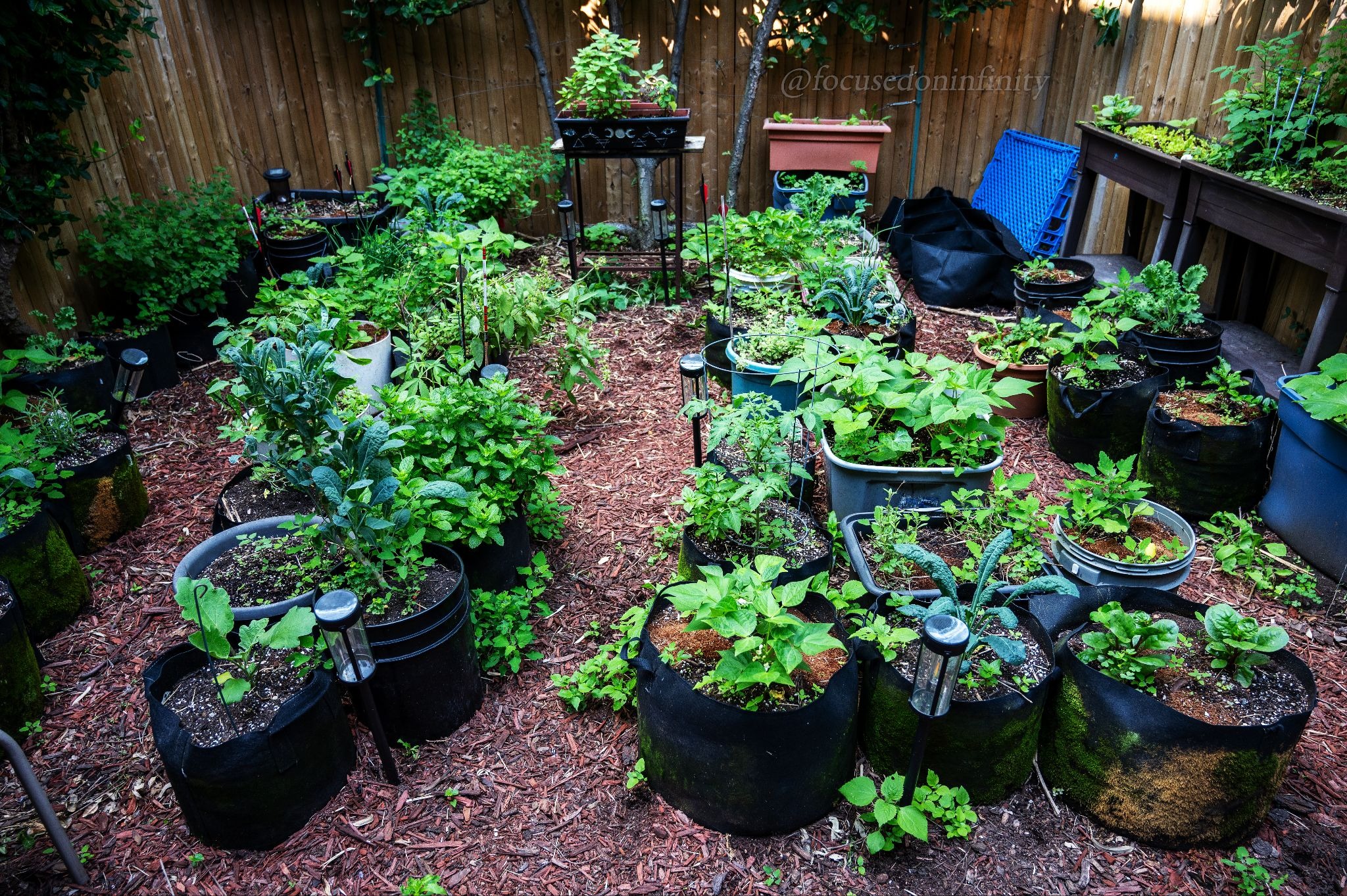
The Infinity Garden in one of its many incarnations. Photo credit: Logan Grendel. Used with permission.
Logan is among the growing number of people who have recognized how deeply empowering it is to claim their independence from cannabis capitalism.
“Growing and sharing cannabis is a way to put power back into the hands of the people, right?” they said. “Because even though it is legal now and you can buy it without having to do anything sketchy or worry about getting arrested (at least if you’re in a place where it’s legal), the people who still have control over that process are getting money from you.”

“And growing and sharing cannabis could literally be something that you just do in your neighborhood, or you have people in your community who grow,” they continued. “And that is political control. That is political power. Every resource that we have control over as the people, that we can share between each other without the need for usury, or without the need for money, or without somebody else coming into our neighborhood and bringing it for us—that really is the big thing,” they said. “When people bring things in to sell them to you, when they are bringing them in and you can’t produce it yourself, they have control over you, especially if it is something that you really want and/or need.”
“Resistance is fertile. We grow the future that we need,” they added. “It’s not just about everyone being nicer—even though that’s actually true, because when people are less desperate they are able to be kinder—but it’s because it just makes more sense. Kindness makes more sense. Mutualism makes more sense.”
Culture Appears
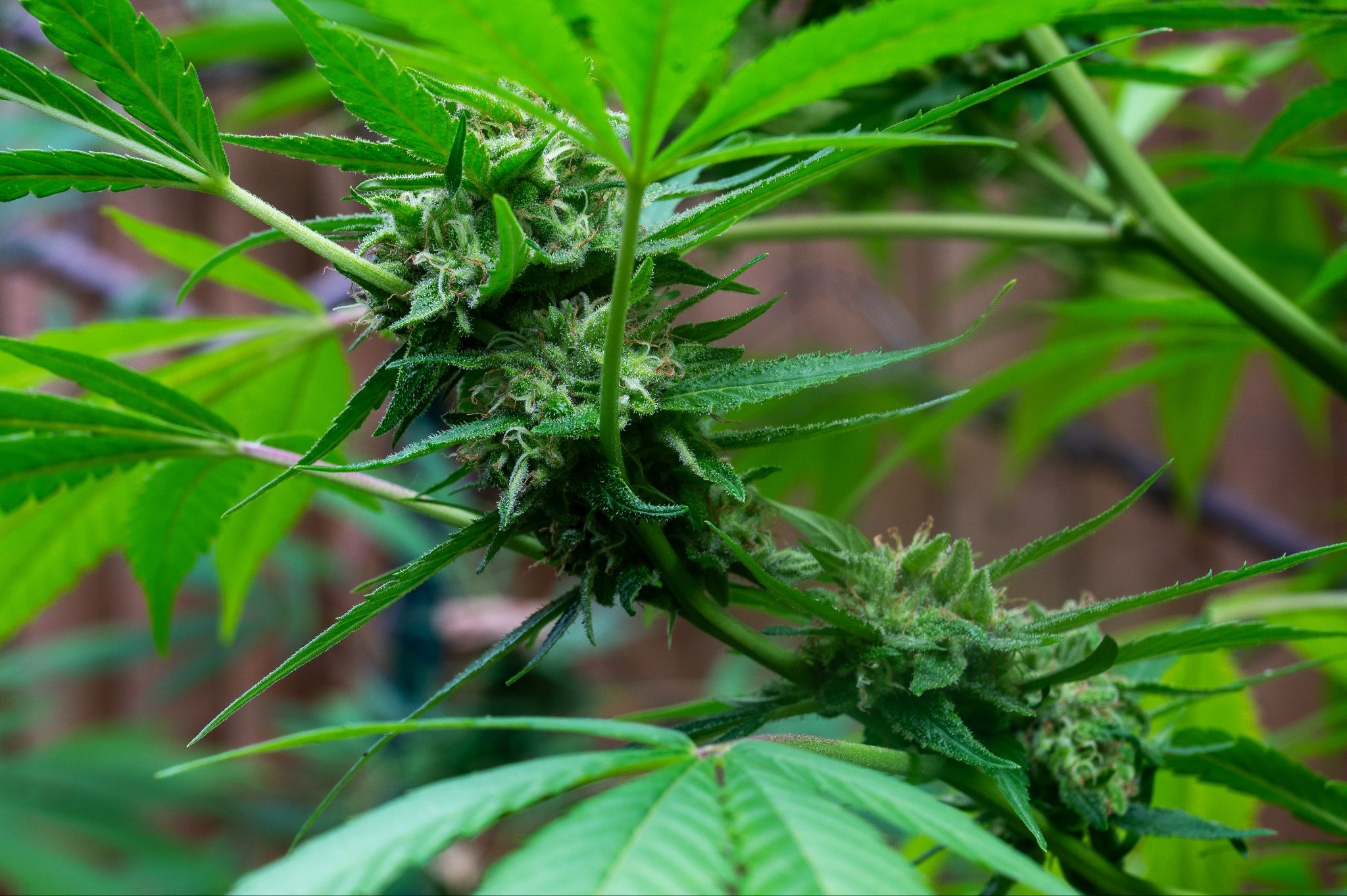
A cannabis plant grown by Logan in a previous season. Photo credit: Logan Grendel. Used with permission.
And it is a sort of sense that a lot of people are here for. “You cannot walk down the street in the city—I have not probably in my life, even when it wasn’t legal—” and here they paused.
“Actually, I didn’t see anything. Before it was legal, I never saw anything,” they said. “But now that it is legal, it’s like every block, at most every other block, you see someone smoking. So, having control of production of that would be so powerful—and again, that would be another thing people could share.”
This could ultimately shape cannabis cultivar development away from unilateral, quantifiable metrics such as the sole focus on THC percentages… and back to the experiences, needs, and preferences of the people who are the roots and life of cannabis culture.
“You’d have local strains that are just like, Oh, yeah: that’s the one everyone in Harlem grows, because of one person who shared all these seeds,” they said. “And oh yeah: you’ve got a North Brooklyn strain. And this is something I foresee in the future, whether you’re talking about vegetables, whether you’re talking about cannabis, whatever it is you’re talking about—clothing, music styles—”
“The way that culture actually grows is that when you leave humans the fuck alone to provide for themselves, they do—and then culture appears,” they continued. “Culture, to me, includes the things that people do that are expressions of this process—whether we’re talking about clothing, whether we’re talking about music, or style of talking, dressing, what they eat or how they eat it, and how they smoke.”
“And cannabis—for all the reasons that we’ve talked about here—can serve as a connective tissue for a lot of those experiences.”
Growing Toward a Better Future
The conversations Logan has with their neighbors, and every tomato seedling and cannabis bud they share, are not separate from the overarching work they are committed to: continuously growing toward a better future.
“I always say the most selfish thing you can do is be good to everyone you meet,” Logan said. “Because then you will not create any enemies. Then you will get to experience joy. Then you will be welcomed wherever you are.”
“Getting back to the idea of the village witch: that is kind of how I see myself really,” they said. “I am a very, very modern version of the village witch, you know? Like, I have some cannabis, I have medicinal herbs, I have some plants and witching herbs that I will share with people, and that’s—we need that.”
“With the future that is coming, what we need to do is rely on each other,” they added. “We need to make lines that are drawn based on who we are and who we want to be, as well as what really appeals to us as people—and what we really can do for each other.”
This may sound daunting, but it is also the most natural thing in the world. “This is our natural state,” they said. “We are part of each other. We are part of the world. We are from this planet. We need to reindigenize ourselves by restoring our connections—and cannabis is one of the ways we can do that.”
Logan emphasized the importance of starting seeds, literal and figurative. “I hope that more people will start growing—in every way, not just cannabis. Everything we get is going to come from the ground up.”
“I really feel like we have to remember that everything good—everything really good—and everything real is on the other side of this.”
This article is from an external, unpaid contributor. It does not represent High Times’ reporting and has not been edited for content or accuracy.