






A powerful congressional committee is allowing a psychedelics-focused amendment to a major military bill to proceed to a floor vote in the House of Representatives—but it is also blocking other cannabis- and drug-related proposals from advancing.
The House Rules Committee on Monday considered the amendments to the National Defense Authorization Act (NDAA) for Fiscal Year 2027, allowing one that would extend a psychedelics research effort at the Department of Defense (DOD) for an additional six years to move forward.
Sponsored by Reps. Morgan Luttrell (R-TX), Jack Bergman (R-MI), Derrick Van Orden (R-WI), Mike Ezell (R-MS), Troy Carter (D-LA) and Morgan McGarvey (D-KY), Lou Correa (DCA), Seth Moulton (D-MA), Sarah Elfreth (D MD) and Michael Rulli(R-OH), the amendment seeks to include language in the bill expanding DOD studies on psychedelics that were first authorized under the earlier 2024 NDAA.
That program, signed into law by then-President Joe Biden, directed DOD to establish a process by which active duty service members with post-traumatic stress disorder (PTSD) or traumatic brain injury could participate in clinical trials involving psilocybin, MDMA, ibogaine, 5-MeO-DMT and “qualified plant-based alternative therapies.”
As enacted, it only required the secretary of defense to issue updated reports on progress within one year of the law passing and then annually for three years after that. The new amendment would replace “three years” in the law with “nine years.” It also specifies that DOD would have to “extend the performance of research conducted using funding awarded under this section to September 30, 2033.”
The previously enacted legislation, which was also championed by Luttrell, set aside $10 million to fund the military psychedelic studies.
Earlier this month, the House Armed Services Committee approved its version of NDAA and an attached report that calls on military officials to pay greater attention to potential “access pathways” to psychedelic therapies for servicemembers.
Citing a psychedelics executive order signed by President Donald Trump in April, the panel urged DOD leaders to “remain informed of lawful research and access pathways relevant to post-traumatic stress disorder and other serious mental health conditions affecting servicemembers during post-deployment and transition periods, and members of the Reserve Components and National Guard who also serve as first responders.”
That includes studies on “psilocybin-containing investigational products, including naturally derived whole-mushroom formulations administered in structured therapeutic settings,” the report that the panel approved to be attached to NDAA says.
The panel is directing the secretary of defense to issue a report by February 1, 2027 that assesses data on such trials, along with an assessment of “legal and regulatory requirements for expanded access,” including under Trump’s psychedelics executive order as well as a Right to Try law the president signed during his first term in office.
The secretary’s report would also need to include a “proposed timeline for potential pilot activities or expanded clinical research beginning in fiscal year 2027, and for any broader implementation thereafter.”
Lawmakers also used last year’s NDAA to push DOD for a “progress report” on the ongoing psychedelic therapy clinical trials.
—
Marijuana Moment is tracking hundreds of cannabis, psychedelics and drug policy bills in state legislatures and Congress this year. Patreon supporters pledging at least $25/month get access to our interactive maps, charts and hearing calendar so they don’t miss any developments.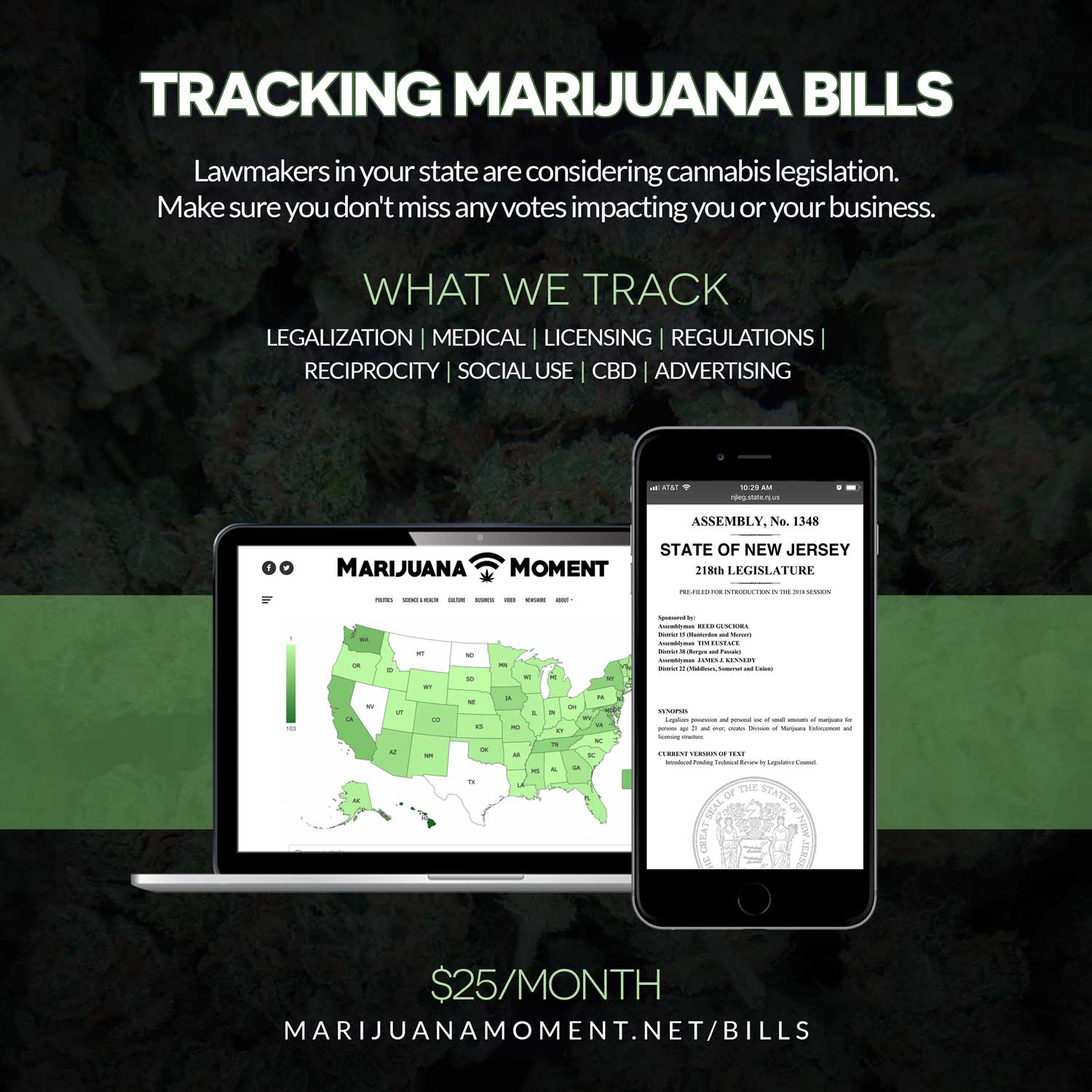
Learn more about our marijuana bill tracker and become a supporter on Patreon to get access.
—
Another proposed amendment to the current NDAA from Reps. Dave Joyce (R-OH) and Dina Titus (D-NV), would have expanded waivers for military recruits who’ve tested positive for marijuana—but the Rules Committee is not allowing it to advance.
The amendment acknowledges that the Army and Navy have already “taken positive steps in their work to design and implement a waiver system that permits potential enlistees into the Armed Forces to reapply for enlistment following a positive toxicology test for tetrahydrocannabinol.”
It calls on the Air Force, Space Force and Marine Corps to follow through, especially “given the ongoing recruitment and retention challenges undermining the Armed Forces readiness goals.”
A similar measure filed by Joyce and Titus, who are co-chairs of the Congressional Cannabis Caucus, was passed by the House of Representatives last year but was not enacted into law.
The current measure would have required those military branches to “develop and implement their own permanent waiver system commensurate with the process employed by the Army and Navy.”
It says that the secretary of defense “shall develop a program through which to provide waivers for potential enlistees into the Armed Forces who were not permitted to enlist following a positive toxicology test for tetrahydrocannabinol so that such potential enlistees are permitted to reapply for enlistment.”
Further, the Department of Defense would have been required to “assess the feasibility of contacting” prospective enlistees who were previously rejected over cannabis and, “to the extent feasible, develop a plan to contact such potential enlistees.”
Within 180 days of enactment, the defense secretary would have needed to submit a report to the congressional committees of jurisdiction with a “plan to create, disseminate, and use a clear definition that highlights that all waivered recruits are qualified and eligible to enlist in the Armed Forces, even if they do not meet every enlistment standard, and that existing standards of enlistment allow for waivers.”
In April, the Army enacted a new policy making it so recruits will no longer need to obtain a waiver to enlist if they have a single conviction for possessing marijuana or drug paraphernalia on their records.
Another drug policy amendment to NDAA that was blocked, from Reps. Madeleine Dean (D-PA) and Nancy Mace (R-SC), would have allowed doctors to administer Schedule I drugs such as certain psychedelics to patients with life-threatening conditions by expanding on the country’s “right to try” law.
The policy creates an exception within the Controlled Substances Act (CSA) that gives qualified patients access to potential therapies that haven’t yet been approved by the Food and Drug Administration (FDA).
The Dean-Mace proposal is similar to a standalone bill the bipartisan duo filed in Congress late last year.
The lawmakers noted when filing the earlier bill that the Food and Drug Administration (FDA) has designated two psychedelics, MDMA and psilocybin, as breakthrough therapies for the treatment of serious mental health conditions. Yet the Drug Enforcement Administration (DEA) currently has no pathway to authorize physicians to administer the drugs despite the broader right to try policy, they said.
To address that, the new legislation would amend current statute to allow DEA to register and authorize doctors to administer the novel therapeutics.
In 2024, the House passed a version of NDAA that would have prevented drug testing for marijuana as a condition of enlistment in the military or for commission as an officer. But it was not included in the final version that was signed into law following bicameral negotiations with the Senate.
Lawmakers have also previously considered amendments to address restrictive military policies prohibiting service members from using hemp products.
Last month, for example, the Army published a post reminding soldiers of its “zero-tolerance” policy for all forms of cannabis and its derivatives—including hair care products and lotions made from hemp.
Last year, a memo to Air Force personnel in Massachusetts warned that not only marijuana but also hemp-derived cannabinoids, including CBD and delta-8 THC, are prohibited on military bases and related properties.
In 2022, the Air Force expressed concern that even using CBD-infused hand sanitizer or hemp granola could inadvertently compromise “military readiness.”
After its initial 2019 announcement, DOD more broadly reaffirmed that CBD is off limits to service members in notices published in 2020.
The Navy, for its part, issued an initial notice in 2018 informing ranks that they’re barred from using CBD and hemp products no matter their legality. Then in 2020 it released an update explaining why it enacted the rule change.
The Coast Guard said that sailors can’t use marijuana or visit state-legal dispensaries.
Separately, a general in 2022 said that the Air Force and Space Force were reviewing marijuana policies and considering a “common sense” change that could give potential recruits a pass if they test positive for cannabis.
Image element courtesy of Kristie Gianopulos.
Marijuana Moment is made possible with support from readers. If you rely on our cannabis advocacy journalism to stay informed, please consider a monthly Patreon pledge.