




This article was originally published by Cultivated and is republished here with permission.
Sawadee krab!
I was in Thailand this week visiting my wife’s family and I had to satisfy some professional curiosity and see what was going on in the country’s cannabis market for myself.
I’ve been coming to Thailand regularly for over a decade, and no matter where you are in the country — the beautiful tropical islands down south, the tropical forests of Chiang Mai, or the urban jungle of Bangkok — cannabis is always widely available.
Thailand first legalized medical cannabis in 2018 and decriminalized broader cannabis use in 2022.
Licensed and unlicensed shops flourished across the country similar to the early days of New York’s legalization where illicit sales went mostly un-enforced. In tourist and expat-dominated areas, you practically come across a new shop every block.
In June of last year, the government reversed course forcing all cannabis back under a prescription-only, medical regime.
There’s a funny detail in all of this: Thailand’s Prime Minister, Anutin Charnvirakul, a former business executive who leans conservative, was one of the early leaders of the push to legalize cannabis in the early 2020s.
But like we are now starting to see in the US, the pushback to the widespread, loosely-regulated cannabis market became too severe for the government to not react.
There was international pressure too, as legally purchased Thai cannabis was illegally exported to other Asian countries like Singapore and Indonesia, which have strict no-tolerance policies (Indonesia still considers the death penalty for drug cases, which is as shocking as it is cruel).
As Prime Minister, Charnvirakul helped spearhead the July 2026 Cannabis and Hemp Act which permanently bans recreational consumption and mandates medical-only sales at existing cannabis shops.
These shops are theoretically supposed to have on-site doctors ready to diagnose for ailments like insomnia, anxiety, or even glaucoma, similar to how California operated in the early 2000s.
My boots-on-the-ground reporting found mixed results.
The first shop I walked into in Bangkok’s tourist-heavy Sukhumvit neighborhood had no such protocol. It wasn’t much different than American dispensaries — you aren’t allowed to smell the product, but there’s pretty pictures and placards with strain info for you to peruse.
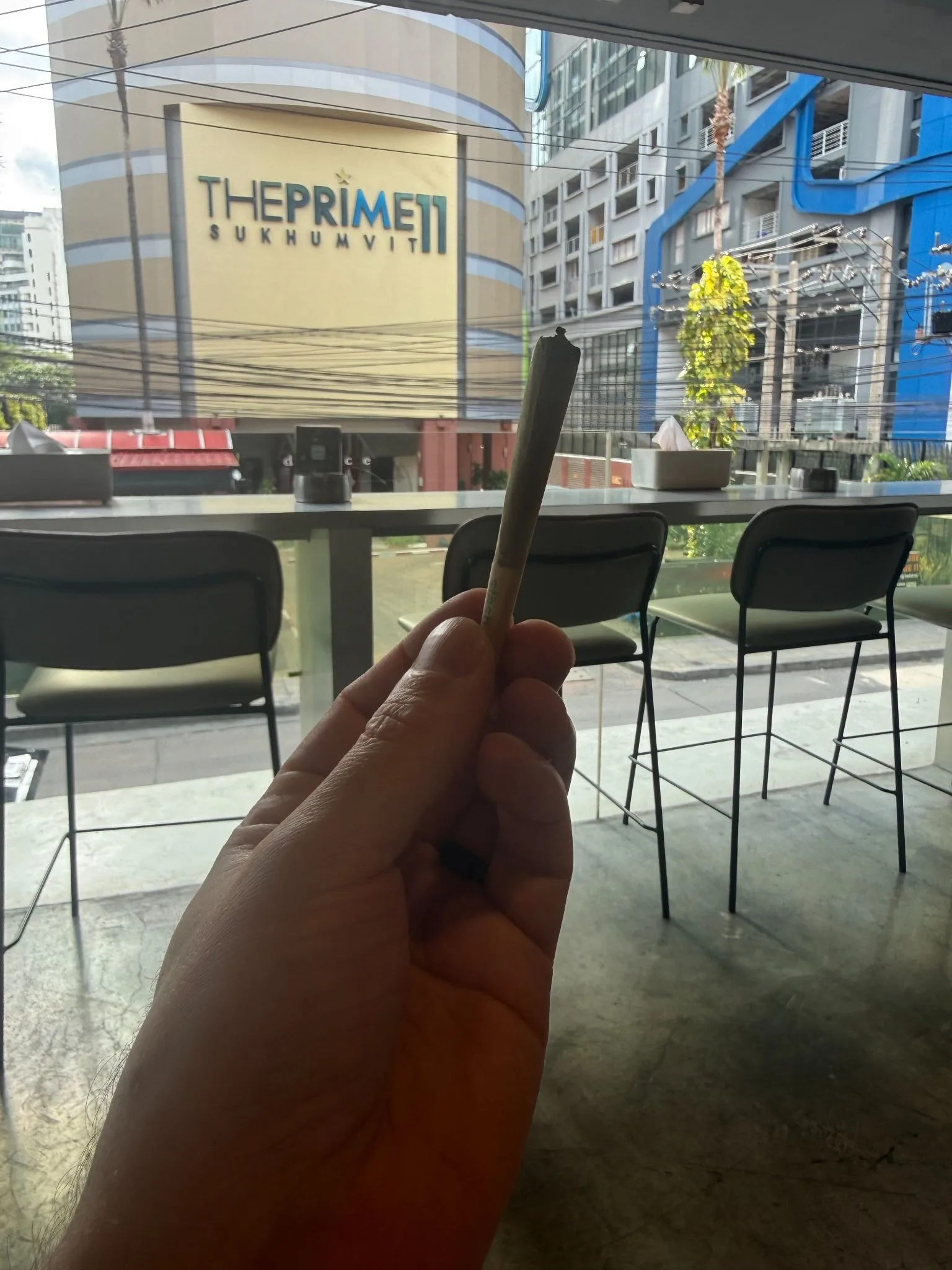
I was able to walk right up to the counter and buy multiple joints of different strains, sativas, indicas, and hybrids alike. It was about 500 baht for four large joints, with one label claiming 25% THC, which seemed like a pretty good deal to me though I’m sure I paid somewhat of a farang fee.
I headed to the smoking lounge in the back to sample the product, a fruit-forward sativa, Laughing Buddha. The woman working at the front desk came back to smoke too, and it turns out she’s a grower and we chatted for a while about the strains which is always fun. Thailand’s fertile soil and warm weather grows quality bud. Another store I walked by but didn’t enter had the full MedMen signage out front which is either a knock-off or the company still exists in pockets… I’m not entirely sure.
The next shop I went into had no medical protocol either. I’ll keep the names anonymous so I don’t get anyone in trouble, but it appears either the July law isn’t being enforced, or again, like the early days of New York’s legalization, law enforcement doesn’t seem to care.
That’s sort of par for the course culturally in Thailand. The country is a strict monarchy, where you stand up for the King’s royal anthem in movie theaters and on public transit. It’s deeply Buddhist and monks have real political power. Outside of that deeply conservative core, there’s a veneer of Sin City, with mega-clubs, weed shops, and, yes, go-go bars though I don’t personally frequent those.
So the lessons here for the US and other countries, I think, are two-fold: One, legalizing cannabis without developing strict regulations around sale and consumption always leads to pushback.
Countries need to consider regulations before they decriminalize lest they give a political opening for social conservatives to push to squeeze the toothpaste back in the tube.
And two, for all the hand-wringing in the press and among conservative, anti-legalization groups, the pushback is hardly as widespread as they’d like to believe. Massachusetts’ ballot measure to recriminalize cannabis sales will be a litmus test.
Like in Canada where cannabis is federally legal, if you aren’t seeking it out, there’s really not much you notice on the streets other than signs for stores. The sky doesn’t fall with legal cannabis shops. In Bangkok, Toronto, and New York City, life simply keeps moving.
I don’t know what the future holds for Thailand’s cannabis industry, but it’s a shame if these stores were to close. That’s a loss for jobs and economic growth. And my humble tip to the Thai groups concerned with the social order of the country, the red light districts are… a lot more in your face.
This article is from an external, unpaid contributor. It does not represent High Times’ reporting and has not been edited for content or accuracy.