



Every CBD-for-athletes pitch of the last decade has sold the same story: sore muscles, faster recovery, inflammation. A dataset covering 47,522 people who both train and use medical cannabis says the top complaints are something else entirely. Focus. Sleep. Stress.
The recovery pitch has been the entire commercial thesis behind cannabis in sport. Sponsorships, product lines, retired-athlete endorsements. All of it built on the same image: a beat-up body reaching for relief.
Turns out that might be the wrong body part.
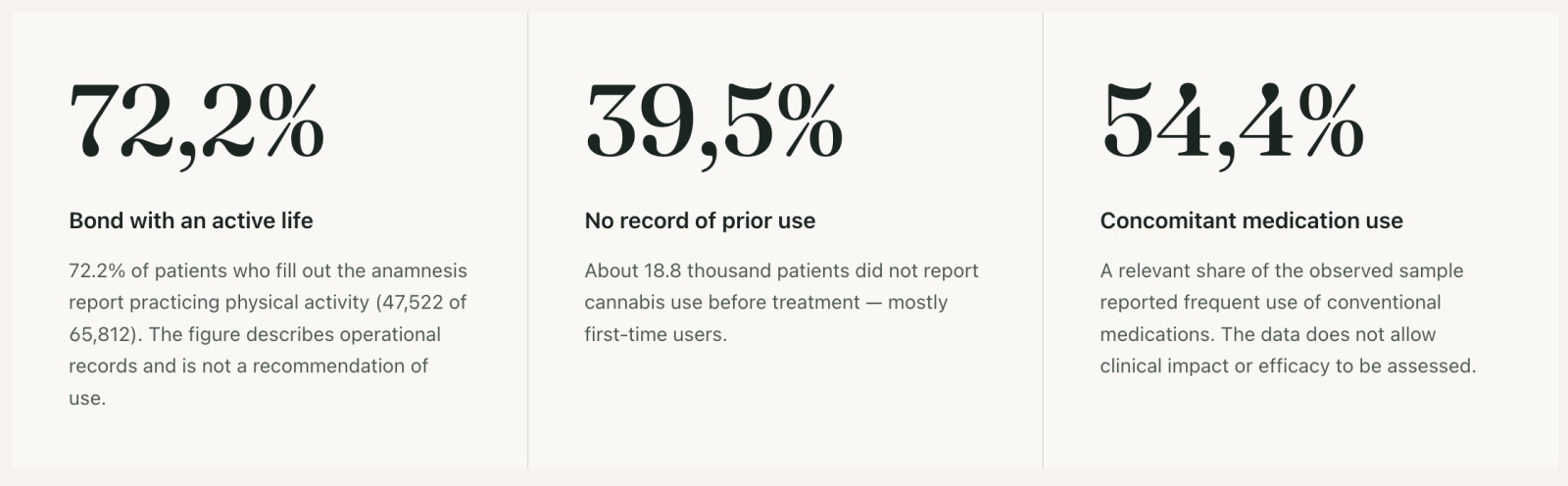
Blis Data, the analytics arm of the Brazilian medical cannabis platform blis, published a descriptive report on 47,522 patients who said they exercise regularly, all of them holding a physician’s prescription and at least one active regulatory authorization. That’s 72.2% of everyone who filled out the platform’s pre-consultation intake form.
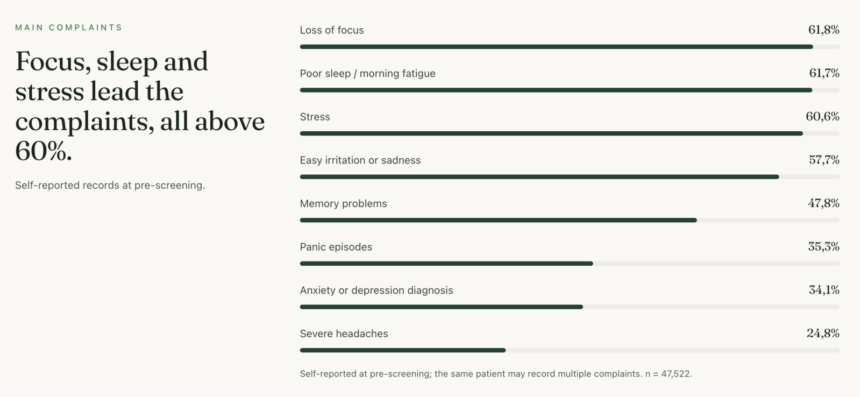
The three most common complaints in that group, each above 60%: loss of focus (61.8%), poor sleep or morning fatigue (61.7%), and stress (60.6%).
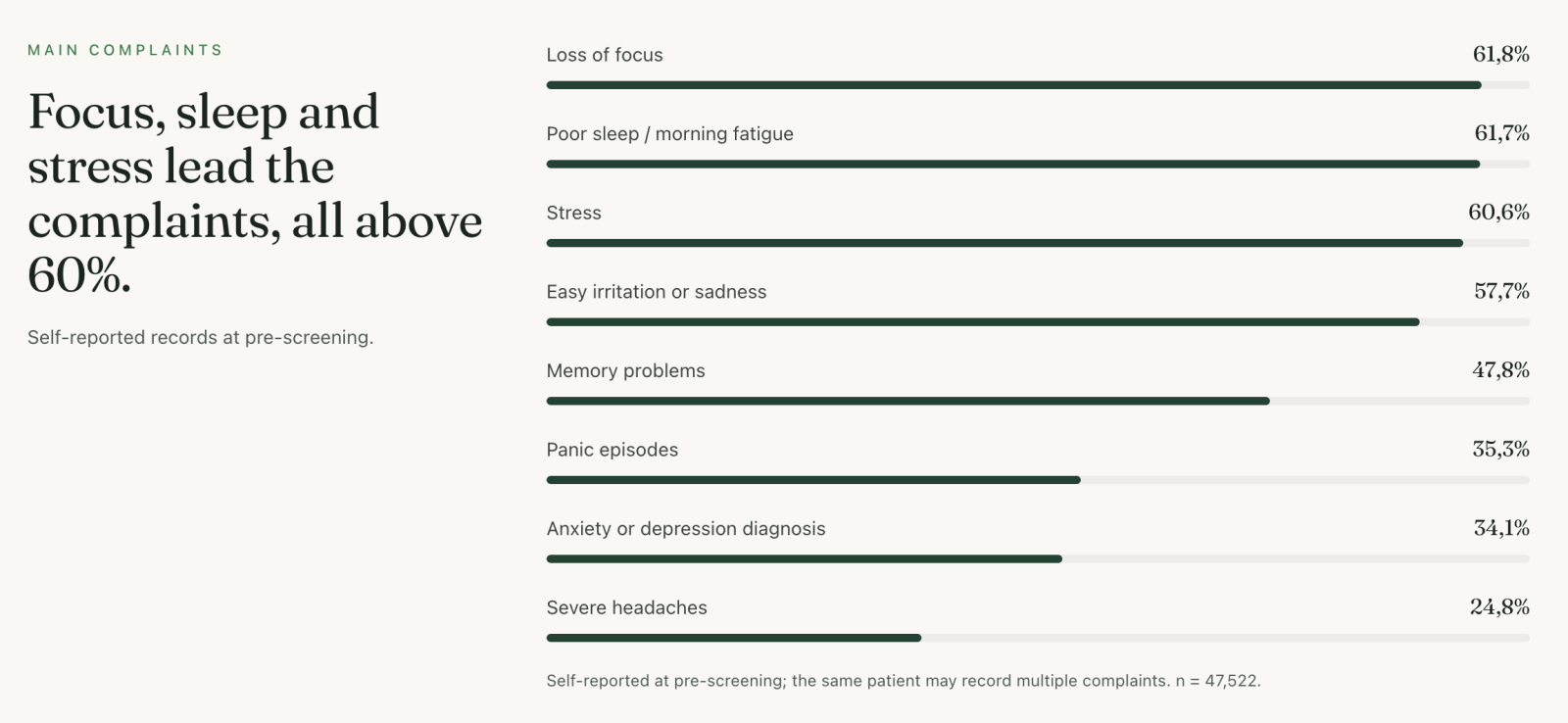
Severe headaches came in last at 24.8%.
The harder they train, the less it’s about pain
The most interesting cut in the report breaks complaints down by discipline, and the pattern is clean.
CrossFit athletes in the dataset average 39.2 years old. 64% report focus problems. Only 17% report chronic pain. Runners land in nearly the same place: 39.8 years old, 58% focus, 17% chronic pain.
Flip to low-impact practice and the picture inverts. Yoga and pilates patients average 51.4 years old, with chronic pain at 44%, poor sleep at 65%, and anxiety or depression at 42%. Walkers, at 50 years old on average, report 38% chronic pain.
Weight training, the single largest category at 44.1% of all mentions, sits between them: 42.6 years old, 24% chronic pain, 60% focus complaints.
Age explains part of that. Someone doing yoga at 51 is carrying a different body than someone doing CrossFit at 39. But the direction is worth sitting with: the harder the training, the more the complaint shifts from the body to the head. High-intensity athletes in this dataset aren’t showing up for repair. They’re showing up for performance, and the performance they’re chasing is cognitive.

Four in ten had never used cannabis before
39.5% of patients in the sample, roughly 18,800 people, reported no prior cannabis use before treatment.
They didn’t come through the culture. No dispensary, no dealer, no college dorm. They came through a doctor’s office, in a country where legal access runs through individual import authorizations, licensed pharmacies and patient associations.
They’re also not replacing conventional medicine with it. 54.4% report frequent use of conventional medications, and 41.5% were in treatment for something at the time of consultation. Cannabis is an addition to the stack, not a substitution.
The people who train the most are the most stressed
Here’s the finding that runs hardest against intuition. Within blis’ patient base, the physically active report more stress, anxiety and panic episodes than the ones who don’t exercise.
35.3% report panic episodes. 34.1% carry an anxiety or depression diagnosis. And these are people training seriously: among those who reported frequency, 73% train three or more times per week, and 19% train daily.
Exercise reads less like a wellness indicator here and more like a marker for a high-demand life. People pushing hard, sleeping badly, and looking for something to help hold the line.
This is a middle-aged story
The demographic profile kills another cliché. Average age is 44.7. More than half the sample, 53.5%, falls between 35 and 54. This is not a young crowd.
64% are men. Among women, the average age runs higher at 48.5 versus 43.2.
Geographically, the data covers all 27 Brazilian states, though heavily concentrated: 79.4% sit in the Southeast and South, with the São Paulo region alone accounting for 61.2%.
Where anti-doping still draws the line
None of this makes the competitive picture simpler.
Under international anti-doping rules, CBD is not currently listed as a prohibited substance. THC and other cannabinoids remain prohibited in competition. That gap is why product composition, prescription documentation, quality control and cross-contamination risk matter so much for anyone competing. A poorly formulated CBD product can carry enough THC to end a season.
The institutional side has been moving anyway. In Brazil, football club Portuguesa brought cannabis into its athlete recovery protocols. Internationally, Saracens, Angel City FC and Major League Baseball have all signed deals tied to CBD and athletic wellness.
Which sets up an awkward alignment. The commercial partnerships are largely built on recovery. The patient data points at sleep and focus. Those aren’t the same product, and they aren’t the same regulatory conversation either.
What the data can’t tell you
A sample of nearly 50,000 invites conclusions it can’t support, so the limits matter.
These are anonymized operational records from a company operating inside the access chain. Blis describes itself as technological infrastructure connecting patients to the steps of regulated access, and says it doesn’t perform consultations, prescriptions, sales, imports or product delivery. Still: this is a company reporting on its own users, not a representative sample of Brazilian athletes.
All symptom data is self-reported on an intake form completed before the medical consultation. These are complaints, not diagnoses.
The company states plainly that the material doesn’t measure efficacy, safety or clinical outcomes, and supports no causal inference between cannabis use and any result.
And one limitation cuts straight at the subject matter: the intake form doesn’t ask about muscle recovery, inflammation, injury or athletic performance. That data doesn’t exist in the survey. What the report actually measures is how a population that trains sleeps, concentrates and handles stress.
What it leaves
With all of that on the table, something still stands.
Nearly 19,000 people who had never touched the plant walked into it through a prescription. Middle-aged, spread across an entire country, training three or four times a week, asking about sleep and focus and stress.
The report doesn’t prove cannabis helps any of it. It was never built to.
What it shows is who’s walking in the door, and what they’re asking for when they get there. Neither one looks much like the guy in the recovery ad.