




4,516 people logged what they drank for three weeks. On the days they had a THC beverage, their odds of also drinking alcohol fell by roughly half. The finding held for 23 of the 36 products tested, and moved the same direction in every one.
The largest real-world study of hemp THC beverages has published its numbers, and the clearest thing in it has nothing to do with sleep, pain or productivity.
It’s beer.
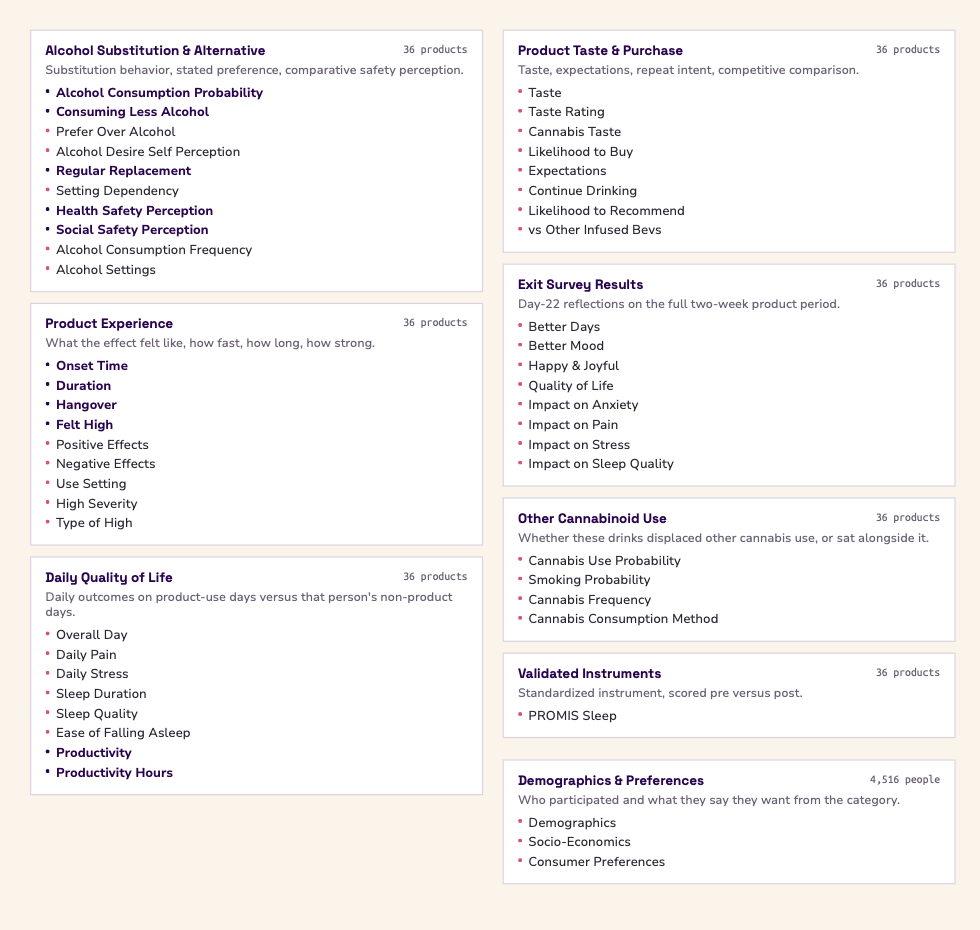
MoreBetter, a Philadelphia research firm that has run observational studies on consumer products since 2016, tracked 4,516 people across 36 products from 23 brands, at doses between 1 and 10 milligrams of THC. Each participant logged seven days before touching any product, fourteen days on it, then answered an exit survey. Every person served as their own control, measured against their own pre-use baseline. The fieldwork ran in two waves across 2025, so the results are new rather than the research. The company published the full dataset free on its Real-World Data Exchange platform and prepared a findings summary exclusively for High Times, breaking out the numbers behind each measure.

On a participant’s ordinary day, before any of this started, the modeled probability that they would drink alcohol was 22.9%. On days they drank one of these beverages, it was 10.9%.
Probability of drinking alcohol
Modeled per person against their own pre-use baseline. Significant for 23 of 36 products.
Before any product use
22.9%
On days they drank a THC beverage
10.9%
Every one of the 23 significant results moved the same direction. No product produced a significant result pointing the other way.
Source: MoreBetter, Ltd., Infused Beverage Study.
Two Measurements, One Direction
What gives that number weight is that it doesn’t come from asking anybody about it. It comes from what people logged, day by day, about what they actually drank, run through a model that compares each person to themselves.
The exit survey asked the question directly, and the answers point the same way. Two-thirds said they were consuming less alcohol. Fifty-six percent called the drinks a regular replacement for it. Those are people describing themselves, which is a weaker kind of evidence, but they line up with the behavioral measure instead of contradicting it.
| What participants said on day 22 | Result | Range across products |
|---|---|---|
| Consuming less alcohol | 65.4% | 46.8 – 78.5% |
| A regular replacement for alcohol | 56.0% | 36.7 – 71.2% |
| Believe it is safer than alcohol for health | 86.6% | 80.0 – 95.5% |
| Believe it is safer than alcohol socially | 75.3% | 64.6 – 91.7% |
The tightest number in that group is the health one. An 86.6% average with a floor of 80% across every single product means the belief holds no matter which drink somebody picked up. Worth being precise about what that measures: it’s what people think, not what is true. Nothing in this study tested whether these products are safer than alcohol.
The eleven-point gap between the health answer and the social one is the more interesting detail. People are more confident about what these drinks do to their body than about how showing up with one plays in a room.
Fifty Days Later
The obvious question about a two-week study is whether anything survives it. MoreBetter went back and asked.
Fifty days after the study period ended, the company surveyed participants from 18 of the 36 products about how their relationship with alcohol had changed. It got 1,420 responses. Setting aside the 249 who weren’t drinking alcohol before any of this began leaves 1,171 people who were. Those results are not on the public dashboard; MoreBetter provided them to High Times on the record.
Fifty days after the study ended
1,171 respondents who were drinking alcohol before the study, from 18 of the 36 products.
Drinking slightly less
20.2%
Stopped drinking alcohol completely
13.5%
63% reported drinking less than before. 2.4% reported drinking more.
Source: MoreBetter post-study survey, provided to High Times.
Two things to hold onto there. A third of respondents reported no change at all, which is the honest headline alongside the 63%. And this is people recalling their own drinking seven weeks later, on a narrower base than the main dataset, which makes it softer evidence than the daily logs. It points the same direction anyway, and the gap between 63% and 2.4% is not a close call.
MoreBetter also says a portion of the original group has continued into a second and now a third cohort, the third of which is currently open, spanning 12 to 18 months between the first and the present one. The point is to see whether consumption patterns and substitution behavior hold up over that kind of stretch. Those results don’t exist yet.
What It Actually Feels Like
The experience these numbers describe is mild and short, which is the whole design premise of the category and now has some evidence under it.
| Measure | Average | Range across products |
|---|---|---|
| Time to feel effects | 26.9 min | 20.9 – 33.9 min |
| Duration of effects | 2.4 hrs | 2.0 – 2.9 hrs |
| Share of use days that involved feeling high | 53.3% | 18.8 – 81.5% |
| Share of use days with hangover-like effects | 4.3% | 1.2 – 8.8% |
Duration is the most consistent thing in the entire dataset. Thirty-six products, 23 brands, doses spanning a factor of ten, and every one of them landed between two and 2.9 hours. The standard deviation is 0.2 hours. Whatever else varies in this category, how long it lasts does not.
Feeling high is the opposite. It swings from 18.8% of use days to 81.5%, which is what a 1 to 10 milligram spread would predict, and it means the 53.3% average describes almost nobody’s actual product. Half the people buying in this category are not particularly trying to get high, and the products know it.
The onset figure needs an asterisk. Participants picked from bands rather than clocking themselves, so 26.9 minutes is a center of mass, not a stopwatch reading.
And the hangover number, which the industry will want to run with, is a share of use days rather than a share of people. There was no alcohol comparison group in this study, so it cannot be read as better or worse than a hangover from drinking. MoreBetter says so itself, in writing, which is not something most industry-funded research bothers to do.
The Productivity Number, Handled Carefully
Participants reported roughly 36 more minutes of productive time on product days than on their own non-product days, a jump from 5.64 hours to 6.24. That reached significance for 20 of the 36 products, and every significant result was positive.
The companion measure is messier and deserves the scrutiny. The probability of reporting a productive day rose 12.5 points on average, but that only held for 13 of 36 products, and one product moved 15 points in the other direction. The accurate version is that for about a third of the products tested, people were more likely to report a good day, and for one of them the reverse was true.
Both are estimates people made about their own hours, not measured output.
How to Read Any of This
This is observational, not a clinical trial. There is no placebo arm and no separate comparison group; the comparison is each participant against their own pre-use baseline, which is a real method with real limits. People chose to enroll and chose their product through what MoreBetter calls a semi-blinded process. Almost everything here is self-reported, including the alcohol logs behind the headline finding. This describes what a large group of people reported while drinking these products. It does not establish that the products caused any of it.
One caveat matters more than the rest, and it comes from MoreBetter rather than from us. When a finding is significant for 23 of 36 products, the headline average covers only those 23. Products that showed no significant change are left out of the average, not counted as zero. Quote the twelve-point drop without the coverage number and you have overstated it. That warning is printed in the company’s own summary, in bold.
What we know / What we don’t know
What we know
- 4,516 people logged their drinking daily for three weeks, each measured against their own baseline.
- Alcohol probability fell from 22.9% to 10.9% on product days, significant for 23 of 36 products.
- Every significant result moved the same direction. None pointed the other way.
- Effects lasted 2.0 to 2.9 hours across every product tested.
What we don’t know
- Whether the products caused the change. This is a within-person design with no placebo arm and no separate comparison group.
- Whether these drinks are safer than alcohol. Nothing here measured that.
- Whether the substitution holds past a few months. A second and third cohort are still running.
- How any of this looks for people who didn’t volunteer for a cannabis study.
Who Paid For It
MoreBetter says it funded the Infused Beverage Study primarily itself, with partial funding from the beverage brands whose products were tested, and that those brands had no influence over protocol design, data analysis or published findings.
Twenty-three brands participated: BRĒZ, Cantrip, Nowadays, Uncle Arnie’s, Willie’s Remedy+, Woodstock, Medterra, Rebel Rabbit, Snoop Dogg’s Iconic Tonics, Herbal Oasis, Cornbread Hemp, Stiiizy, 1906, Sober(ish), Wims!, Hippie Water, Squared, Hightail, Kava Haven, 23rd State, Drippy, Good Feels and Rexis Biotech.
None of that makes the data bad, and the company reports 17 peer-reviewed publications across 12 university research partnerships behind it. It does mean some of the companies that helped pay for the study sell the products the study is being used to defend, and anyone citing these numbers in a policy fight should say so. Nothing is broken out by brand, so no figure here belongs to any individual participant.
The Products in This Study Are About to Stop Being Legal
Section 781 of Public Law 119-37 caps finished hemp products at 0.4 milligrams of total THC per container, applied to the whole package rather than a serving. It takes effect November 12.
The products in this study run from 1 to 10 milligrams per serving. The weakest one carries more than twice the legal ceiling for an entire container.
None of the 36 would survive it.
That date is still moving. The Senate has passed a stopgap that would push most of the new restrictions to December 11, and the House hasn’t taken it up. Until it does, November 12 is the law. We’ve been tracking the whole fight here.
Some brands have already made their bet. Cann pulled the THC out of part of its lineup, while B-Real and Rachel Wolfson launched into the same market with full-dose product. One side is reformulating for the rule on the books. The other is betting Congress changes it first. NielsenIQ data cited by MoreBetter puts the category at $239 million in tracked retail sales over the 52 weeks ending June 27, up 135% year over year, which is what the 0.4 milligram number is aimed at and why the fight has pulled in everyone from trade groups to Rosario Dawson.
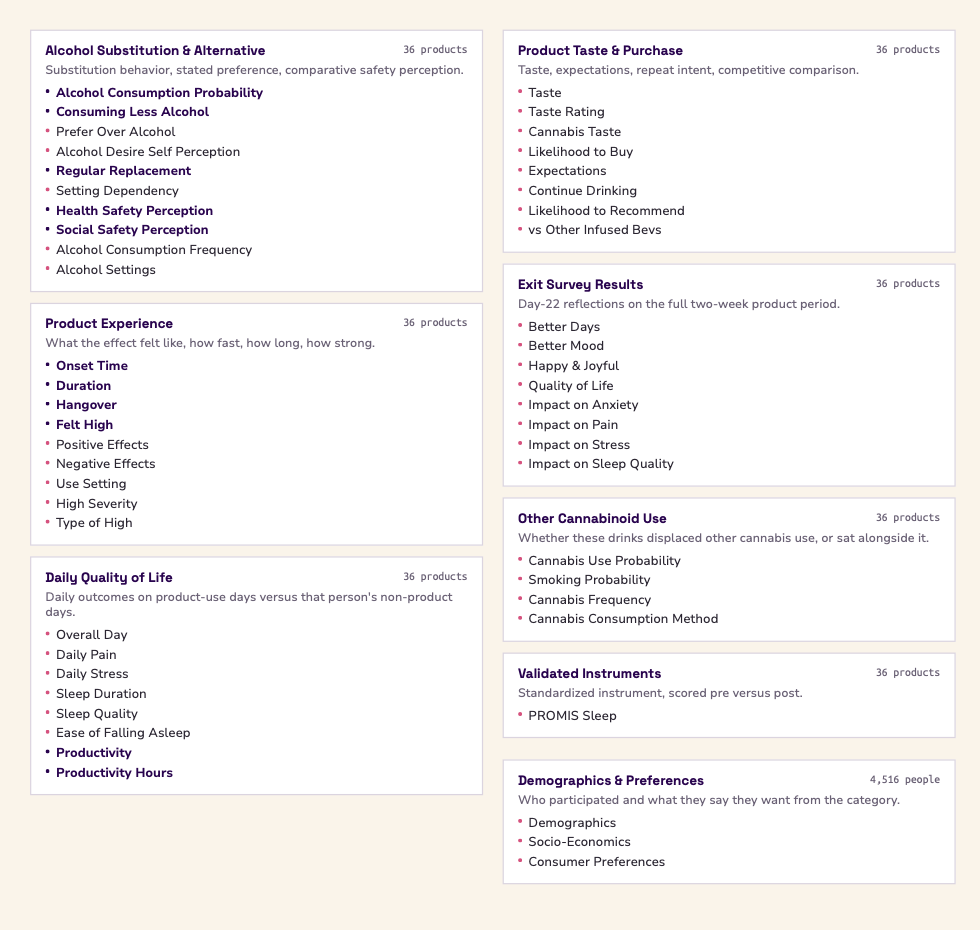
Every figure in this article, and the several dozen measures that didn’t make it in, are free at rwdexchange.com/community. Verify a phone number or email, enter the code, then open Community Insights and the Infused Beverage Performance Data dashboard. No cost, no trial period, no card. Everything is filterable by seltzer, soda, sparkling beverage, functional tonic, and spirits, shots and mixers, and MoreBetter asks that anyone using the figures credit the source.
The data arrived after the vote.