






Georgia regulators have approved new regulations that will allow medical marijuana to be delivered directly to patients—including via the U.S. Postal Service (USPS) and private carriers like FedEx, UPS and DHL. It’s not clear, however, if those entities are willing to participate in cannabis commerce.
The Georgia Access to Medical Cannabis Commission (GMCC) adopted the reform on Wednesday as part of a broader package of new rules covering issues such as product recalls, tracking, business license applications and research.
The most notable change, on delivery via the mail, is being made possible by the Trump administration’s move to reclassify medical cannabis, which effectively federally legalizes it, state officials have said.
The rule specifies that:
“Where delivery is performed by the U.S. Postal Service, a common carrier, the Commission, or a common carrier engaged by the Commission, the dispensing licensee shall use certified mail, or a carrier service providing equivalent tracking and proof of delivery, with delivery restricted to, and the signature required of, the patient, caregiver, or healthcare institution employee. No person other than the registered patient, the patient’s caregiver, or the listed healthcare institution employee may sign for or accept such delivery. A dispensing licensee shall record the certified mail receipt, tracking number, or other information evidencing proof of delivery in the Commission-approved tracking system immediately upon completion of delivery.”
A USPS official, when contacted by Marijuana Moment, refused to clearly state the agency’s position on participating in medical marijuana deliveries.
Nikolaj Hagen, a senior public relations representative for USPS, pointed to general regulations on the mailability of controlled substances.
Those rules state that if distribution of a controlled substance is unlawful, “then the mailing of the substance is also unlawful.”
Mailing of controlled substances in domestic mail, it says, is only acceptable under three conditions.
One is when both the mailer and the addressee are registered with the Drug Enforcement Administration (DEA).
While DEA has launched a process to register medical marijuana businesses that want to receive protections in line with federal rescheduling, there is no such registration process for patients. There is a carve-out in the USPS rule for those who are exempt from DEA registration, but it cites “military, civil defense, and law enforcement personnel” who are “performing official duties.”
Another condition under which mailing controlled substances is acceptable concerns mail-back programs, which allow patients to send unused or expired prescription drugs for safe destruction. That also doesn’t apply to patients who want to receive medical marijuana deliveries to their homes.
The final and perhaps most applicable condition in the USPS rules allows mailing of prescription medications “when mailed by drug manufacturers or their registered agents, pharmacies, medical practitioners, or other authorized dispensers, as permitted by 21 CFR § 1307.11, or in compliance with any regulation of the FDA or other applicable law.”
While state medical marijuana laws have allowed patients to access it via doctors’ recommendations, and not the formal prescription process due to federal prohibition, the cannabis rescheduling order that Attorney General Todd Blanche issued in April contains a provision that seems to deem those recommendations as prescriptions for the purposes of federal law:
“Prescriptions. Notwithstanding part 1306 of this chapter or any other provision of these rules, a certification or other document (including an electronic document) that state law deems sufficient for a user to obtain marijuana or products containing marijuana for medical purposes shall be sufficient to permit dispensing of marijuana or products containing marijuana to a user so long as the certification or other document is dated as of, and signed on, the day when issued; bears the full name and address of the user; and contains the name, address, and state license number of the practitioner who signed the certification or other document and is authorized to do so under state law.”
When pressed for further clarification on USPS’s position on mailing medical marijuana in light of rescheduling, Hagen simply said that “we have nothing additional to offer at this time.”
A spokesperson for DHL told Marijuana Moment that the company is “monitoring and will continue to comply with all applicable laws and regulations in the countries and territories where we operate.”
Representatives for UPS and FedEx did not reply to requests for comment.
Georgia officials, meanwhile, seem confident that federal rescheduling will allow mailing of medical cannabis under the the newly adopted state rule.
“We think this provides a great pathway. It maintains the same tracking standards that the commission has, and it really leverages the authority in that DEA rescheduling order for state-regulated medical marijuana program,” Andrew Turnage, GMCC’s executive director, previously said of the newly adopted rule in a earlier meeting in August. “Without these regulations, we don’t have guidelines in place for things like delivery. We think it’s really important to put those guardrails in place and establish standards.”
He noted that Georgia is a “very large state” and that it has been hard for some patients to easily access the medical cannabis that their doctors have recommended.
“Patients in many areas are having to travel two hours or more, either into a congested metropolitan area or around large geographic divides—whether that’s the mountains, the rivers, or the lakes, and it makes it impossible to get east to west across our great state, Turnage said.
The GMCC official noted that one of the “greatest values” of the new proposed delivery rules will be getting cannabis to patients in healthcare facilities, including those such as nursing homes where they are permanent residents.
“This creates a much more secure transaction for that healthcare facility to be able to make a purchase at our dispensaries and have that shipped and delivered securely to those facilities, without presenting a risk for diversion, without presenting a risk for, frankly, theft, robbery, an attack in the parking lot,” he said.
This isn’t the first time the state has pushed the envelope of what’s federally acceptable with its medical marijuana program. In 2023, the DEA warned Georgia pharmacies that they could potentially lose their federal registrations if they began dispensing THC products under a provision of state law.
Meanwhile, Georgia’s medical cannabis program is seeing a huge influx in the number of registered patients as the state implements a recently enacted law that expands access.
The legislation, which Gov. Brian Kemp (R) signed in May and which officially took effect on July 1, adds new qualifying conditions for the program, allows patients to vaporize medical cannabis and changes THC potency limits, among other reforms.
Gary Long, the CEO of Botanical Sciences, a Georgia-based medical cannabis company, recently predicted that the expanded law could triple the number of patients by mid-2027.
Under the legislation, patients with lupus are allowed to legally access medical marijuana, building on the state’s prior law that allowed certain people with cancer, Parkinson’s disease, multiple sclerosis, Alzheimer’s disease, ALS, autism spectrum disorder, intractable pain and other conditions to qualify.
The policy, which was sponsored in the legislature by Sen. Matt Brass (R), also removes the requirement for many conditions that the patient’s status be severe or end-stage to be allowed to enter the medical cannabis program.
The reform also expands how patients can use medical marijuana. Previously they were able to access oils, tinctures, capsules, lozenges, topicals and transdermal patches—but now vaping is allowed as delivery method for people over 21 years of age, though smoking continues to be prohibited for all patients.
The Putting Georgia’s Patients First Act additionally replaces the current 5 percent THC potency cap for medical cannabis products with a limit of 12,000 milligrams of THC that a patient can possess at any one time.
“These changes, while meaningful to the affected patients, do not materially alter where Georgia sits in the national landscape on this issue,” Kemp said in a signing statement. “This bill passed with a constitutional majority in both chambers of the General Assembly.”
“I, like many of those who expressed opposition to this bill, have reservations about the legalization of recreational cannabis. Many states that have legalized recreational cannabis have come to regret that decision,” he said. “I also recognize that for some patients, medical cannabis provides significant relief to symptoms that would otherwise go untreated or would be treated with even more harmful opioids.”
“I do not believe that a well-implemented medical cannabis program must inevitably lead to the legalization of recreational use in Georgia, nor is the question of recreational use anywhere in the bill on my desk for signature,” the governor said.
The new law also replaces references to “low THC oil” in current law with “medical cannabis.”
—
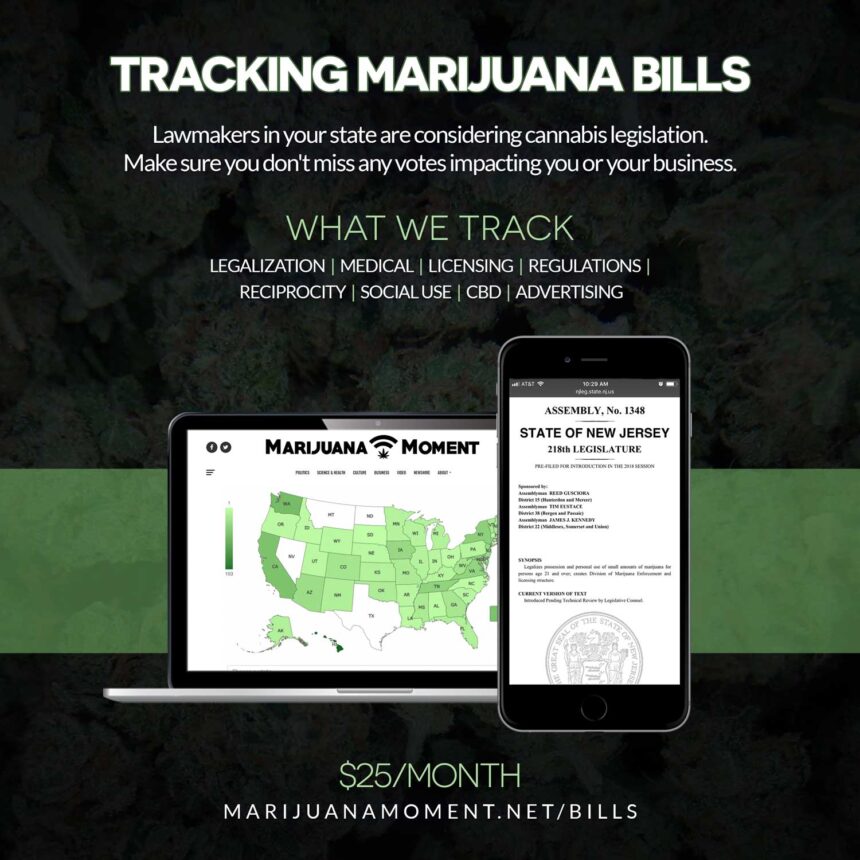
Marijuana Moment is tracking hundreds of cannabis, psychedelics and drug policy bills in state legislatures and Congress this year. Patreon supporters pledging at least $25/month get access to our interactive maps, charts and hearing calendar so they don’t miss any developments.
Learn more about our marijuana bill tracker and become a supporter on Patreon to get access.
—
The Georgia Access to Medical Cannabis Commission, which oversees the program, also now has a new duty of conducting public awareness activities about “effective uses of medical cannabis and products, including, but not limited to, publishing materials and conducting outreach and public education activities to inform members of the public, law enforcement, and healthcare providers about the medical cannabis program in this state and the potential benefits that medical cannabis and products may have to eligible patients.”
Last year, House leaders created a Blue-Ribbon Study Committee on Georgia’s Medical Marijuana and Hemp Policies to examine the state’s cannabis laws.
Lawmakers in Georgia have also considered legislation to support research on the therapeutic benefits of psychedelics.
Marijuana Moment is made possible with support from readers. If you rely on our cannabis advocacy journalism to stay informed, please consider a monthly Patreon pledge.