





An off-grid chemist swapped sassafras for clove oil. What came out is being used in ceremonies in British Columbia, and nobody has run a toxicology study on it.
This article originally appeared in High Times’ Spring/Summer 2026 print edition. Get yours here.
Kelly Dragonfly has spent her life working at the edges of birth, death and altered states of consciousness. As the co-founder of Dragonfly Earth Medicine and a longtime practitioner in emerging psychedelic therapy circles, she has built a healing practice shaped by intuition, community and decades of hands-on experience.
To understand how she arrived at this work, you have to look at where her story began and the unlikely places that shaped her early sense of purpose.
The Church of the Dead
Born into a conservative, Catholic family on the East Coast, Kelly never quite fit the mold. “I always knew I was a little bit different,” she says. Her early years were defined by questioning religion, social norms and boundaries that felt too small for what she sensed the world could be. By the mid-1980s, her search for meaning found rhythm and community in an unlikely church: the traveling congregation of Grateful Dead followers.
Kelly joined the Dead tour, selling cannabis and vegetarian chili to make her way through university. “I felt like I’d finally found my people,” she recalls. “It was like discovering a language that matched mine.” Psychedelics were woven into that discovery, less as escapism and more like a communion.
The road led her west, to Oregon, where she immersed herself in cultivation and community care. She grew high-grade strains of cannabis, studied early childhood development, became a naturopath and midwife. Between concerts and harvests, she also became an advocate for safety in psychedelic spaces.
Kelly helped design protocols for what were then called “trip tents,” early safe spaces for people having difficult psychedelic experiences at concerts and festivals. “I wrote this little pamphlet called A Tripper’s Guide to the Galaxy,” she says. “It was all about creating safety and space for people.” Her guide circulated widely, helping shape harm reduction practices that are still standard at music festivals today.
Birth, Death and Psychedelic Medicine
Over the next three decades, Kelly’s work evolved into something that blurred traditional lines of healing. As a midwife, she delivered babies in remote parts of the world, from post-earthquake Haiti to Indonesian villages rebuilt after the tsunami, often funded, she notes with pride, “by weed money and the generosity of our community.”
Back home in rural British Columbia, she also became what she calls a “death worker.” Her small town cemetery, maintained by Quaker tradition, allows home burials. “People bring me their family members,” she says. “I help prepare the body. I sit with them.”
Between the thresholds of birth and death, Kelly found a calling in psychedelic therapy. Since the early 1990s, she’s been guiding people through journeys. Her philosophy, she says, is rooted in the same principle that guides midwifery: readiness. “It’s about letting the process unfold,” she explains. “You don’t force a baby to be born. You create the conditions for it to happen. It’s the same with healing.”
The Green Crystal and Its Soft Medicine
Kelly’s path shifted five years ago at a conference in Vancouver, when something unexpected landed in her hands. A colleague placed a large, translucent green crystal in her palm. “The moment I touched it,” she says, “I saw faces, hundreds, maybe thousands, flashing before me. Friends, strangers, people I have helped. I just knew it was important.”
The crystal, it turns out, was not a gemstone. It was a new form of a familiar molecule, built without sassafras, the tree that yields the oil most MDMA is made from. “It’s a clove-derived analogue,” Kelly explains carefully, aware of how sensitive the information is. The substance was created by an off-grid chemist with decades of experience in both pharmaceuticals and psychedelics. His experiment: to see if the chemical process used to make MDMA from sassafras oil could be replicated using eugenol, the essential oil found in clove.
What emerged is a crystalline substance that, according to Kelly and those who have used it therapeutically, shares the empathogenic effects of MDMA but carries a distinctly gentler, more spiritual quality.
Like MDMA, Kelly says, it quiets the brain’s fear response, allowing people to approach difficult emotions with openness. But the tone, she insists, is entirely different. “People think power means struggle,” she says. “They think healing has to be hard. But this medicine reminds you that softness is power too. Being held, being safe is where real breakthroughs happen.”

Her clients, she says, experience what she calls “the of-course moment,” that instant when a painful memory reframes itself with meaning. “They’ll say, ‘Of course that happened. Of course that’s my life. What a gift.’”
She uses words like “fulfillment” and laughs when she says “filled twice,” to describe what happens. “Every nook and cranny of your being fills up with you,” she says. “And when that happens, there’s no space left for anything that doesn’t belong, including fear, shame, or whatever’s been taking up room.”
Kelly speaks of this green medicine with a mix of reverence and precision. She describes administering it in microdoses: a small amount to begin, another two hours later, and sometimes a final, smaller amount to extend the journey. The full experience lasts about seven hours. “It’s not something you’d take at a party,” she says. “This isn’t a club drug. This is a medicine you take when you’re ready to face yourself… without fear.”
Between Science and Spirit
Kelly’s descriptions of the journey veer between the clinical and the mystical. She talks about serotonin, dopamine and receptor-binding with the same fluency she uses for energy and frequency. She describes seeing “entities” leave people, not as metaphor but as observable reality. “I’ve seen them come out,” she says. “I’ve seen people free themselves.”
For a practitioner like Kelly, the scientific legitimacy of her work remains largely anecdotal, yet her approach reflects the emerging ethos of modern psychedelic therapy: set, setting and safety. “Nature has to be the ally,” she says firmly. “We can’t heal inside walls, under fluorescent lights. Healing doesn’t happen in sterile spaces.”
Her critique is aimed not at science itself, but at its disconnection from the natural world. “They’re building psychedelic therapy clinics in commercial zones,” she says. “They want you to break walls inside walls. But nature is the real therapist. We’ve forgotten that.”
After decades of facilitating both physical and psychedelic journeys, Kelly says she’s found her medicine. “I’m not interested in working with anything else anymore,” she says. “This is it.”
Her philosophy defies the prevailing cultural script of healing as struggle. “We’ve been taught that transformation means pain,” she says. “That if you want something bad enough, you have to work for it, sweat for it, bleed for it. But what if you’ve already done the work? What if healing can be the easiest thing we do?”
Her life has been a long arc from Catholic Virginia to Deadhead Oregon to the forests of British Columbia and she seems to always circle back to a single lesson: patience. “You wait long enough,” she says, echoing an old mentor’s words about childbirth, “and the baby will come.”
Voices From the Green Crystal
The Green Crystal is being introduced through guided, ceremonial settings. One of those sessions involves Maya Elisabeth, founder of OM Edibles (now OM Living and OM Wellness) and a longtime cannabis innovator known for developing wellness products that honor the body’s natural balance. Her personal encounter with the Green Crystal marked a new chapter. “My best day before the Green Crystal wasn’t as good as my worst day after,” she says.
She describes the experience as restorative and free of the physical roughness she associates with other psychedelics. Maya’s session led to what she calls “trauma removal,” helping her process buried pain and physical tension linked to past loss. “It was like a century of healing in hours,” she explains. Participants in these sessions describe similarly transformative outcomes, including clarity, renewed energy and a sense of inner lightness.
For Kelly and Maya, the goal is connection. As Maya says, “This medicine wants out. It’s time for the world to know there’s a safe, sacred plant that can move mountains within you.”
For now, the Green Crystal remains a quiet phenomenon, a molecule without a name, a therapy without sanction. Whether it ever emerges into the light of scientific validation remains uncertain. But for Kelly and Maya, its promise is already realized. “When people take it,” says Kelly, “they remember what it means to belong on this Earth.”
A Lifetime of Healing
Dr. Lakisha Jenkins, professionally known as Dr. Lakisha, has spent more than 20 years shaping the fields of plant medicine, patient advocacy and medical autonomy. A traditional naturopath, clinical herbalist and research scientist, her work spans the endocannabinoid system (ECS), botanical drug discovery and pediatric health equity. She is the mother of nine and has endured the loss of three of her children, a grief that guides the work that follows.

Dr. Lakisha tried everything to manage the overwhelming weight of compounded grief: therapy, psilocybin work, community support. “You’re always good until you’re not,” she says. “And I didn’t want to get anywhere near not.”
It was another mother and healer, Kelly, who reached out. “We have known each other for years. She told me, ‘Come rest. Let me help you heal your heart.’” A year passed before Dr. Lakisha felt ready. In May 2025, she traveled to Canada, where Kelly works with the green medicine in a ceremonial setting.
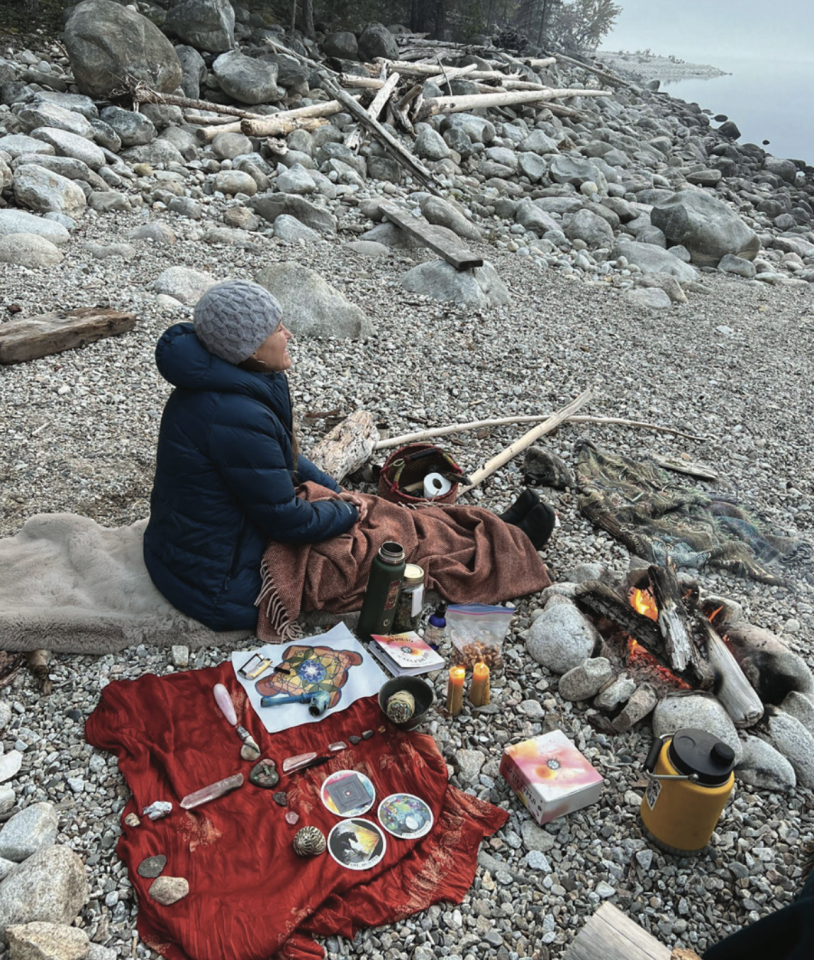
The ceremony took place on a beach. Kelly built a throne from driftwood, fed her grapes and oranges, and created a container, Dr. Lakisha says, that honored her both as a mother and as a woman holding immense pain.
Unlike psilocybin, which Dr. Lakisha describes as abstract and hard to recall, the green medicine was “literal, coherent, intentional.” She remained conscious and aware the entire time, crying out to her children, her sister, her ancestors, before experiencing a powerful spiritual purge. “It wasn’t physiological. Nothing came up. But I know I was releasing burdens I couldn’t carry anymore.”
Then, at two in the morning, Kelly burst into the room: Come outside. The Northern Lights were streaking across the entire sky. “I had said once in my life I wanted to see them,” Dr. Lakisha recalls. “I felt like my children and my sister were answering me. Telling me to keep going.”
The ceremony did not erase grief. It created a foundation, something stable to stand on in the churn of daily survival. “It’s not a cure-all,” says Dr. Lakisha. “I’ve lost three children. Some days are better. Some days are not. But I did this so I can give my three-year-old daughter now the healed version of me that all my other kids had.”
Dr. Lakisha left Canada and immediately wrote her memoir. She doubled down on her research, including a study on the biomarkers of ECS deficiency, one of the first of its kind, soon underway in New York.
“Plant medicine was the medicine for millennia,” she says. “Conventional medicine is what’s new. As long as you’re working with someone ethical, someone who knows what they’re doing, there is real healing here.” But at the core of her story is not medicine. It’s motherhood, loss and the radical, unending effort to remain alive for the children who remain.
Bridging the Trust Gap
Plant-based and psychedelic-adjacent substances are emerging faster than the research that can validate, or challenge, their safety. Among the newest and most mysterious offerings is the Green Crystal, circulating quietly within parts of the healing community. Early adopters, like Kelly, speak of profound healing and emotional transformation. But for ethicists, researchers and practitioners, the lack of data raises questions.
One of those voices belongs to Dr. Sandra Dreisbach, a psychedelic-ethics practitioner who has worked extensively with traditional healers, clinical researchers, facilitators and therapists. She reviewed the green medicine stories and offered a nuanced reflection of admiration, alongside caution. “I don’t doubt the experiences at all,” says Dr. Dreisbach. “But substances that are natural in their original form can behave very differently once synthesized. Historically, many became more dangerous. The lack of data here is not a small footnote.”
“We don’t know toxicity levels. We don’t know interactions. We don’t know whether it’s safe for pregnant women, or whether it affects the heart, or interacts with SSRIs. Even the FDA’s most basic toxicity studies aren’t possible yet.”
Dr. Sandra Dreisbach, psychedelic-ethics practitioner
That gap is not unique to the Green Crystal. MDMA itself has no approved medical use in the United States. The FDA declined to approve midomafetamine-assisted therapy for PTSD in August 2024 and asked for another Phase 3 trial, releasing the full letter publicly a year later. The hunt for gentler MDMA-like molecules has meanwhile stayed inside laboratories, where teams are still testing analogues in cell lines and animals, and where reviews of the field note that almost none of them reproduce MDMA’s full pharmacological profile.
In the world of modern Western psychedelics, safety protocols are well documented: screening for hypertension, contraindicated medications, pregnancy, suicidality risk. Even these known substances can cause harm when misused or administered by unqualified guides. With new compounds, that baseline does not exist. Her position is not anti-medicine. It’s pro-research. “It might be a breakthrough. Truly. But rushing ahead without caution is how we lose public trust, and how people get hurt.”
The psychedelic world has seen rapid expansion, often outrunning the infrastructure needed to keep people safe. But Dr. Dreisbach points out an uncomfortable imbalance: society places enormous trust in doctors, scientists and therapists. “People walk into clinical offices assuming safety. But the history of medicine is full of blind spots and harms that were caused by following the rules as written. So yes, we must be cautious with new substances, but we must also be honest about the risks people already face within the established system.”
According to Dr. Dreisbach, women, BIPOC, LGBTQIA+ and other disenfranchised communities face greater risks, and the harms they do experience are too often dismissed. In altered states, the potential for abuse, emotional, psychological or physical, rises sharply. “Harm reduction isn’t optional. It’s essential.”
The conversation opens a wider cultural dialogue. How does a movement built on community knowledge reconcile with the demands of modern research? “We’ve extracted plant traditions from Indigenous cultures for centuries,” says Dr. Dreisbach. “Western science dismissed these communities’ knowledge as unscientific, only to circle back decades later and discover they were right.” She argues that the future lies not in choosing sides but in integration. “We need people who can hold both worlds. The scientist who honors subjective experience, and the healer who respects evidence. People who can speak data, and also speak humanity.” This blend, she says, is rare, but emerging. And it’s essential.
Her vision for the future of plant medicine is not hierarchical but ecological. “Imagine every part of the healing world, researchers, therapists, community practitioners, Indigenous knowledge-keepers, as an ecosystem. Science is one community. Traditional healers are another. Policy makers, spiritual practitioners and clinicians are all part of a larger relational web.”
When these groups collaborate instead of compete, she explains, “we get better research, better safety, better understanding, and better outcomes.”
There is a shift happening across multiple communities, a reclamation of intuitive wisdom alongside a demand for data. A refusal to dismiss subjective experience, and a recognition that untested substances carry real risks. From Dr. Dreisbach’s perspective, this moment, this uncertainty, is actually a gift. “We’re expanding our lens. We’re learning how to work across cultures, mindsets and systems. And if we do it well, we create a future where healing is more accessible, safer and more deeply aligned with who we are as humans.”
The space between hippies and scientists is no longer a divide. It’s becoming a bridge.
Editor’s note: The compound described in this article has not been identified, characterized or studied in any published research, and its legal status has not been independently verified by High Times. Under Canada’s Controlled Drugs and Substances Act, amphetamines and their analogues are Schedule III substances. Accounts of its effects come from the practitioners and participants quoted here and are personal experiences, not clinical findings. Nothing in this article is medical advice or an endorsement, and High Times does not encourage the use of uncharacterized substances. Actual plant medicine described in this piece is provided by a nonprofit organization that specializes in no-cost, safe, integrative medicine, and is never provided directly by Kelly Dragonfly.