




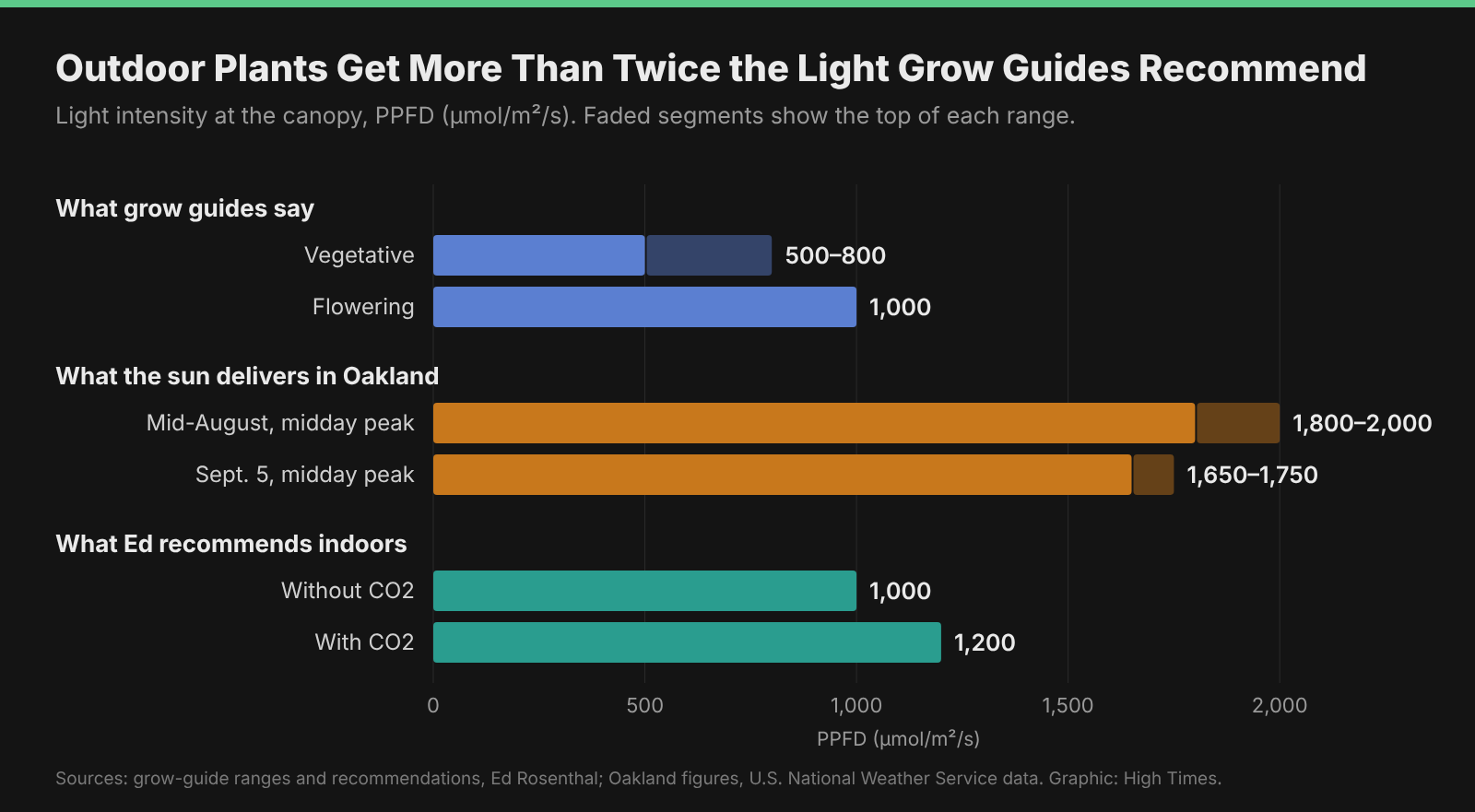
Grow guides say vegetative plants want 500 to 800 PPFD. Outdoors, plants vegetate in summer sun at more than twice that and thrive. Ed Rosenthal ran two casual experiments to see which side the plants agree with, and explains why CO2 is cheaper than watts.
How much light can I give my indoor plants?
Jerry G., Santa Rosa, CA
During the summer months across great swaths of the U.S., the light level approaches 2,000 PPFD. PPFD is the measure of the number of photosynthetic photons arriving at the canopy. All photons between 400–700 nm are counted. This light spectrum is represented visually as our rainbow. Dr. Bruce Bugbee of Utah State University includes far red, which is 700–750 nm.
| PAR | 400–700 nm | The waveband plants photosynthesize in |
| PPF | µmol/s | Total photosynthetic photons a fixture emits each second |
| PPFD | µmol/m²/s | Photosynthetic photons arriving at the canopy each second in a square meter |
| DLI | mol/m²/day | Total photons delivered over a full day |
| Efficacy | µmol/J | Photosynthetic photons per joule of electricity. These vary by LED model. The higher the number, the more light it produces per unit of energy. |
Light powers photosynthesis. This is the process in which plants use the energy from light to break water into its two elements, hydrogen and oxygen. The oxygen is released into the air. The hydrogen is bonded with a CO2 molecule to make sugar. This is used by the plant for two purposes: metabolic functioning (living) and building tissue.
Light = Growth
With more light, the plant creates more sugar that is used to build tissue. So, the more light, the faster the growth, resulting in bigger plants with higher yields.
CO2 plays a part in this too. As photosynthesis is taking place, the plant is mining the air for CO2, which comprises 0.04% of the atmosphere. However, with bright light, the plant can use far more CO2 faster if it is a larger component of the air, up to 0.12%, or 1,200 ppm (parts per million). This gives the plant a chance to photosynthesize at a far faster rate, too, resulting in far faster growth. You can measure the amount of light your plant is receiving using even an inexpensive light meter built to measure PPFD.
Even without enhanced CO2, the plants will function far faster under bright rather than dim light as long as there is good airflow to replace the CO2-depleted air.
Most marijuana authors try to build on prior knowledge, which is admirable. But if the “knowledge” that is being transmitted is faulty, it may fail Colbert’s test: “Something that is generally accepted as true, but isn’t.” Has this knowledge been tested or just transmitted?
Most guidebooks have generally accepted that vegetative plants should be illuminated at 500–800 PPFD. Seedlings perhaps under even dimmer lights. Then, at flowering, the PPFD should be raised to 1,000 PPFD. But outdoors, in the fall, as the plants are flowering, the intensity of the sun is declining. Recapping, outdoors the plants receive the most light, both in intensity and total radiation (because of the longer days) during the summer, and less light in autumn, when the plants are flowering.

Believe Your Eyes
So, according to the indoor cultivation advisors, all those outdoor plants basking in the sun vegetatively at 1,500–2,000 PPFD must all be mistaken? Hey plants, that much light will mess you up. Get out of the sun. I don’t think so.

Indoor Growing
What does this mean for the indoor grower?
With good ventilation but no CO2 enrichment, plants can use 1,000 PPFD once the first set of true leaves appears. With CO2 enrichment, the indoor PPFD can probably go higher.
CO2 is much cheaper than light.
Ed Rosenthal
To prove that young plants thrive in high light, I recently conducted two casual experiments.
I was given 8 Hella Jelly clones with 3 sets of leaves in early August, when the sun is still in summer mode. They had been started in a natural light greenhouse. I transplanted them to 3-gallon containers and placed them outdoors, where they initially received 1,500–1,800 PPFD of direct sunlight for 6 hours daily. They suffered no damage, grew vigorously and were harvested on Sept. 2nd.
Light Metrics for Oakland in August
- Peak Midday PPFD (Clear Sky): ~1,800–2,000 µmol/m²/s
- Average Daytime DLI (Daily Light Integral): ~45–55 mol/m²/day on clear days, though local morning coastal fog/marine layer common to Oakland can temporarily reduce ambient values during early hours.
- Day Length around August 15: ~13.5 hours (sunrise around 6:30 AM, sunset around 8:00 PM).
Source: U.S. National Weather Service data.
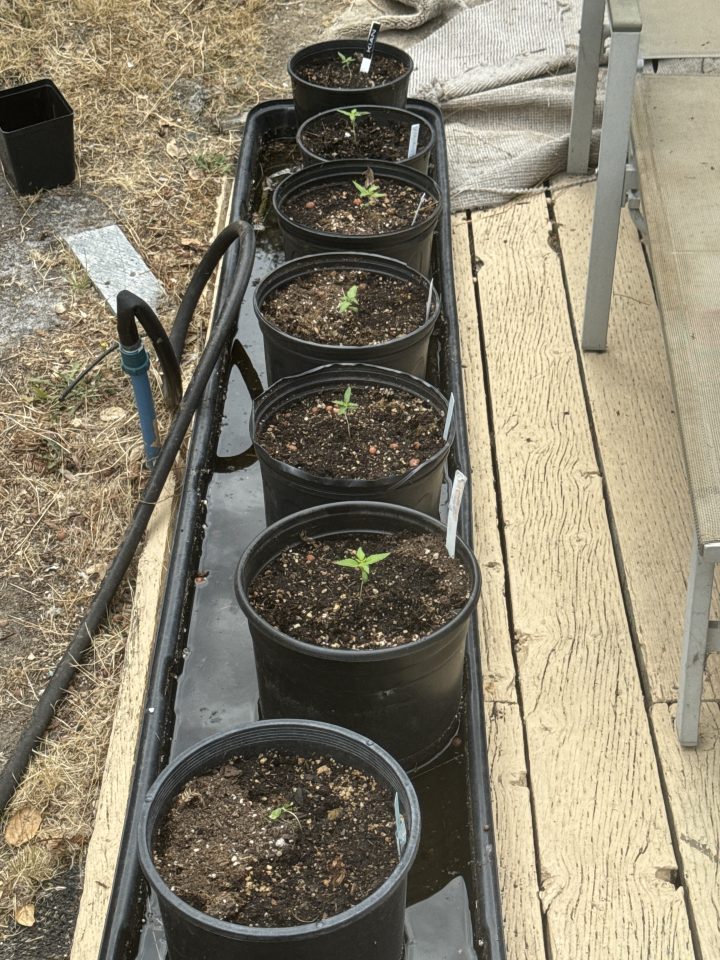
The second experiment began in early September, when I started some assorted autoflower seeds. I chose 8 seedlings to transfer to 3-gallon containers and placed them in full sun. The plants immediately started growing and are doing very well, thank you.
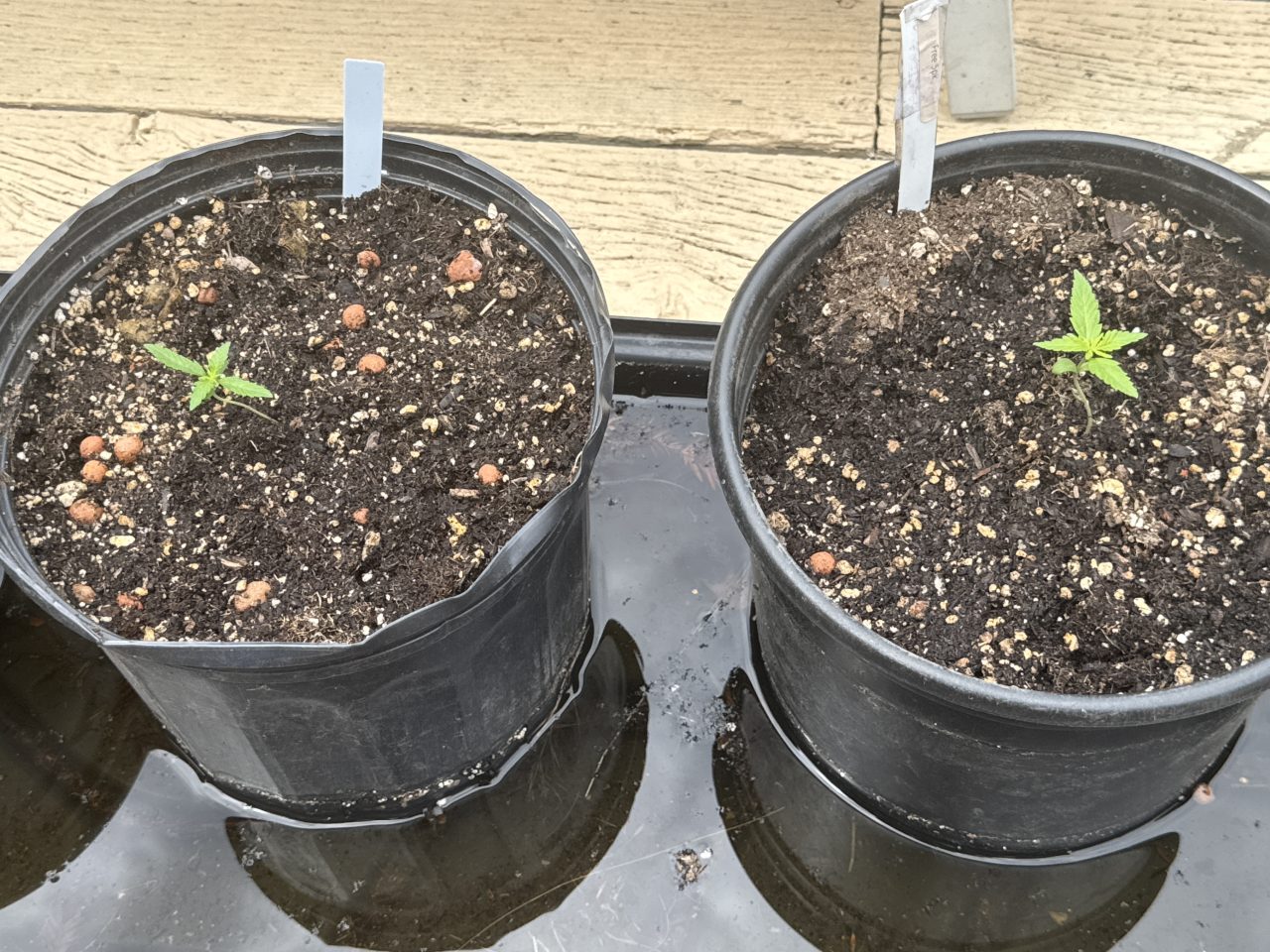
You can see that in both experiments the plants were getting much more light intensity than the plants receive indoors. The plants had no adverse effects from bright light in early growth.
The peak outdoor photosynthetic photon flux density (PPFD) in Oakland, CA, on September 5 under clear-sky conditions is approximately 1,650 to 1,750 µmol/m²/s.
Because PPFD varies continuously throughout the day based on the sun’s angle and cloud cover, you can expect the following typical ranges for early September:
- Solar Noon (Peak): 1,650–1,750 µmol/m²/s at approximately 1:00 PM PDT. This is when the sun reaches its highest point in the sky.
- Mid-Morning / Mid-Afternoon: 1,000–1,400 µmol/m²/s (around 10:00 AM and 4:00 PM).
- Early Morning / Late Evening: 200–600 µmol/m²/s.
Source: U.S. National Weather Service data.
What Does This Mean to You?
- Growing outdoors, seedlings can be placed directly into the sun without conditioning, but the soil must be kept moist and the temperature moderate.
- Clones must be hardened by placing them in bright shade because the leaves were conditioned for low PPFD during cloning and the old leaves must reconfigure. New growth will do fine. When transplanted clones die outdoors, it’s the result of dried roots or hot temperatures baking the plants. Use water-cooled fans or 5-micron misters to cool the air until the plants adjust to their new home.
- Indoors, using watts for lighting without using CO2 is a waste of electricity. CO2 is much cheaper than light. For new growers: Buy more lights after installing CO2 enrichment.
- With CO2, for most varieties, a PPFD of 1,200 will spur terrific growth resulting in higher yields, up to 50%. The high intensity can be used beginning with seed germination extending through ripening.
All photos by Ed Rosenthal. Copyright 2026 by Ed Rosenthal. First publishing rights to High Times Magazine. No other reproduction of this material permitted without the specific written permission of the author/copyright holder.