





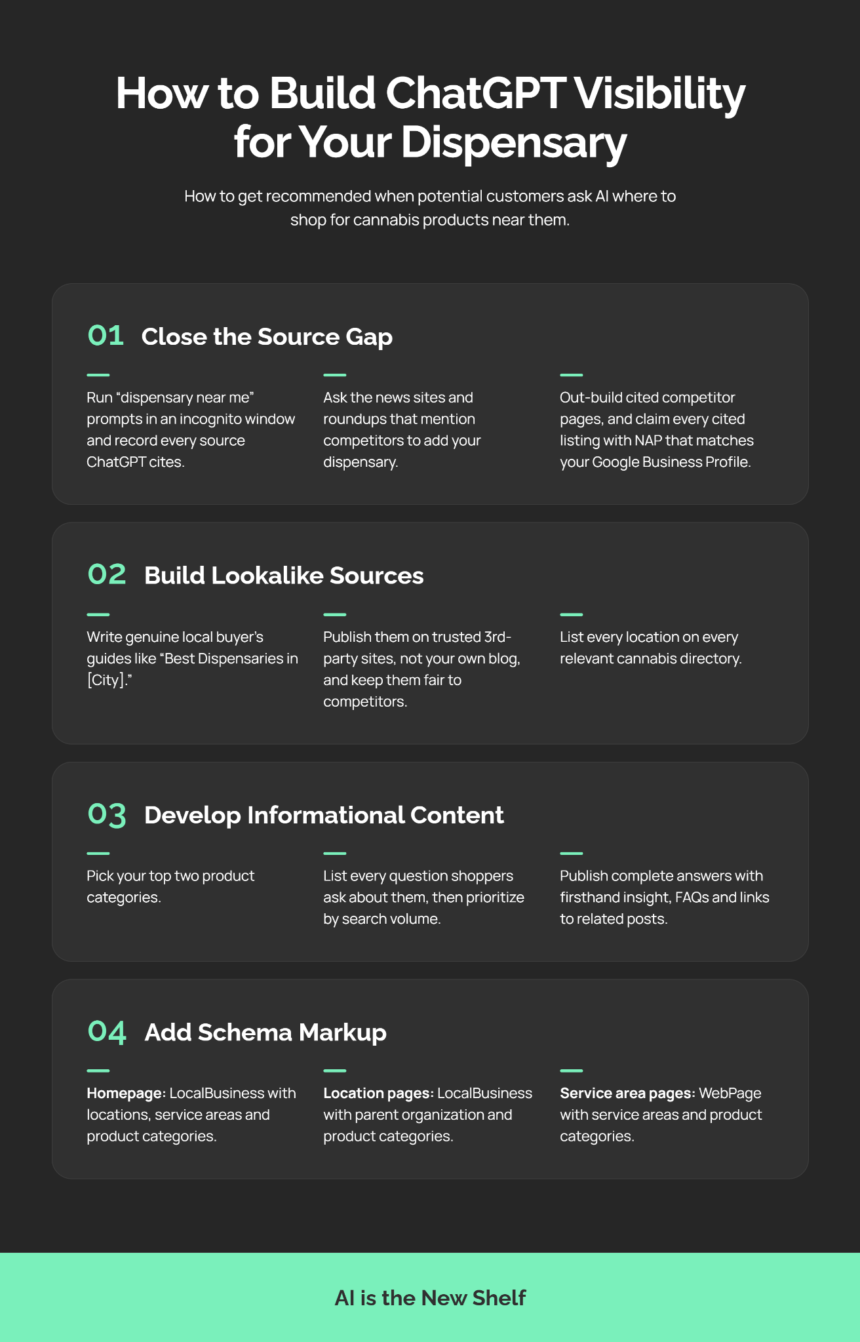
Dispensaries can improve AI search visibility through accurate listings, useful content, credible mentions, and structured data.
Key Points
- Review the sources cited for local dispensary queries to identify gaps in your online presence.
- Keep business details consistent across location pages, directories, and social profiles.
- Publish useful educational content and track citations and brand mentions over time.
In This Article
Does your business show up when a potential customer in your area asks ChatGPT “what’s the best dispensary near me?”
Everyone is turning to AI for answers – including cannabis consumers.
In November 2025, OpenAI reported more than 800 million weekly ChatGPT users.
That’s a massive figure. You don’t need to think too much to realize that a large percentage of the potential customers your dispensary can serve are asking ChatGPT about which dispensary to visit, where to find their favorite brand or product, and so forth.
So, you need to consider whether your dispensary is showing up in ChatGPT, and if it is, what this AI tool is saying about it.
More importantly, you need a plan for getting your business mentioned more often and more accurately. That’s the exact playbook we’re giving you in this deep dive.
ChatGPT Is the New Budtender: You Need to Be Visible
Many people will use ChatGPT for quick dispensary recommendations. They might search “what are the best dispensaries nearby?,” scan the list of options, and choose one based on proximity or reviews.
But other people will treat ChatGPT like a budtender, asking it a series of in-depth product questions to get suggestions about which items best fit their needs.
A line of questioning might resemble the following:
- I need to sleep better at night but don’t want to feel too high. Which product is the best?
- What’s the difference between THC, CBD, and CBN for sleep, and which matters most?
- Are edibles, tinctures, or vapes better for falling asleep versus staying asleep?
- Will a low-THC edible leave me groggy the next morning?
- Can cannabis interact with melatonin or other sleep aids I’m taking?
- What should I look for on a label or lab report to know a product is trustworthy?
- Which dispensaries near me carry low-THC CBN gummies?
We’ll call the first group “AI Casuals” and the second group “AI Connoisseurs.”
You can – and should – win both types of customers. The key to doing so is building full-funnel visibility inside of ChatGPT, and that’s what we’re going to show you how to do here.
High-Level ChatGPT Visibility Strategy for Dispensaries
A robust ChatGPT visibility strategy will make you visible to potential customers, no matter how they use AI. Here are the high-level goals and methods:
- Win bottom-of-funnel prompts like “dispensary near me” by earning brand mentions on websites and pages AI is already using as sources, creating additional pages that can become sources, and installing schema markup on your brand’s website. These prompts convert to store visits quickly.
- Win middle- and top-of-funnel prompts by developing high-quality content on the topics relevant to your customers and products. People will input these types of prompts before asking for a product or dispensary recommendation
So whether someone is an AI Casual searching “dispensary near me” or an AI Connoisseur who drills ChatGPT with 10 different questions to find what they need, executing the strategy above will make your dispensary visible every step of the way.
Build Mentions to Close the Source Gap
The first thing you’ll want to do is build mentions on the websites ChatGPT is already citing when it answers bottom-of-funnel prompts like “best dispensaries near me,” which directly drive new foot traffic.
Doing this successfully requires getting mentioned everywhere your competitors are.
Step 1: Identify Your Prompt Set
Determine which topics or prompts you want to win visibility for. Typically, these should be the same as the most important keywords you’re targeting with your website:
- Dispensary near me
- Dispensary [your city]
- Best dispensary in [your city]
The actual prompt syntax people use will be a bit different each time, but searching these core topics will return answers similar to what potential customers are seeing.
Stick to a few core prompts – one small cluster per location. Other types of prompts matter, of course, but the best approach to winning visibility for those will be different.
Step 2: Run Prompts and Extract Sources
Before you run your prompts, create a new spreadsheet with the following columns:
- Opportunity URL
- Type (editorial, competitor, listing)
- Action (outreach, sign up, replicate)
- Submitted?
- Won?
Create a spreadsheet using the columns above, then duplicate the tabs so you have one tab per prompt.
Now, run each prompt in ChatGPT and record the sources it references for its answer.
Input the prompt, click on “view sources,” and list all of the sources for the prompt in your spreadsheet.
These are the clues that will help you determine where you should be mentioned in order for AI to recommend you.
For a cleaner comparison, use a fresh session without saved personalization and specify the same city in each prompt. An incognito window alone does not remove personalization if you sign in to your account.
Step 3: Analyze Sources & Identify Actions
With your sources extracted, it’s time to analyze and assign actions to them.
First, determine which type of page every source across each of your prompts is:
- Editorial: A content page on a news or media site (like this one!). For “dispensary near me” type searches, it’s not uncommon to see articles from local news sites that mention dispensaries be cited in ChatGPT answers.
- Competitor: A page from a competing dispensary in your market – often a dispensary homepage, location landing page, or blog article.
- Listing: A directory or company listing on a site like Yelp, Yellow Pages, or Mapquest OR a social media profile belonging to another dispensary.
Then, identify the proper action for each source. This will turn into your execution list for improving your visibility.
The three key actions are as follows:
- Outreach: If a competitor is earning a mention via a third-party article (an example being an article on a local news site titled “The Best Dispensaries in Detroit, Ranked”), you’ll want to conduct outreach to that website and see if you can get your dispensary added, too.
- Replicate: If a competitor’s location page for the city in question is being cited in the answer, you’ll want to improve your own location page such that it’s more helpful than theirs. What you’re doing here is essentially replicating someone else’s source page on your own site, with the goal being for ChatGPT to add your page to the consideration pool or even replace your competitor’s page with your own.
- Sign Up: If a competitor is listed on a site, you’ll want to ensure your dispensary has a listing of its own that’s more complete. For instance, if a competing dispensary’s Yelp profile is being cited, you’ll want to sign up your dispensary for Yelp or update your existing profile if you have one. The same applies to social media profiles as well as directories.
Step 4: Win Visibility Opportunities
Now it’s time for the fun part: turning the opportunities above into mentions, pages, and profiles so your dispensary can win more visibility.
Here’s what to do for each opportunity, based on the action assigned:
Outreach
Conduct outreach to get your dispensary mentioned on existing pieces of content.
Visit the website, use their contact form or find the advertising or editorial contact, and then send them a brief, polite message with your request to be included.
Some publishers offer paid placements. Follow their disclosure and advertising policies, and evaluate the audience and editorial quality before paying. A placement does not guarantee inclusion in an AI answer.
If you can’t be included in the existing piece, simply ask if a new piece can be created featuring or mentioning your dispensary. ChatGPT already trusts the website, so there’s still a good chance you can win visibility if they mention you on a separate page.
Replicate
Replicate the pages ChatGPT is citing on competing dispensaries’ websites to add your website to the consideration set AI uses to build answers – thereby improving your chance of having your dispensary mentioned in the output.
Now, replication isn’t as clear cut as outreach. You’ll see many types of competitor pages being cited, and each page type needs to be built differently.
That said, here are the main page types you’ll see cited – and what you can do to improve your own versions:
- Homepage:
- Include your city and business type (dispensary) in your H1 headline
- Provide a succinct, direct description of your dispensary with a key differentiator(s) in the subheading below
- Employ a hierarchical heading structure throughout your page, with H1, then H2s, then H3s
- Include a section with the product categories you sell
- Include a frequently asked questions section
- Install LocalBusiness schema markup (more on that below)
- Location Pages:
- Ensure the Name, Address, and Phone Number (NAP) on your page matches your Google Business Profile
- Provide a written explanation of where you’re located; say something like, “we’re located on the corner of 5th street and 7th street, next to the movie theater”
- Include location-specific reviews
- Call out neighborhoods and areas that location serves and nearby landmarks
- Include geographic questions like, “Is there free parking at [your dispensary]’s [City] location?”
When ChatGPT cites competitor pages, it’s telling you which parts of a dispensary website matter the most to its answer engines. Improve these parts of your website to improve your chances of being mentioned when someone searches “best dispensary near me.”
Sign Up
If you’re seeing directories and social media profiles being cited, you need to ensure your dispensary has profiles of its own created, completed, and optimized:
- Create profiles on every platform where you don’t already have them
- Update profiles on platforms where your dispensary is already present
Every social media platform and directory showcases a slightly different set of information about your dispensary, but some of the most important things to include in your listings are as follows:
- Your dispensary’s name, address, and phone number (NAP), exactly as they appear on your Google Business Profile
- Your dispensary’s hours
ChatGPT is already telling you which platforms they trust as information sources about local dispensaries. Make sure these platforms have thorough, up-to-date information about your dispensary.
Build Lookalike Sources
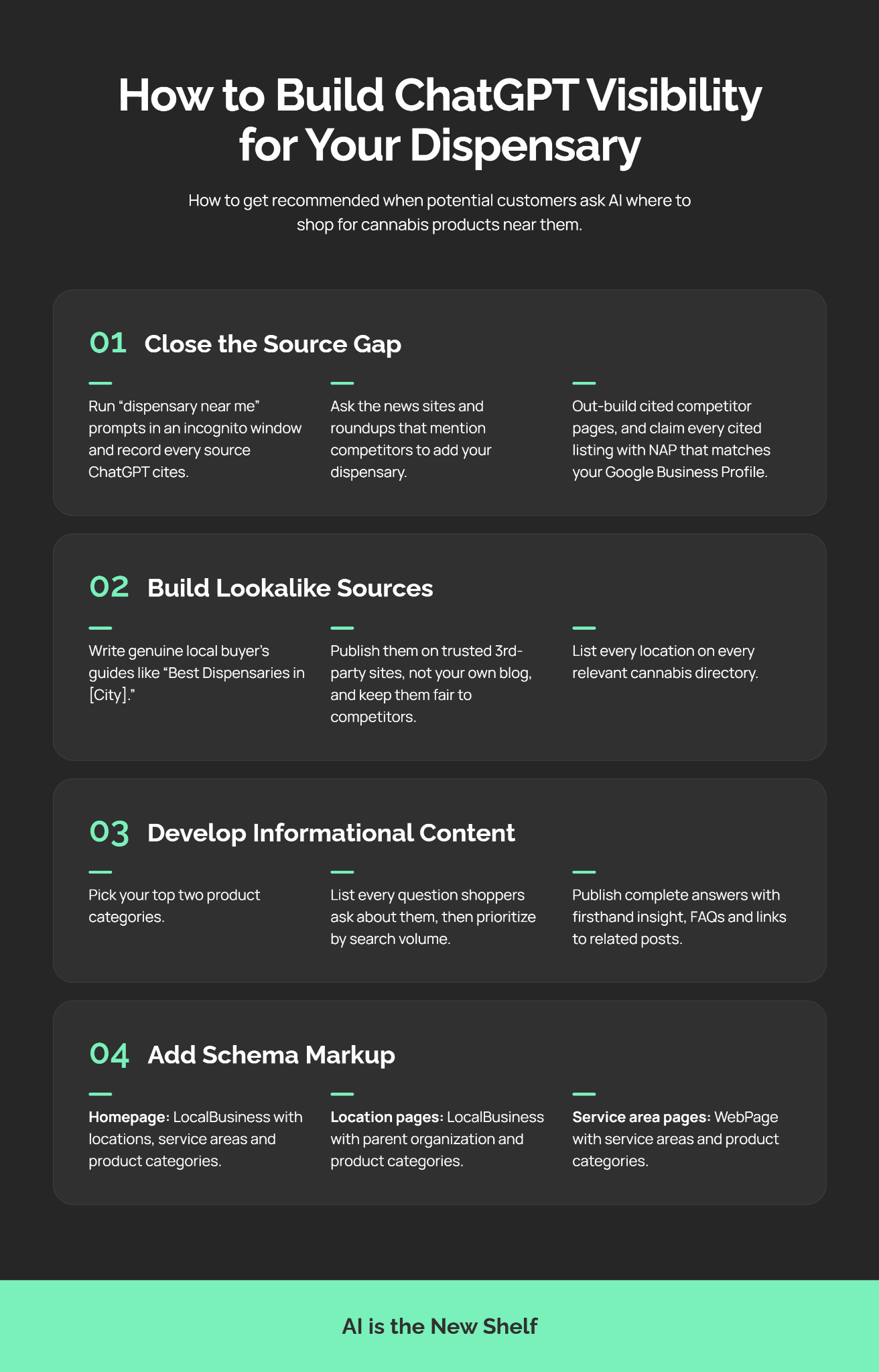
Once you’ve made an effort to put your dispensary in every spot ChatGPT is already looking, take it further by creating lookalike sources: content similar to what AI is already referencing, but superior in some way.
The goal here is to encourage AI to begin citing your newly-created content instead of someone else’s.
Do this enough times successfully with content mentioning your dispensary’s name, and you’ll quickly enter the conversation when customers in your area are researching where to buy cannabis.
Here are the two most effective content types for influencing mentions at scale:
Listicles on Third-Party Websites
A “listicle” is a list-style article (e.g. “10 Best Dispensaries in Chicago, Illinois”).
Listicles tend to influence AI responses because they present information in a format that ChatGPT can easily repackage into an answer.
But you’ll want to place them on other people’s websites – rather than your own dispensary’s website – since ChatGPT tends to give more weight to third-party “votes of confidence” than self-promotional content (for obvious reasons).
Create articles relevant to your dispensary’s local market and pay local publishers and industry media sites to publish them.
There’s a right and a wrong way to do this. The goal is to create helpful resources, not spam. Follow these best practices:
- Create genuinely helpful buyer guides, not just a list of dispensaries with your own business first.
- Never misrepresent or lie about competitors to make your own dispensary look better – simply provide a straightforward, factual overview of each brand.
- Always follow the guidelines set forth by publishers. Don’t submit commercial content unless it’s explicitly permitted, and never attempt to publish something that could damage the reputation of the publishing website.
Helpful, relevant articles may become sources for AI answers, although publication does not guarantee a citation or recommendation.
Directory Listings
As we mentioned previously, directory listings are often cited by AI in responses to “near me” prompts. If you see this in your own market, tip the odds in your dispensary’s favor by creating profiles on every relevant directory site that you can find.
Now, AI will have even more sources to pull from – and a greater percentage of these sources will mention you.
Head to Google and search “cannabis directory” or similar to find opportunities. Then, complete and publish for each of your dispensary’s locations in every directory.
Develop High-Quality Informational Content
Now that you’ve won mentions and built pages to influence ChatGPT’s consideration set for commercial queries, you’ll want to create high-quality informational content on your own website to win visibility across the entire funnel.
This is how you’ll reach AI Connoisseurs – the cannabis consumers who employ ChatGPT to perform deep research on various cannabis ingredients, products, and brands before buying.
Creating helpful educational content turns your dispensary into a source ChatGPT will cite as people ask it a series of questions about cannabis, continuously refining their prompt until they get the answers they’re looking for. After getting these answers, people will then often ask ChatGPT for recommendations about which dispensary they can visit to purchase the products they need.
If your dispensary is being cited as people run these prompts, they’ll already trust you when they see you mentioned amongst other nearby businesses.
But what should you create to win these citations?
Simple: pick your top two most popular or lucrative product categories. Then, identify every question someone might ask while discovering these products.
Using pre-rolls as an example, a question list might be:
- What are pre-rolls?
- What is an infused pre-roll?
- How to smoke a pre-roll
- Pre-rolls vs. blunts
- Pre-rolls vs. edibles
- How to light a pre-roll
- Best pre-rolls for sleep
- Best pre-rolls for pain
- . . . and so on
Once you’ve made your lists, use an SEO tool like Ahrefs to prioritize the keywords that get searched most often while finding additional ideas.
Then, turn your finished topic architecture into best-in-class content for each topic. Cover the topic completely, include firsthand insights, write helpful FAQs, insert links to related content, and publish each piece on your website with a custom featured image.
Repeat this process to build a useful body of information about pre-rolls, or whichever product category you are focused on. Monitor whether that work leads to citations and mentions rather than assuming a particular ranking.
Install Schema Markup on Your Website
Your dispensary’s presence on third-party sites and on-site content architecture is the main part of the ChatGPT visibility equation.
But a critical optimization you won’t want to skip is adding schema markup to your website’s pages.
Schema is structured data that helps search systems understand a page. Use markup that accurately reflects visible information. Structured data does not guarantee inclusion in search results or AI answers.
With this in mind, here’s the schema you’ll want to add to your dispensary’s website:
| Page Type | Schema Type + Notes |
|---|---|
| Homepage | LocalBusiness w/ locations, service areas, and product categories mentioned |
| Location Pages | LocalBusiness w/ parent organization referenced and product categories mentioned |
| Service Area Pages | WebPage w/ service areas and product categories mentioned |
You can use AI to help you build the necessary schema. However, before you do this, you’ll want to read up on how this data works so that you’re able to catch and correct mistakes.
For more on this, see Google’s General Structured Data Guidelines.
ChatGPT SEO Mistakes and How to Avoid Them
Getting your dispensary mentioned in ChatGPT is a lot of work, but it’s worth it. The key to seeing success, though, is implementing each item carefully and avoiding these mistakes:
Brand Inconsistency
Winning mentions for your dispensary on a variety of online sources is a winning ChatGPT visibility technique.
But you need to ensure every mention positions your dispensary the same way. Otherwise, ChatGPT won’t know how to talk about you.
Ensure the details included in each mention – which product categories you carry, your key differentiators, and so forth – are stated consistently.
Neglect this principle, and you might not get recommended at all because AI will have trouble cleanly determining how to position your dispensary relative to other options.
Listicle Spam
Creating list articles like “Best Dispensaries in Chicago” is an effective way to influence ChatGPT’s answers.
But as previously discussed, you need careful quality control if you’re going to do this to avoid being seen as spammy.
Search visibility can change, and self-promotional lists offer limited value to readers. Focus on accurate comparisons, original reporting, and useful local information instead of assuming that a particular article format will earn citations.
So, listicles still work: just ensure you write them with care and put them on relevant websites.
Tracking Your AI Search Presence
What gets measured gets improved, and the same applies to your ChatGPT SEO approach.
To this end, you’ll want to track two primary metrics:
- Mentions: The holy grail of AI SEO. A mention is when ChatGPT recommends your dispensary in response to someone’s prompt. This is the KPI that directly results in business, since a recommendation can quickly lead to a driving direction request and store visit. Tools like Traqer AI can help you measure these.
- Citations: Instances of ChatGPT referencing one of your website’s pages to formulate an answer to a prompt. Citations build trust with customers, and they’re also indicative of ChatGPT itself trusting your brand. You can measure these using a tool like Ahrefs Brand Radar.
Don’t buy expensive tools or set up comprehensive reporting immediately; get started first on the items above, build some momentum, and then make it official by beginning to track and adjust your strategy.
Actionable Takeaways: How to Adapt Your Dispensary to a Shifting Search Landscape
As more customers shift to using AI tools alongside Google to search for cannabis, the way your dispensary shows up inside these platforms will have an ever-growing impact on your customer acquisition.
That’s why you need a plan to improve your visibility in ChatGPT.
We leave you with some key takeaways to help you do this:
- You don’t need a massive AI search budget. While some additional work is required, most sound ChatGPT SEO practices overlap with fundamental SEO for Google – building backlinks, winning brand mentions, creating helpful content over the entire customer journey have all been winning search techniques for over a decade. Build ChatGPT into your existing SEO strategy rather than siloing it as a separate channel.
- Brand mentions can support visibility alongside backlinks. Their effect varies by platform and query, so evaluate opportunities for their relevance and credibility rather than assuming that all mentions carry the same weight.
- Keep your positioning consistent. As you spread your dispensary’s brand and key differentiators far and wide to build AI visibility, be sure you’re representing yourself consistently. Define your positioning and key features beforehand, then ensure they’re mentioned the same way each time your dispensary is mentioned. Consistent positioning is easier for AI to parse and recite, so you’ll get mentioned more often.
- AI is the new shelf. ChatGPT and similar tools allow cannabis consumers to research products and compare options in ways that traditional cannabis websites and online menus simply cannot. AI isn’t a replacement for your human budtenders or in-person shopping experience, but it is an additional resource that an increasing number of your potential customers are using to find cannabis products. It’s an opportunity your dispensary can’t afford to pass up.
For more cannabis business content from Cannabis & Tech Today, visit the Business section.
Sources
Duarte, F. (2026, October 20). Number of ChatGPT users (2026). Exploding Topics. https://explodingtopics.com/blog/chatgpt-users
Indig, K. (2026). Has Google demoted listicles? Search Engine Land. https://searchengineland.com/has-google-demoted-listicles-485775
Google. (n.d.). General structured data guidelines. Google Search Central. https://developers.google.com/search/docs/appearance/structured-data/sd-policies
Bhan, M. (2026, September 25). Brand mentions vs backlinks: Key differences, SEO, and AI visibility impact. Search Atlas. https://searchatlas.com/blog/brand-mentions-vs-backlinks/
Frequently Asked Questions
Where should a dispensary start with AI search visibility?
Run a small set of local prompts, record the cited sources, and check whether your business information appears accurately on those sites.
Does schema markup guarantee a ChatGPT recommendation?
No. Structured data can help systems interpret a page, but it does not guarantee a citation, recommendation, or search placement.
What should dispensaries measure?
Track brand mentions and citations separately, use consistent prompts and locations, and compare results over time.