



After seven growing cycles, a Missouri cultivator reports 30% higher yields from under-canopy lighting. Now he’s experimenting with far-red to improve aroma, while X-ray technology tackles microbes after harvest.
Justin Sheffield has a running joke about the lights beneath his cannabis plants. Across seven full growing runs, he says, the extra yield has varied from 20% to 40%, depending on the genetics, but the average keeps coming back to the same number.
“It’s averaging out to 30% on the dot every time, which is getting scary,” he told High Times.
Sheffield, director of cultivation at BeLeaf Medical in Missouri, started working with under-canopy fixtures about a year and a half ago. The results encouraged him to keep installing them, and the equipment has opened up another experiment: using far-red light to influence how the plants develop.
Elsewhere in the production process, XRpure is working with a very different part of the electromagnetic spectrum. The company’s machines use X-rays to reduce the microbial load on harvested flower, adapting a decades-old food-safety technology to cannabis with the aim of preserving the qualities growers spent months developing.
These technologies give light a few more jobs around a cannabis operation, from reaching the shaded parts of a living plant to treating buds after harvest. For growers, the attraction is getting more usable flower out of the work, space and time already invested in a crop. And having better toys.
Lighting the Plant From Below
Sheffield started growing commercial cannabis in Colorado in 2010, later worked in large-scale hemp production in South Carolina and joined BeLeaf in Missouri in January 2021. He now describes an operation with about 60 cultivation workers and roughly 50,000 square feet of flowering canopy.
His interest in under-canopy lighting grew out of research and conversations with other growers. The idea is easy enough to picture. Overhead fixtures light the crop from above, while foliage shades the growth farther down. Additional fixtures beneath the canopy bring light into that lower part of the plant.
At BeLeaf, Sheffield says, the change produced larger harvests, better colors and a higher proportion of the larger flowers sold as A buds. The yield figures come from the company’s own runs.
“They did everything they said they would do,” he said.
That last detail matters in a market where buyers still attach a premium to a big nug. As Sheffield describes it, a bigger share of large flowers can raise the value of a pound on top of the increase in total pounds harvested. The smaller buds may still be perfectly good weed, but they occupy a different place in the market.
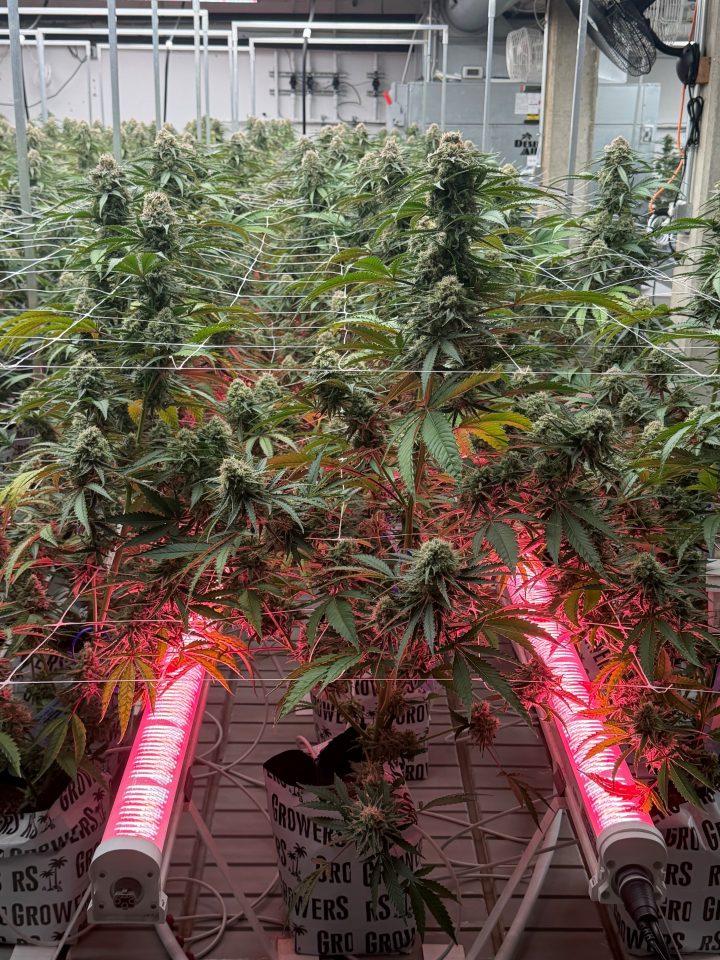
The fixtures have also changed the work around the plants. Sheffield says his team spends less time pruning, defoliating and cleaning up lower nodes, freeing people for other tasks. He is still working on the numbers. The labor data aren’t yet detailed enough to put a reliable figure on the savings, and a bigger harvest means more flower to process and package afterward.
Giving Plants a Different Signal
Growers have been thinking about the color of light for a long time. Sheffield remembers choosing metal halide lamps for vegetative growth and high-pressure sodium lamps for flowering, using their different spectral characteristics at different stages of the crop.

“What’s new is the ability to control that blue red ratio through the life cycle with minute changes,” he said.
His far-red equipment comes from Faven, whose Chroma fixtures include an independently controlled far-red channel alongside adjustable red and white light. For BeLeaf, experimenting from below was an accessible way into that level of control.
“There’s much less of a barrier to entry than outfitting a room with overhead lights with spectral control,” Sheffield said.
Far-red sits just beyond the red end of the visible spectrum. Plants detect the balance between red and far-red through light-sensitive proteins called phytochromes and use those signals to respond to their surroundings. Changes in that balance can affect plant shape and development. In a way, the technique imitates the sun, since the spectrum of natural light shifts as it sets. Applying far-red near the end of the day gives growers a way to experiment with those signals indoors.
The response depends on the plant and the treatment. A 2025 study in Scientific Reports found that far-red effects varied among cannabis varieties and exposure schedules, with some treatments improving cannabinoid concentration and an extended treatment reducing yields.

At BeLeaf, Sheffield and his colleagues have noticed something they like about the plants receiving end-of-day far-red.
“We all agree the plants getting the end-of-day far-red treatment smell better than the control group,” he said. Still, he was cautious, noting that the team doesn’t yet have a data set big enough to establish that effect.
One advantage is that BeLeaf has years of experience with some of the same genetics. Its Blueberry Muffin, from Humboldt Seed Company, has been in the operation since the beginning and remains popular enough to grow across facilities. Familiar plants give the team a useful basis for comparison when it changes an input or a lighting treatment.
“When we do trials, whether it’s input or lighting or pruning or density, it’s very easy to see when something moves the needle,” Sheffield said.
Send in the X-Rays
Once the plants come down, light gets a very different job.
Joseph Bancheri, XRpure’s national sales manager, says he has spent close to 30 years in cannabis and about as long in technology. Joining the conversation was XRpure founder and managing director Jeff Adams, who has worked in X-ray equipment for more than 20 years. The company is a wholly owned subsidiary of Varex Imaging, a manufacturer of X-ray tubes and imaging components.
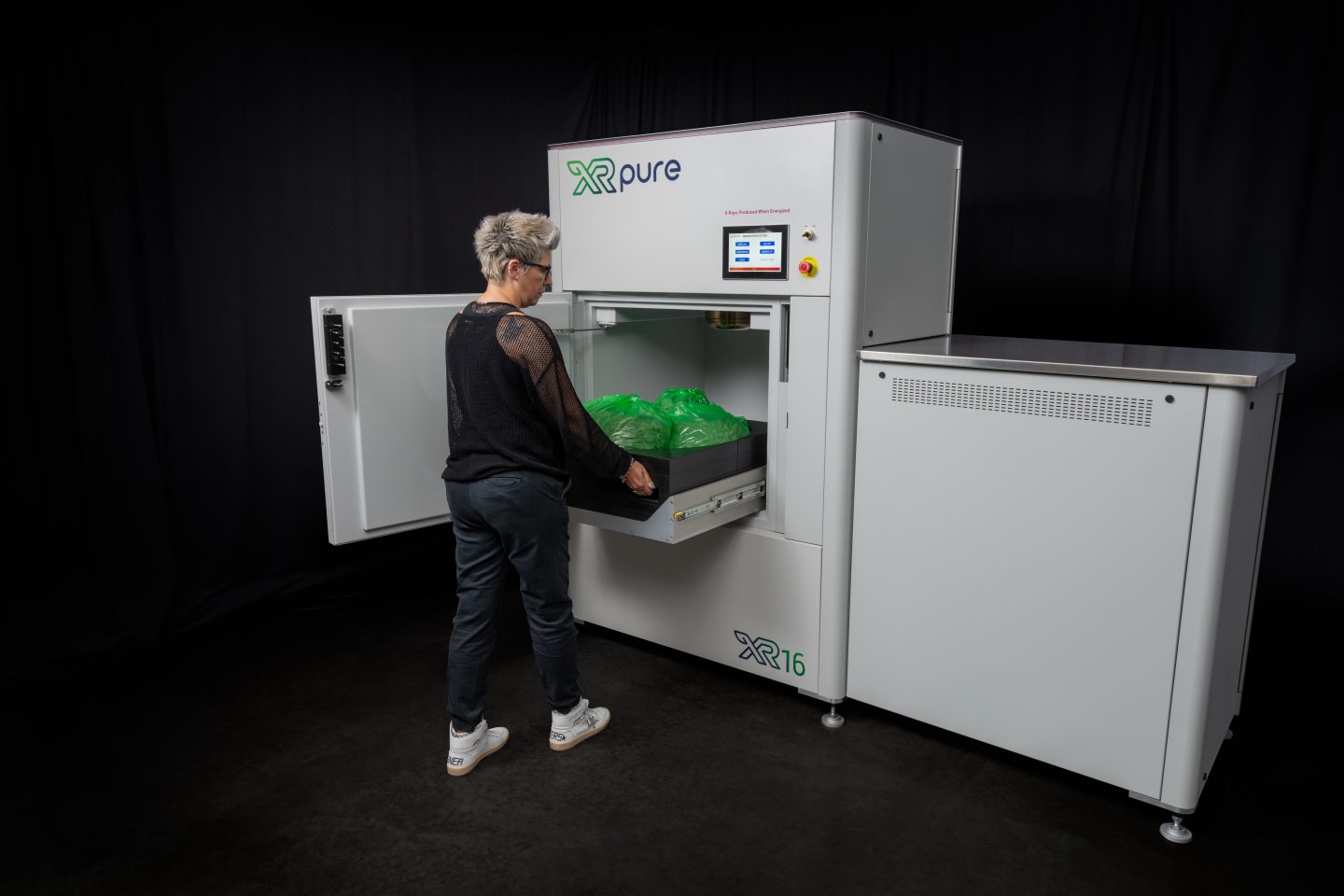
Their equipment puts that experience to work after the harvest. Cannabis goes into a shielded cabinet, where X-ray energy penetrates the flower and damages microbial DNA, killing viable organisms such as mold and bacteria. Adams compared the process with the familiar medical X-ray, explaining that his machine delivers a sustained treatment rather than the brief exposure used to take an image.
“You can think of it as like a fire hose of X-ray that’s just shooting down constantly,” he said.
The ability to reach inside a dense bud is a large part of the appeal. Adams described the difficulty of getting a surface treatment into the interior of a dense, sticky flower, where microbes are usually present. With X-rays, he said, “it treats all the way through.”
The technology isn’t new. Food irradiation has been around for decades. The FDA describes its use to reduce microorganisms in foods including spices, produce and meat, and explains that the process does not make food radioactive.
Adams sees an advantage in bringing X-ray equipment directly into a cannabis facility, where growers can treat their own product on site.
The practical question for anyone who enjoys weed is what happens to the flower along the way, and whether its structure, color, smell or terpenes change.
Adams said the company has run laboratory tests before and after treatment, including terpene and water content, and found no change beyond the tests’ margin of error. XRpure describes it as a cold process meant to reduce microbes while preserving the characteristics of the finished bud.
Operator safety is the other obvious question, since anyone who has had a medical X-ray knows the precautions involved. The radiation stays inside the shielded cabinet, and customers load the flower in sealed bags that stay closed throughout treatment, Adams explained.
“So when you’re running your flower, you never have to take it out of the bag,” Bancheri said.
Treating by the Pound
The system Adams describes holds about 15 to 20 pounds of finished flower, depending on bud size. A typical treatment takes roughly two and a half hours, with the dose and batch size affecting the processing time. Day to day, he said, the operator mostly loads the bags and pushes a few buttons.
Bancheri sees the economics in the amount of work that has already gone into those pounds. By the time flower reaches testing, the grower has paid to cultivate, harvest and cure it. Reducing microbial failures is a way to preserve more of that investment.
“So you get the most value for all your efforts on that harvest,” he said.
Some customers use treatment as a routine step in their production process, Bancheri said. Others offer the service to smaller growers, a practice known as toll processing. The machine can also treat packaged flower and finished pre-rolls, according to the company, allowing treatment at different points after harvest.
The hardware is heavy-duty industrial equipment, built around lead shielding and X-ray tubes containing materials such as beryllium and tungsten, so buying one takes a substantial investment. XRpure also offers leasing.
The company has also taken the machine on the road, installing a unit in a self-contained trailer operating in New York.
“We come and park at a farm for a few days,” Adams explained.
Growers pay by the pound for treatment, he added, and the trailer then moves on to the next customer. For a smaller operation, that puts the service within reach without installing a machine of its own.
What Makes a Good Smoke
Back at BeLeaf, Sheffield’s interest in new lighting remains tied to what consumers eventually experience. Missouri buyers still shop heavily by THC percentage, he says, so his team has to balance what it likes to grow with what moves off the shelf. His own preference is straightforward.
“For me, I’m all about nose and flavor,” he said.
Asked what he wants from the finished product, he described an experience that brings together the effects, smoothness and flavor. It is the part of the work that eventually leaves the facility and reaches the person opening the jar.
“I need all four legs of the table to hold it.”
Editor’s note: This is an editorial article. It was not sponsored, and no company paid for or reviewed it before publication. SWADE, the Missouri cannabis brand operated by BeLeaf Medical, has separately sponsored High Times events and the High Times docuseries Kicking Back.