





White House officials are giving feedback on pending legislation to create a regulatory framework for hemp amid a swirl of proposals from lawmakers on the issue—including a new amendment that seeks to expedite enforcement of the pending recriminalization of hemp-derived THC products that is currently scheduled for November.
On Tuesday, Vince Haley, director of the White House Domestic Policy Council and James Braid, assistant to the president for legislative affairs, sent hemp policy suggestions to Rep. Andy Barr (R-KY), who has been helping to lead efforts to enact regulations for the plant as an alternative to prohibition.
“We appreciate your work to advance the policy of” an executive order President Donald Trump signed in December that included provisions seeking to protect Americans’ access to CBD products, the staffers wrote in a letter to the congressman.
“We are transmitting for your consideration draft legislative text and comments to address the statutory definition of final hemp-derived cannabinoid products in order to allow Americans to benefit from access to appropriate full-spectrum CBD products while preserving the Congress’s intent to restrict the sale of products that pose serious health risks,” the White House officials said, according to a social media post containing a screenshot of the letter. “We are available for discussion and further technical assistance.”
The attachment with the administration’s proposed legislative text was not included in the post, and the White House and Barr’s office did not immediately respond to Marijuana Moment’s request for further details.
Barr filed a hemp amendment this week to the pending Farm Bill, but he later withdrew it for reasons that he did not announce.
It’s not clear from the letter’s text whether the White House was proactively sending legislative proposals to the lawmaker or if they were replying to something his office submitted—though two cannabis industry sources suggested to Marijuana Moment that Barr first sent language to the administration, which then provided technical feedback.
Barr’s now-withdrawn amendment, according to the sponsor’s summary, “amends the definition of ‘Hemp’ to preserve the lawful hemp market while creating a regulatory framework that protects children, bans synthetics, and ensures that any products on the market place are of American origin.”
Meanwhile, Rep. Mary Miller (R-IL) also filed a new Farm Bill amendment that she said “expedites enforcement of the hemp restriction provisions” that are now set to take effect on November 12.
Instead, under her proposal, the ban would kick in on the date the new Farm Bill is enacted—though it’s not clear based on current progress in Congress when that will actually be, and the legislation could potentially not end up passing until after the current recriminalization date, making the amendment moot.
Hemp derivatives with less than 0.3 percent delta-9 THC on a drug-weight basis were federally legalized under the 2018 Farm Bill that Trump signed during his first term in office. But late last year, the president signed new legislation containing provisions that will redefine hemp to make it so only products with 0.4 milligrams of total THC per container will remain legal after November 12.
Trump this week pushed congressional lawmakers to take action to amend the currently scheduled hemp ban, which he suggested threatens to federally recriminalize full-spectrum CBD products.
“I am calling on Congress to update the Law to ensure that Americans can continue to access the full-spectrum CBD products they have come to rely on, and that help them, while preserving Congress’s intent to restrict the sale of products that pose Health risks,” the president said in a Truth Social post on Thursday, the same day his administration announced it is moving forward to reschedule marijuana.
“We must get this done RIGHT and FAST, especially for those who saw that CBD helps them,” he said. “Plus, I am told it will also help our GREAT FARMERS, who we love, and will always be there for.”
Barr promoted the president’s comments, saying in his own post that he is “working in Congress to deliver these critical reforms so farmers have certainty and Americans can continue to access safe, reliable hemp-derived products.”
An additional pending Farm Bill amendment from Reps. James Comer (R-KY) and Kelly Morrison (D-MN) would push back the scheduled federal recriminalization of hemp THC products for another year.
Submitted amendments to the Farm Bill, formally known as the Farm, Food, and National Security Act of 2026, or H.R. 7567, are expected to be considered next week by the Rules Committee. That panel will decide whether the proposals can receive votes on the House floor.
Rep. Jim Baird (R-IN) had filed a hemp ban delay amendment before the House Agriculture Committee when it took up the Farm Bill last month, but that panel’s chairman determined that the proposal was not germane to the legislation.
The Farm Bill as approved by the prior committee does contain some provisions aimed at aiding the hemp industry and farmers who grow cannabis for industrial purposes such as fiber and grain. For example, the legislation would amend existing statute related to the development of industrial hemp production regulatory plans by states and tribes—including surrounding polices for testing, sampling, background checks and record-keeping.
A number of other bipartisan hemp reform bills are pending in Congress.
Last week, for example, Sens. Rand Paul (R-KY), Amy Klobuchar (D-MN) and Joni Ernst (R-IA) filed the Hemp Safety Enforcement Act, which would effectively let states opt out of the federal recriminalization of hemp THC products that is set to be enacted later this year.
Ernst on Wednesday, however, withdrew her name as a cosponsor of the legislation. Her office did not reply to Marijuana Moment’s request for clarification on the move.
—
Marijuana Moment is tracking hundreds of cannabis, psychedelics and drug policy bills in state legislatures and Congress this year. Patreon supporters pledging at least $25/month get access to our interactive maps, charts and hearing calendar so they don’t miss any developments.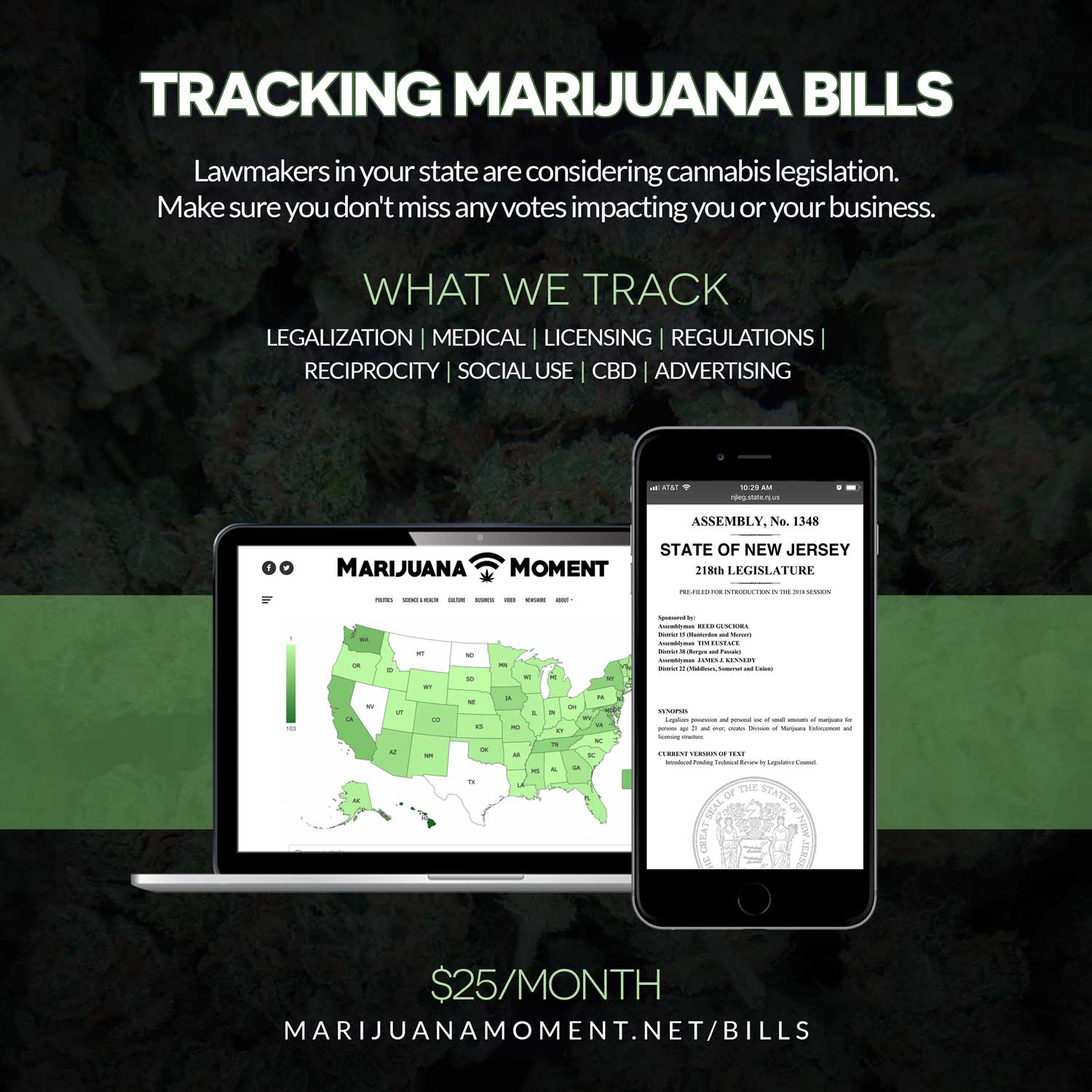
Learn more about our marijuana bill tracker and become a supporter on Patreon to get access.
—
A U.S. Department of Agriculture report published this month shows that farmers in the U.S. grew three-quarters of a billion dollars worth of hemp crops in 2025—a 64 percent increase from the prior year.
Meanwhile, the Trump administration this month launched a new initiative to cover up to $500 worth of hemp-derived products each year for eligible Medicare patients. The program being implemented by the Centers for Medicare & Medicaid Services (CMS) focuses largely on CBD but also allows a certain amount of THC in products.
Anti-marijuana organizations filed a lawsuit suit against the Medicare hemp coverage policy, and lawyers for Health and Human Services Sec. Robert F. Kennedy Jr. and CMS Director Mehmet Oz recently filed a brief asking that the case be dismissed.
Meanwhile, the White House Office of Management and Budget has been holding a series of meetings about a Food and Drug Administration (FDA) CBD products enforcement policy.
FDA also issued guidance making clear that it does not intend to interfere with implementation of the Medicare hemp-derived products coverage plan.
CMS separately finalized a rule that will allow coverage of some hemp products as specialized, non-primarily health-related benefits through Medicare Advantage plans.
As hemp products have become more popular with consumers, some large brands are attempting to get in on action.
Major retailer Target, for example, is expanding its participation in the hemp-derived THC beverage market. Last year, the company began a pilot program involving sales of cannabis drinks at 10 select stores in Minnesota. That apparently went well, and now the company has obtained licenses from Minnesota regulators to sell lower-potency hemp edible products—including THC drinks—at all 72 of its stores in the state.
Marijuana Moment is made possible with support from readers. If you rely on our cannabis advocacy journalism to stay informed, please consider a monthly Patreon pledge.