






He smokes in boardrooms, but he’s still on that underground frequency.
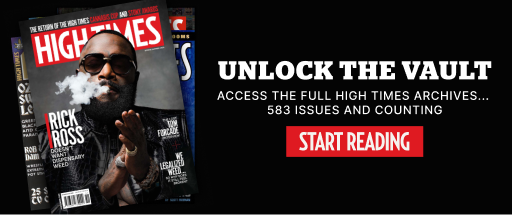
This content originally appeared in the High Times Spring/Summer 2026 print issue. Get yours here.
“You’ve taken control of your life when you decide when, where, and what you smoke,” Rick Ross says. Not posturing, not flexing. Just his take on success. A measurement you can feel in your calendar and your wallet, in whether the day belongs to you or whether you are still borrowing space inside somebody else’s rules. That definition makes it pretty clear why he has so little patience for dispensary weed.
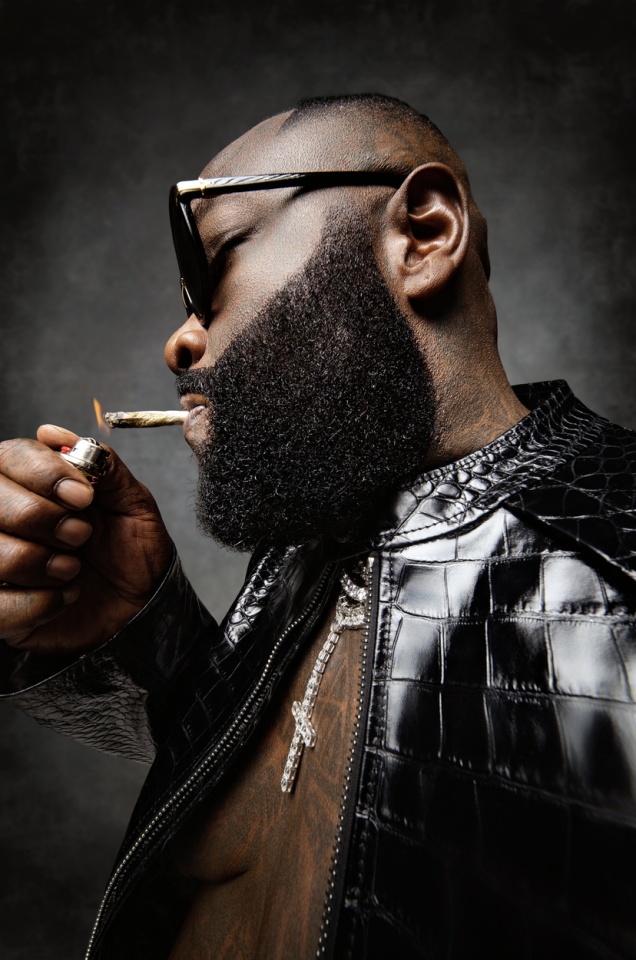
Before any of it gets unpacked, he does what he always does. A match from a small box, one scrape, that half-second paper-and-sulfur snap and the cherry catches. The joint is burning. Tips tap for a quick cheers. The smell gets its due, and Ross answers like he is closing the loop on something already settled: “Without a doubt. We got to light up for High Times.”
He traces his first joint back to his teenage years. “I may have put my lips on my first joint at 13 and chilled,” he recalls. He’s quick to add that he doesn’t recommend smoking that young. That’s just how it happened for him, and without glorifying it, he still recognizes the calm he felt with that first hit.
A couple of years later, novelty is gone. It locks in because it fuses with the first machine that mattered to him, music. “Then by the time I was 15, it was really something that I enjoyed doing,” Ross says. “Because I think the connection for me was with music on the street… my homies that played the music, they always had a joint and the music would play… I was always sunk into production. I would drift more into beats, damn near more than into rhymes.”
The picture does not need much help: a room, a few friends, a track looping, the joint moving hand to hand, a kid listening like a builder, beats first, structure first, blueprint before shine. “So once I understood the combination of cannabis and sound production,” he continues, “I couldn’t have one without the other.” The line that keeps steering the rest of his thinking lands right after: “Once I was in control of my life, weed was always there. Period.”
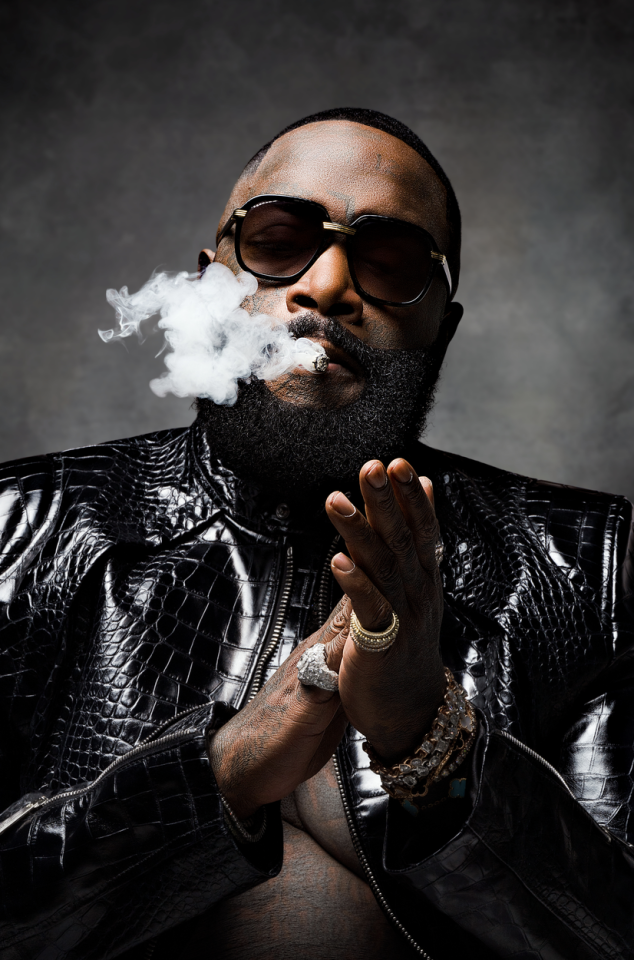
Control, to Ross, is not a motivational poster. It means logistics, ownership, the difference between sneaking around and setting the terms. “That’s when you could really determine when and where you smoke,” he explains. “That should be the deciding factor of when you’ve taken control of your life.” He puts it even cleaner: “That’s you purchasing your own cannabis. Wherever you at, you could smoke your cannabis. You understand?” From there, he pulls it back to the early version, the part people romanticize until they remember how anxious and inconvenient it really was.
“As a youngster at 13 and 14, you went to the park,” Ross says. “You had to walk all the way out the house. You couldn’t smoke in your mom’s crib… so you had to be creative. That’s when all the weed charges came about because you just rode around the city in the car just wanting to get hot, not knowing, ‘damn, I’m going to get a weed charge,’ when you really should just sit your ass at the park by the lake and smoke.”
“Sit your ass at the park by the lake.” Plain delivery, and a whole education inside it: sometimes you think you are free because you are moving, and sometimes movement is exactly what gets you caught. He sharpens it with the part most people skip, that “control” counts even when the numbers change: “But that’s when you took control, when you make those decisions, whether that’s a nickel bag or if that’s a motherfucking $1,200 ounce of gelato.”
So how do you go from that kid to the adult who calls the shots? Ross does not dress it up. “It’s almost like you got to make that… decision up of what you’re going to be,” he says, “and it’s almost to a psychotic sense. You must believe in yourself and force yourself to become that.” Psychotic is his word. He does not apologize for it. “Me becoming successful before I was a successful artist,” he adds. “Me smoking the best weed and as much as I wanted was right there at the top… right there next to… whatever my favorite fucking car was. The weed was right there with me.” Money matters, he admits, because it finances everything. But the plant was never something that showed up after the trophies. It was part of the picture from the beginning, one of the north stars he could actually imagine in his hands. And then: “I’m one of them,” Ross says. “I’m a firm believer that Chevy muscle cars were created for cannabis users.”
When he describes his relationship with weed, it reads like routine. Not a performance. “While I got dressed, I wanted to smoke,” he says. “Before I ate food, I wanted to smoke. Soon as the dessert was finished, I wanted to smoke. Soon as we got in the car, I wanted to smoke. Soon as the music came on, I wanted to smoke. Soon as everybody left, I wanted to smoke.” For him, it’s celebratory and personal, something he can do alone or with a group. “I just knew it would always make the situation much better,” he says. “So even if you in a good mood, smoke. If you’re in a bad mood, smoke. Shit only going to get better.”
“I’m actually razor sharp when I’m smoking. I’m sluggish when I haven’t smoked.”
Rick Ross
The lazy-stoner stereotype shows up like it always does, and he barely gives it oxygen. “That’s a huge misconception,” Ross says. “I think if you’re a lazy person, you just a lazy person. You can’t blame that on smoking… Nah, if you gonna execute whatever the play is, you could smoke 10 joints a day and do it. I do it every day… I’m focused… I’m actually razor sharp when I’m smoking. I’m sluggish when I haven’t smoked.” He makes it physical. “A long ass flight from fucking Dubai, I’m sluggish,” he goes on. “But give me that joint right now and whatever we need to get done, it’s going to get done.” He shrugs at the suffering as if it were just a toll booth. “That’s how it go. The flight, fuck it… But when you land, you good. Everything, all the problems solved.” And when he wants to kill the stereotype completely, he reaches back to the kind of proof you cannot fake. “When I was in high school playing football, I was smoking right before the games. I fucking made All-City, so I guess I’m an All-City stoner.” Then his own punctuation: “We got to create the game. You know what I’m saying?”
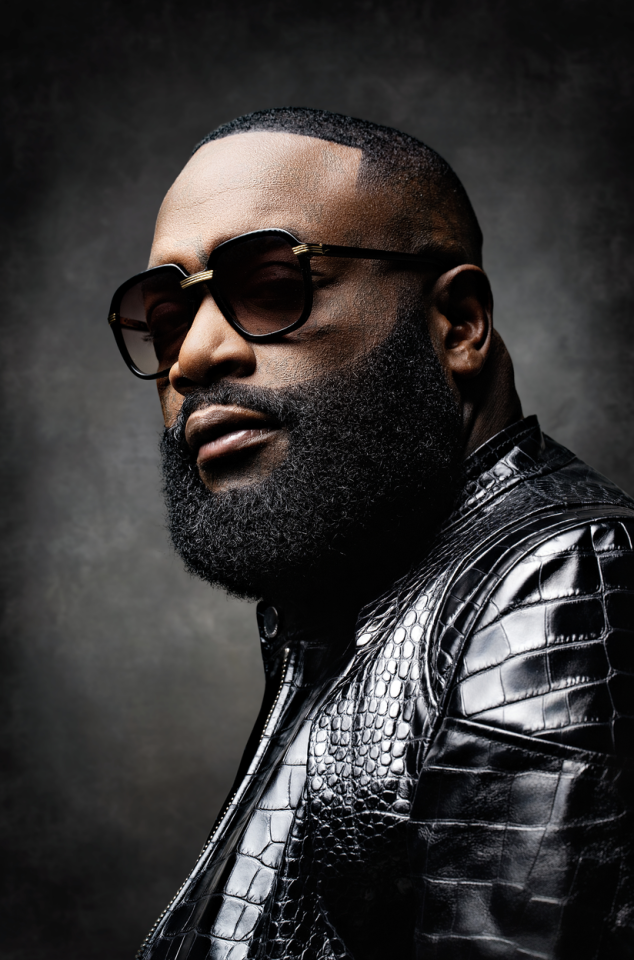
Ross does not separate weed from work the way polite culture likes to. He puts it in rooms where the stakes are real. “Cannabis is most definitely… a conversation piece,” he says. “You could discuss anything while smoking cannabis.” He makes it specific. “I have conversations with my attorneys,” he says. “I could be fighting to be free… or we just not even speaking on it. We just smoking or I’m just sitting there in the meeting smoking it.” He wants the tone understood, because this is where people project the wrong movie onto him. “But everyone’s at peace,” he says. “And what I’m speaking about, I’m razor sharp and I’m talking big business. We all here for one reason: It’s upscaling… I’m smoking and I’m not being goofy. I’m not giggling… we getting straight to the point and everybody respect that and they honor that.” He throws a number on it like it is nothing. “So when it come to my 30-plus partnerships,” he says, he wakes up early, goes to sleep late, and stays excited. The joint is not a detour, it is part of the engine. “It’s right on my hip,” Ross says. “If it was the Westerns, that would be my pistol. I got to have it with me everywhere I go.”
When the conversation turns to cannabis as an industry, the nostalgia drops away, and the quality-control voice takes over. “It’s many more entrepreneurs who have failed in the cannabis market than those who succeeded,” Ross says. “I’m sure everybody see what’s going on in the industry in the last few years.” He speaks from his own scale, the only way he knows how to speak. “I’m close to being a half-a-billion-dollar entrepreneur,” he says. “I can never have enough weed.” He sources from everywhere his mind can reach. “If you growing it in Colombia, cool. If you on the West Coast, cool. If it’s coming from ‘Czechlovakia,’ cool,” he says. “It could be the number one strain, I smoke on it two weeks then I want to switch it.” Even the ritual changes, but not as often. “I’ve been on my RAW papers the last two years,” he says. “Other than that, I was on Grape Swishers for 30 years.” He adds the warning label for anyone walking in thinking it is easy money: “When it comes to hustling and anybody that’s in the market and in the industry, you got to really know what you’re doing.”
“And it begins with the product,” he says. “That’s why I love underground growers,” Ross adds. “I love black market growers.” He plants a flag, High Times-sized. “Let’s make that shit potent, man,” he says. “Fuck the rules. Fuck all rules. This the High Times… We don’t smoke or live by the rules. We don’t play by the rules. We want the best dope on the planet.”
“Dispensaries, that’s trash… Them shits could be chained up. We wouldn’t miss them at all.”
Rick Ross
Dispensaries come up, and Ross lights up. “Dispensaries, that’s trash,” he says, then adds a caveat that sounds almost generous. “We not gonna say it’s personally they fault, but they got to play by the rules.” The line that follows tells you exactly where he stands. “And we not playing by the rules,” Ross says. “I don’t give a fuck… If you got the dope that I’m looking for, I give you fucking $5,000 for seven grams. You just better have some shit that when I hit it, it talk to my seizures. It got to do something like that.” For him, it’s all about quality, not hype. “For the real smokers, the real connoisseurs,” he says, “we gonna enjoy… the space we in right now.” But he does not treat dispensaries as the future. “Them shits could be chained up,” he says. “We wouldn’t miss them at all.”
He raises a toast, old-school and sincere. “One time for the black market,” Ross says. “One time for the underground. One time for the ones that’s making it happen on the side of their… granny house.” Later, he gives a metaphor that explains how he sorts culture from marketing. “If it’s underground, it’s just like a mixtape,” he says. “Fuck how many followers you got… If you got that heat, boy, I’ma fuck with you.”
That same logic runs through how he talks about entrepreneurship. There’s no tidy origin story, just belief plus repetition and appetite. “I’m a firm believer that I could do shit,” Ross says. “I could make shit happen.” He talks about writing for other artists before he “got on,” then the moment the world caught up. “Once I finally made my hit record in ’06,” he remembers, “I knew people understood the vision.” The hook became a cultural shorthand, but the record was “Hustlin’,” the debut single that first broke him out, the one now closing in on its 20-year anniversary.
And hustlin, for him, was never one lane. “When I said ‘Everyday I’m Hustlin’,’ we wasn’t just talking about one thing,” he says. “In the streets in Miami… it’s multiple choice. What you here for?”
Failure comes up, and he treats it like an enemy he does not let in. “It’ll haunt you,” Ross says, “but it’ll only haunt you as long as you allow it to… you got to bounce back.” Instead of keeping it tidy for print, he gives you the voice in his head when he climbs out of the hole, the kind of line that makes you laugh and then makes you understand exactly how he survives it: “…that’s when you could look at that little weak ass failure and say, ‘You little weak ass son of a bitch failure. You couldn’t stop me. I’m smoking motherfucking big at the mountaintop where the air is much thinner, and the dope, every time you touch the back of that RAW joint, it tastes like you licking a pretty bitch ass.’ You understand?”
He does not pretend the failures don’t show up. He just refuses to let them steal his headspace. “So we don’t let the failures stop us, ’cause we take failures everywhere as entrepreneurs.” He does something most people avoid and names one without hesitation, a cannabis-growing collaboration that never worked out. “That shit weren’t growing right. We got to pack up and take it somewhere else.” There’s no excuse-making in it. “And that’s cool,” he adds. “That’s what we are. We hustlers.”
The corrections officer question comes, the one people still pull out like a gotcha, and he does not flinch. “That’s too easy,” he says. “Down here in the streets… it’s different moves you could make to make different things happen. It wasn’t about the money at the time. I had to do it for other reasons.” He is not interested in apologizing for the chessboard. He is interested in the fact that the move worked. “Here I am today. The biggest motherfucking boss ever.”
The principle is blunt as a warning. “Sometimes you got to show them what you willing to do,” Ross says. “How far you willing to go.” He backs it up with work, not words. “At 13, washing cars for $30 for the day,” he says, and then roofing, hot tar, real consequences. “If that tar hit your foot, your whole leg gone.” “But are you willing to do that to go get that good joint?” he asks. “What are you willing to do to satisfy what you savor?”
When he wants to make the point explicit, he puts it like a curriculum. “When it come to business, all I ever taught was principles.” And he ties it to something concrete you can hold, sell, scale. “…and now we have Slippery Soap, a car soap, car care product that’s now in 4,000 AutoZone stores.” The message is not ‘be inspired’; it’s ‘watch the line from the driveway to the shelf.’
“I go to great heights.” He closes that loop too, by making the controversial chapter sound small compared to the hunger behind it. “And being a corrections officer, trust me, that was nothing compared to what Roz willing to do to make it to the top.”
He remembers the risk from the weed side, too. “My first time being arrested was buying weed in Opa-locka,” Ross says. He and a friend bought “$10, two nickel bags of weed,” and got pulled over immediately. “But you learn quick in Miami,” he says. “Even if you just… buy $10 worth of weed.” The next line sounds like survival more than bravado. “Once you show me once,” Ross says, “you’re not going to get me many times.”
Race comes up because it has to. “That’s the way they had this shit set up,” Ross explains. Where he is from, they would pull you over for weed and hope to “get lucky and find a 9 millimeter riding with the two young Black kids,” when “all we wanted was two Backwoods and two nickel bags of weed.” He wants the takeaway to be practical. “For anybody that’s a stoner, anybody that smoke cannabis,” Ross says, “I just want us all to move the same way and let’s move correctly. We know who we up against.”
He brings it back to frequency, that word he uses like it is a place you can inhabit. “Reach that frequency we trying to make it to,” he says, because “everybody ain’t on our frequency as much as they would love to be.” He follows it with a line that reads like a comment about hypocrisy, said without ornament. “Trust me,” Ross says. “When they standing there in their uniform, they’ll do anything to take those fucking shoes and socks off and just hit that joint.”
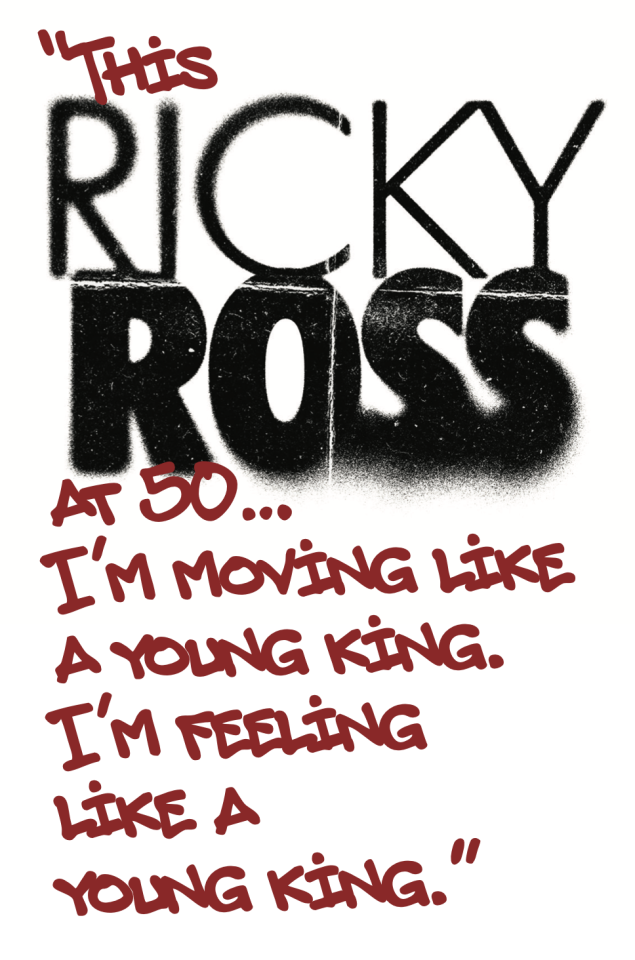
At 50, Ross talks like the second half of life becomes even freer. “I just celebrated my 50th birthday,” he says. “Just imagine when I was 25… I never imagined what would I be like at 50 years old.” And he says the thing most men joke about privately and almost nobody says out loud in an interview: “At one point when I was young, I was wondering, do dudes even still have sex when they 50? Are they too old to smoke weed?” The answer is immediate, like he is offended that the doubt ever existed. “Nah, man,” he adds. “This Ricky Ross at 50… I’m moving like a young king. I’m feeling like a young king.”
That’s the same energy behind his next chapter on paper. Later this year, he’s set to publish RENAISSANCE OF A BOSS: Notes from a Creative Awakening with Hanover Square Press, his third book, following Hurricanes: A Memoir and The Perfect Day to Boss Up, both New York Times bestsellers. It’s framed as a road-trip-style meditation on rediscovering his creative spark and interrogating the habits that keep him prolific. Ask him why a book at all, and he pulls the camera back far enough to show the full climb. “I felt like… I had put myself in a position that, for one, I could never believe and a lot of other people couldn’t believe,” he reflects, from signing “a pretty small record contract in Miami,” to working his way out of it and becoming “the CEO and head of your own label,” to building “close to 50 chicken franchises.”
It is not a victory lap, exactly. It is, in his words, “some game that you may want to lay out for the ones that want to catch up on it.” “Like I said, everybody not on our frequency and that’s cool.” And for the ones who are, he doesn’t complicate it. “For the ones that may want to know how this is done… just light your joint up and go for the ride. Don’t skip no pages.”
In the interview, he frames the whole project as a message for people who feel like their window closed. “It’s never too late to just have that reset button pushed,” Ross says. “You could still be that amazing person that you just quite never made it to yet.” Then he brings it down to earth. “You still that priceless individual,” he says. “Whatever cubicle you sitting behind, it’s never too late to pull that motherfucking move off that you got in you.”
Cannabis, for him, is not something you outgrow into responsibility. “At 50 years old, I’m not celebrating stopping smoking cannabis,” Ross says. “Nah, I’m rolling up even bigger joints now… I want to put a half an ounce of weed in a big burrito.” He laughs, then offers a metaphor to explain how he treats it. “It’s just like setting that AC temperature in the crib that’s perfect for you,” he says.
He tells a shrooms story too, and the lesson lands in the same place: respect set and setting, pay attention, stay awake inside the moment. He wants it on record that this is not a new phase for him. “I been experimenting with shrooms for about half the time of that.” Alone in his theater, watching Emancipation and drinking “liquid shrooms,” he loses track, gets swallowed by the movie, and wakes up to “eight firemen standing over” him. In his version, the slide from entertainment to immersion is not subtle but a bit violent and cinematic. “I’m watching Will run for his life. I’m feeling like I’m a runaway slave from the fucking 1600s… I felt like I was in the fucking lake, running from crocodiles, running from the fucking slave catchers.” He is laughing a little even as he tells it, because he is still shocked by his own brain. “I don’t know if I pissed on my pants in the theater.” He stops and tells you what every author tells you when the best parts still feel unreal. “I don’t know. I’ma just make sure, listen, you guys got to read the book ’cause the details still shaky to me… whenever that happened.”
The takeaway is clean. “You always stay in control guys,” Ross says. “Pay attention to what’s going on.” Cannabis has never put him in that kind of rough spot, he says, but shrooms taught him to respect the edges, and to put guardrails where the culture loves bravado. “So now when I do shrooms, I always make sure someone’s with me.” The most honest part is the simplest: “And I believe me putting myself in that situation with that film… I don’t believe that was the right zone.”
Asked why he has been more vocal lately, he shrugs. He has been in the rooms people mythologize. “I done been to the smoke-offs… I done smoked with big homie Snoop Dogg, Mike Tyson… I done did it.” The difference, he explains, is that he never built an album rollout around weed. “I never marketed one of my albums around just the cannabis culture itself,” Ross says. “Trust me, I was right there smoking. I was high with you right there.” Press him and he goes further, because it is not that he was hiding it, it is that he refused to sell it like a gimmick. “But I never marketed an entire project, ‘Yo, I’ma drop this on 4/20 just for the weed heads,’ you know, the ones like me… So it may have felt like I was a little distant… But I was with you, the stoners.”
His patience thins and the businessman turns into a buyer. “The money right now is underground,” Ross says. “It’s in the streets.” He talks about legal weed like a product that got compromised in the cleanup. “Who wants to buy that little thin-ass shit, man?” he says. “That shit thin.” He hates that “turpentine and all this shit” is even part of the conversation. “I don’t need it,” Ross says. “I don’t want it. Just take me back. Go get me the best dope.” He does the thing he always does, flex and sincerity in the same breath, an open call he actually means. “Anybody who reading this, Roz, hit me in my DM. Rich Forever, Rich Forever. Hit High Times in the DM. We need the very finest.”
Ross does not deny the money. “Am I wealthy? Extremely,” he says. He just refuses to make it the point. He explains himself with a potato chip bag. “Me wanting to be on a potato chip bag… wasn’t about the money,” Ross says. It was about being a kid in a corner store, seeing Bo Jackson or Michael Jordan on the packaging and wanting that kind of moment. “It was about the experience.” And when he gets specific, you can hear the kid inside the mogul. “Me reaching out to Rap Snacks myself to become a small-time partner in a potato chip…you seen Michael Jordan on a Ruffles bag…” Same with buying a Checkers near his high school. “How many fucking hamburgers could I sell?” he laughs. Again, not about the check, about going back to where he is from and making the point visible, and naming it plainly. “Me going back to the community, letting the other ones know where I’m from: you could do this too. We doing this.” When risk comes up, he keeps it simple. “I know what I’m great at,” Ross says. “I understand my weaknesses and I accept them. Let’s get somebody else who is much better than me at that to do that.” That’s the part a lot of wannabe moguls skip, the unglamorous discipline behind the fortune.
And he is not pretending the whole thing is one clean narrative, one brand lane. He likes trying things because he likes the trying. “I own a beer company now. South Beach Brew. South Beach has a beer company now.” He says it with the same casual pride he uses for everything else, but he is clear about the scale. “It’s so small. It’s just for South Beach. It’s just for the city.” He doesn’t spare the texture. “Me being able to crack those, look, this ain’t even cold.” He opens a can and takes a few sips. “With some young homies that go to the University of Miami.” It is not always the profit. Sometimes it is the moment. And the deeper point underneath all of it is repetition, the way you build a life by stacking wins and learning how to keep your balance. “What you created was a habit of being successful. That’s just like writing verses as a young writer. Every time you write another song, it sharpens your pen. Don’t even trip.” And in the same breath, he reminds you it is not just business. It is maintenance. It is stamina. It is life. “It will fall in place.”
He draws a line around what he will not do, even with money on the table. “I done had the big cigarette companies offer me the seven figures just to do the pictures,” Ross says. “I don’t smoke the cigarettes, homie. I can’t do that.” He laughs. “I’ma smoke some weed for free.” He makes it even clearer, because this is his whole philosophy in one small ridiculous image. “I’ma just ask somebody to give me some free weed and I’ma take a picture with them… But I turned down seven figures of the tobacco because that ain’t what I love. That ain’t what I do.”
At the end, he is asked for a message to High Times readers, the people who grew up with the magazine as a signal that the culture was real. He answers with the kind of dream that only makes sense if you remember being a kid. “One of my dreams was to be on Celebrity Wheel of Fortune,” Ross says, watching Vanna White flip those blocks, wanting to smoke a joint and buy a vowel. “So that was just as a young kid, you know what I mean?”
He brings it back to the cover like a man placing a trophy on the table. “High Times is most definitely iconic,” Ross says. “That’s like a star on the Hollywood Walk of Fame for any stoner.” He claims it, satisfied. “I wanted the cover. I pulled it off,” he confirms. “We on the cover, baby.” He signs off the way he lives, not sentimental, just committed. “I’m keeping that torch burning.” And he turns it into a dare. “So for that stoner that’s out there reading this,” Ross says, “smoking one of these, you better… plot on your cover one day.”
Plot, not wish. Decide, then move. Control first. Everything else follows.